


Chronic kidney disease is a prevalent condition worldwide and in Vietnam, characterized by high and increasingly younger incidence and mortality rates, which places a significant burden on the healthcare system. This statement was made by Professor Vo Tam, Vice President of the Vietnam Association of Urology and Nephrology, at a recent workshop in Hanoi organized by the Department of Disease Control, Ministry of Health, focusing on enhancing prevention and management of chronic kidney disease in Vietnam.
Data from the Ministry of Health indicates that approximately 10 million people are currently living with chronic kidney disease. The disease ranks as the 8th leading cause of death among the top 10 causes. Each year, about 8,000 cases undergo screening. Many patients receive a diagnosis only when their condition has progressed to stages 3-5, presenting with severe complications such as cardiovascular issues, anemia, and electrolyte imbalances.
In its early stages, chronic kidney disease progresses silently with non-specific symptoms, often spanning many years, even decades, until kidney function significantly declines. Most patients are diagnosed with chronic kidney disease at a late stage, necessitating dialysis treatment or even kidney transplantation.
Chronic kidney disease imposes a substantial economic burden, particularly in its end stage, which requires regular dialysis. The average treatment cost ranges from 9.6 million to 22.5 million VND per month, equivalent to six to seven times the minimum wage. The portion of costs borne by patients, which they must cover themselves, can account for up to 80% of a near-poor household's income.
The direct treatment cost for hemodialysis patients is estimated at about 130 million VND per year. Hemodialysis accounts for nearly 60% of this total cost, highlighting the significant financial strain on both patients and the health insurance fund. Nationwide, 46,000 patients require dialysis, while the system's capacity remains limited, with approximately 7,000 dialysis machines available. The mortality rate after five years for patients undergoing dialysis is about 50%.
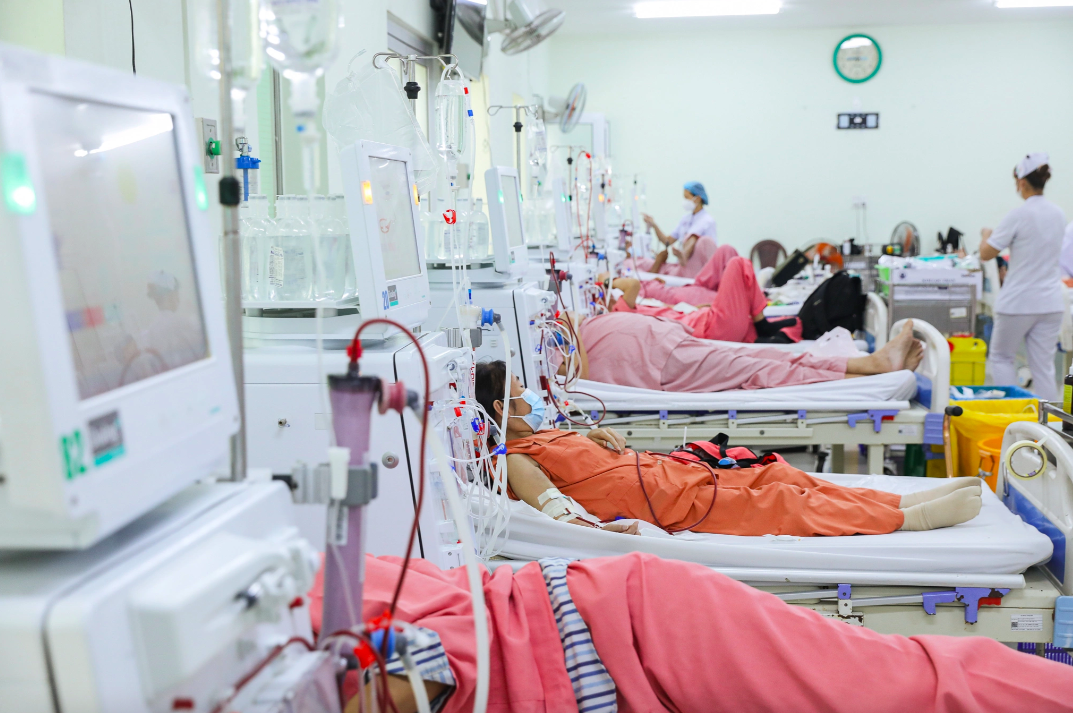 |
Patients undergoing hemodialysis at Thong Nhat Hospital, Ho Chi Minh City. Photo: Phung Tien |
Professor Tam explained that chronic kidney disease originates from damage to renal blood vessels, glomeruli, tubules, interstitial tissue, and the urinary tract. Numerous factors contribute to chronic kidney disease, with several common in modern lifestyles. Diabetes, for example, is the leading cause of kidney failure. Uncontrolled blood sugar levels damage the small blood vessels in the kidneys, impairing their ability to filter waste effectively.
High blood pressure, if left uncontrolled, not only affects the heart but also damages the kidneys. When blood pressure is elevated, the blood vessels within the kidneys are harmed, preventing them from performing their filtering function.
Additionally, an unhealthy lifestyle, including an unscientific diet, high salt intake, physical inactivity, and being overweight, increases the risk of kidney disease. Moreover, insufficient water intake also contributes to declining kidney function.
Professor Nguyen Gia Binh, President of the Vietnam Association of Emergency Resuscitation and Toxicology, noted that acute kidney injury exacerbates challenges in medical care. In critically ill patients in intensive care units, acute kidney injury is a common and dangerous complication following sepsis, trauma, or surgery. This condition complicates the treatment process, with over 40% of patients requiring continuous dialysis.
A survey on the diagnosis, monitoring, and screening of chronic kidney disease, released in August 2025 by the National Conference of Urology and Nephrology, revealed that the proportion of high-risk patients receiving adequate diagnostic tests remains low. More than one-third of healthcare facilities perform comprehensive tests for fewer than 25% of patients. Testing frequency is primarily once a year; some facilities conduct tests irregularly, leading to missed diagnoses.
Experts therefore recommend maintaining a healthy lifestyle and controlling underlying medical conditions. Early screening and intervention for chronic kidney disease can slow disease progression, preserve kidney function, and reduce the risk of advancing to end-stage kidney disease and mortality.
Le Nga


