


In Vietnam, immediately after the Ministry of Health issued a directive to halt circulation of Beba and Alfamino products, Nestle Vietnam proactively withdrew 17 batches of imported NAN infant formula from shelves. This action was taken as a precautionary measure against potential health risks. The company affirmed that "the safety and health of infants are the top priority." Nestle does not import or sell Beba and Alfamino products in Vietnam.
This move comes amid accusations from Austrian authorities and international consumer protection organizations that the food giant "responded slowly, prioritizing silent recalls over earlier public warnings to protect young children," as cited by Food Ingredients First.
The crisis originated from one small link in the supply chain: arachidonic acid (ARA) oil. Nestle stated that during routine self-monitoring at its Nunspeet factory in the Netherlands, a key export hub for 140 markets, the group's control system identified a potential quality issue with a raw material (PUFA oil) from a third-party supplier. The consumer organization FoodWatch reported that Dutch authorities were first informed of the contamination on 9/12/2025, after laboratory tests on 26/11/2025 revealed the presence of *Bacillus cereus* bacteria.
This raw material potentially contained trace amounts of Cereulide, a toxin produced by *Bacillus cereus* bacteria, used in some infant formula products manufactured in Europe. Although the quantity of oil used in these products is small and there is currently no evidence confirming the existence of Cereulide in these specific batches, Nestle proceeded with a voluntary recall of potentially affected batches as a precautionary measure, based on the principle of maximum caution.
 |
Nestle's recall of infant formula products due to suspected toxin contamination is currently underway in over 60 countries. Photo: The Brand Hopper |
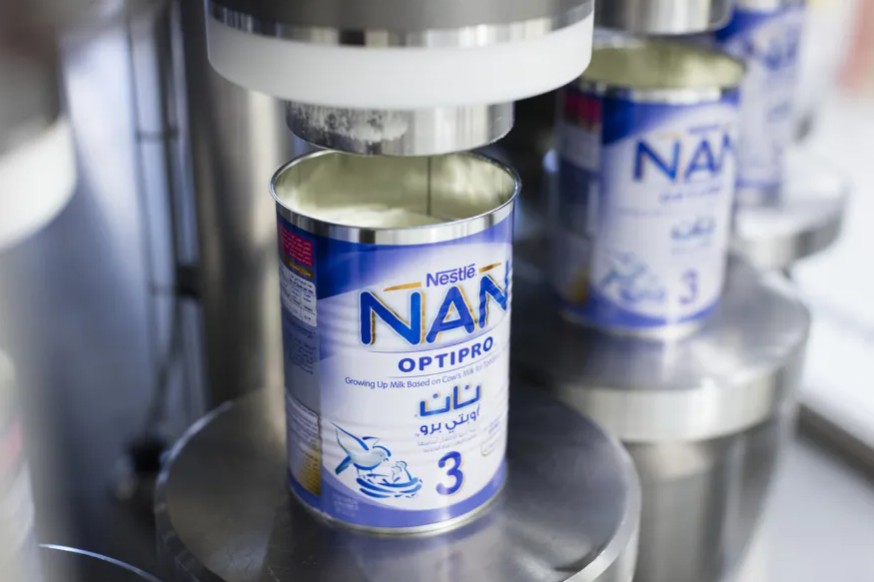
Nestle's recall of infant formula products due to suspected toxin contamination is currently underway in over 60 countries. Photo: The Brand Hopper
According to information published on Nestle's website, the group operates a Quality Management System (NQMS) with stringent internal standards that exceed typical legal requirements and international certifications. The control process begins with supplier approval, where the company only accepts partners who pass regular on-site inspections.
All raw materials arriving at the factory are held in a quarantine area for independent microbiological and physicochemical testing by expert teams. The Quality Management department only releases materials to the production line after confirming that safety and nutritional standards are fully met. During processing, the company applies a "safety by design" principle through strict hygiene zoning and real-time artificial intelligence monitoring.
After packaging, products remain in storage awaiting final verification results before official release to the market. The company regularly conducts random sampling on retail shelves and is prepared to activate a precautionary recall if routine checks detect any potential risks from raw material sources.
However, international media outlets suggest that many questions about the production process for the potentially contaminated infant formula batches remain unanswered by Nestle. For instance, how long was this raw material incorporated into the production line before the "potential risk" was identified? Why was the risk not detected during the inbound material sampling stage? Did Nestle place too much trust in supplier self-certification, overlooking rigorous independent verification steps?
The consumer organization FoodWatch also accused the company and Dutch authorities of a "serious breakdown" in information dissemination and product traceability. FoodWatch stated that Dutch authorities were first informed of the contamination on 9/12/2025. Yet, when FoodWatch contacted the Netherlands Food and Consumer Product Safety Authority (NVWA) on 15/12/2025, Nestle confirmed that no products had been distributed in the Netherlands or Belgium. However, just three weeks later, Dutch consumers faced a recall order.
"Either distribution did occur, or the risk assessment and scope changed, or traceability and communication failed," said Nicole van Gemert, Director of FoodWatch Netherlands. "Consumers deserve a transparent timeline: when authorities and Nestle first learned the news, what they knew then, and why the public message was so delayed or inconsistent."
FoodWatch reported that, according to French authorities, potentially affected Nestle products had been sold since early 10/2025. Several European countries, including France, Finland, and Denmark, initiated recalls in mid-December. However, public recalls in the Netherlands, Belgium, Germany, and Ireland were only activated this week.
"If affected infant formula was sold since October and authorities knew in early December, then a public global recall only in early January indicates a serious breakdown in rapid traceability and risk warning processes," Ms. van Gemert emphasized. "Nearly one month passed before the recall was publicly announced in dozens of countries. For infant formula, such a delay is unacceptable."
Austrian authorities stated that Nestle conducted a "silent recall" during the Christmas holidays before issuing a public warning. Ms. van Gemert deemed this action inadequate.
"With infant formula, a silent recall is an unacceptable way to handle products with potential harm. A silent recall may help the company reduce reputational damage but fails to protect consumers. Public health must be the top priority, especially for young children," she said.
 |
The Swiss food giant, Nestle, is one of the world's largest manufacturers of infant formula. Photo: Keystone / Gaetan Bally |
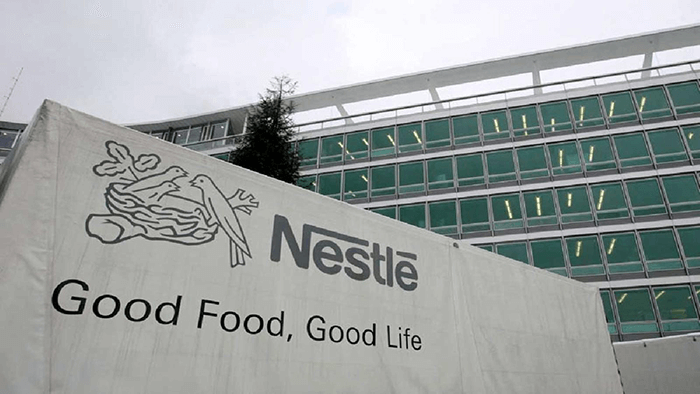
The Swiss food giant, Nestle, is one of the world's largest manufacturers of infant formula. Photo: Keystone / Gaetan Bally
FoodWatch also demanded the public disclosure of the raw material supplier's identity. "Naming the supplier is part of restoring trust and preventing further harm. It is urgent to identify who else this suspected contaminated raw material was delivered to," she added.
The organization also advised parents not to destroy the recalled products, contrary to Nestle's instructions, as the packaging could serve as evidence if families wish to pursue legal action later.
In its product guidance announcement, Nestle affirmed that "to date, no confirmed cases of illness have been linked to the affected products." The company stated it has completed checks of all ARA oil and corresponding oil blends and is working with alternative suppliers to maintain supply. With the former supplier, the company is conducting an investigation to find the root cause. Production has been ramped up at several other facilities.
Binh Minh (According to Food Ingredients First, Nestle, Reuters)





