


Answer:
Nasolabial folds, also known as nasomaxillary folds, are the creases running from the sides of the nose down to the corners of the mouth. For individuals like you, where these folds appear early, the cause is often related to facial structure, thin cheek tissue, weak supporting ligaments, or repetitive facial muscle activity, rather than simply skin aging.
When nasolabial folds are not yet accompanied by severe sagging but tend to deepen over time, energy-based lifting technologies are suitable options to improve tissue foundation and facial support structures. High-intensity focused ultrasound (HIFU) technology, for instance, can penetrate to the superficial muscular aponeurotic system (SMAS) layer at a depth of 3-4.5 mm. This action lifts sagging cheek areas and improves nasolabial folds. This method is appropriate for individuals with clear signs of aging, sagging cheek fat pads, and folds that become more pronounced when smiling or speaking.
SUPERB (Sofwave) technology uses parallel ultrasound waves focused on the dermis at a depth of 1.5 mm. This stimulates the regeneration of collagen and elastin, helping to firm and thicken the skin, thereby naturally supporting the nasolabial folds. This technology is suitable for younger individuals with early-onset nasolabial folds and minimal skin sagging. SUPERB technology is gentler and less painful than HIFU. Both methods require no downtime, and their effects typically last 6 to 12 months, depending on the individual's degree of aging.
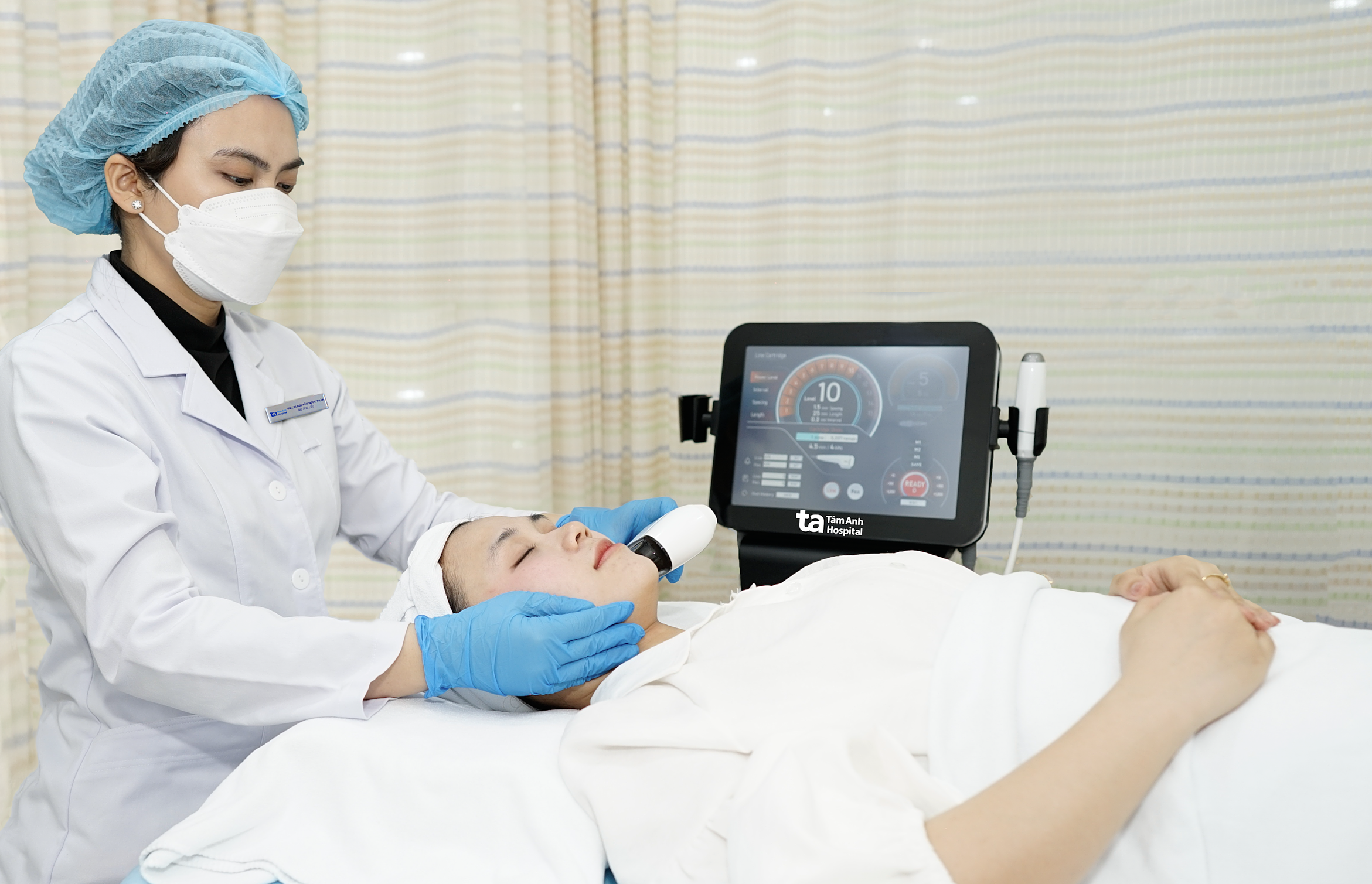 |
Doctor Tran uses high-intensity focused ultrasound (HIFU) to treat nasolabial folds. Illustration: Benh vien Da khoa Tam Anh |
Unlike filler methods, SUPERB and HIFU do not provide immediate results but show gradual improvement over several weeks to months as collagen is restructured. The advantage of both technologies is that they help create a slimmer, natural-looking face without invasive procedures or bleeding, thus requiring no recovery period.
Nasolabial folds are influenced by facial structure, the degree of aging, and individual skin quality. Since this area is close to blood vessels and nerves, individuals with deep nasolabial folds from an early age or those that become increasingly prominent with age should visit a hospital with a Dermatology - Aesthetic Dermatology department. A doctor can then conduct a direct examination, determine the primary cause, and recommend appropriate treatment.
Doctor, Level I Specialist Nguyen Ngoc Tran
Dermatology - Aesthetic Dermatology Department
Benh vien Da khoa Tam Anh TP HCM
| Readers can submit questions about dermatology and aesthetic dermatology here for a doctor's response. |


