According to Sport News Africa, unusual personnel changes just before the Appeals Committee meeting are central to the controversy. This committee was responsible for making the final decision in the dispute between Senegal and Morocco.
Yassin Osman Robleh, who oversaw independent bodies within the Confederation of African Football (CAF)'s legal department, was a central figure. He coordinated the Disciplinary and Appeals Committees, including proposing panel members to ensure impartiality.
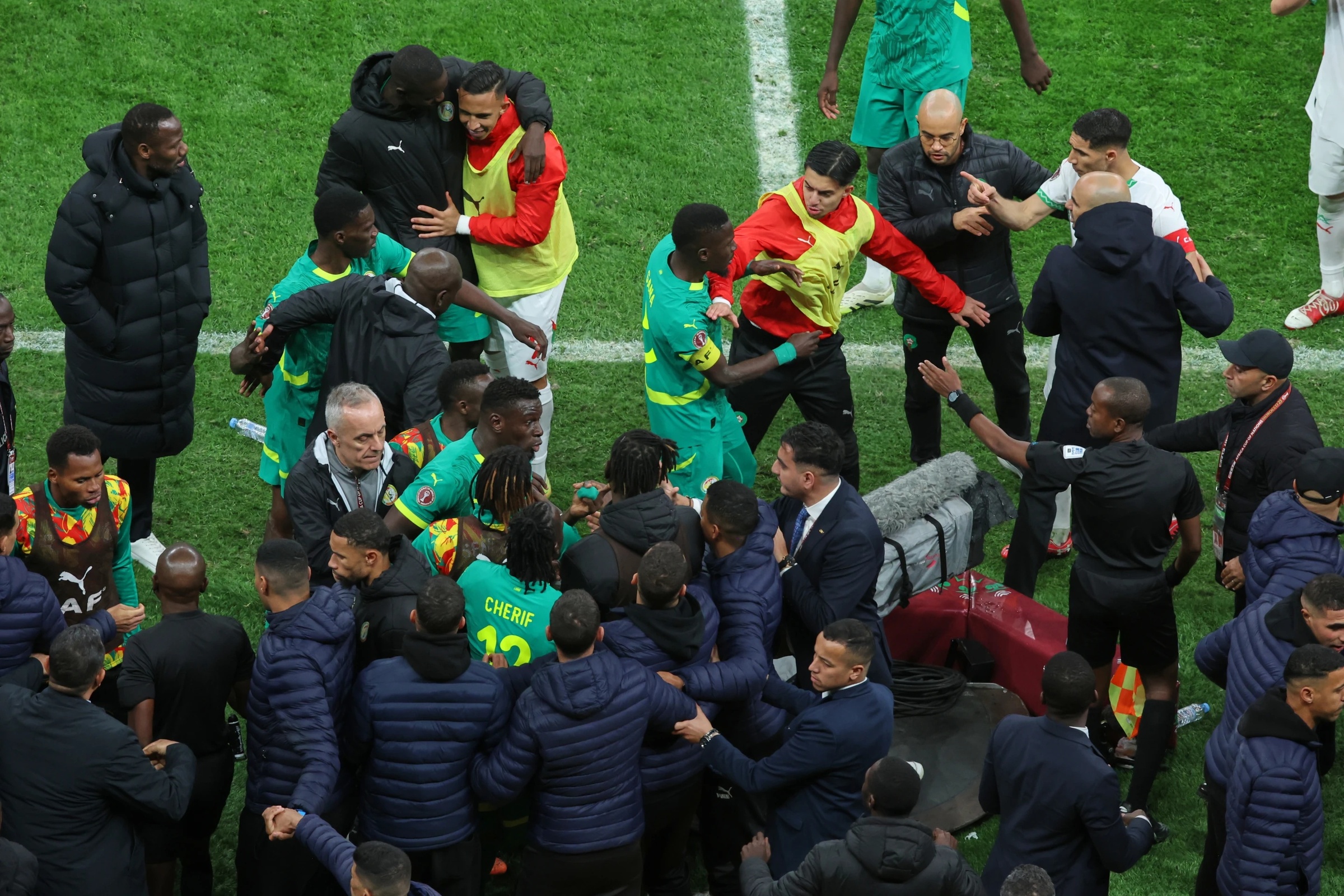 |
Senegal players abandoned the African final against Morocco at Prince Moulay Abdellah Stadium, Rabat, on the evening of 18/1. *Photo: AP*
Robleh was dismissed without specific explanation just over two weeks before the crucial session. This move surprised many within CAF, given his five years of service and high professional regard. His removal, particularly someone tasked with safeguarding independence immediately before a sensitive decision-making process, raised significant doubts.
Secretary-General Veron Mosengo-Omba issued the dismissal. However, some Executive Committee members contend that Mosengo-Omba became ineligible for his position in mid-October 2025 due to age limit regulations. This raises questions about the validity of the personnel decision itself.
CAF's structure dictates that committees, such as the Disciplinary and Appeals, must operate independently from the executive apparatus. Committee members are not directly appointed by CAF leadership. Instead, an intermediary within the legal department proposes a list of members for each case, based on expertise and neutrality, to prevent conflicts of interest. A specific panel is then formed for each hearing, ensuring decisions are free from influence by administrative leaders or involved parties.
Notably, CAF did not appoint a direct replacement for Robleh. Instead, the authority to select judging panel members was given to Cedrick Aghey, the new director of legal and compliance.
Aghey's appointment itself is questionable, as the Executive Committee had not approved it. Despite this, he directly selected five panel members at the Appeals Committee chairman's request.
CAF regulations mandate that independent committees operate autonomously from the executive. Robleh's prior role was to maintain this separation. He worked under contract with CAF, yet was structurally distinct to prevent administrative influence.
CAF's decision to remove Robleh and allow an executive official to directly choose committee members is seen as undermining this control mechanism. Essentially, the "independent" body's formation process was compromised.
Further questions arise concerning Moez Ben Nasri, president of the Tunisian Football Federation, who was on the judging panel. While regulations do not explicitly forbid his participation, statutes require disclosure of conflicts of interest when connections to involved parties exist.
Ben Nasri is a member of the Union of North African Football Federations (UNAF), which includes Morocco, a party to the dispute. He also reportedly has close ties with Faouzi Lekjaa, president of the Moroccan Football Federation.
This incident raises broader questions about CAF's governance under President Patrice Motsepe. Previous internal reports have criticized the organization's consistent failure to fully adhere to its own regulations.
Following the Appeals Committee meeting, CAF announced on 17/3 its decision to award Morocco a 3-0 victory over Senegal in the African final held on 18/1 in Rabat. This ruling, which handed the championship to the host nation, came after an appeal from the Moroccan Football Federation regarding Senegal players abandoning the match in protest of a late penalty decision.
Meanwhile, the Court of Arbitration for Sport (CAS) announced on 25/3 that it had received Senegal's complaint. If the appeal succeeds, Senegal could be reinstated as the African champion, securing the team's second continental title.
Hoang An (according to Sport News Africa)