Instead of building a large-scale Athletes' Village, host nation Japan arranged accommodation for ASIAD 2026 athletes in container homes at Garden Pier, Nagoya port. This approach was initially introduced to save costs but is now sparking debate over living conditions.
The China men's basketball team has raised concerns about the accommodation. A Chinese media professional present in Nagoya posted on Weibo that athletes are staying in small rooms converted from containers, with three people per room sharing a toilet and bathroom. This individual described the living conditions as "too poor".
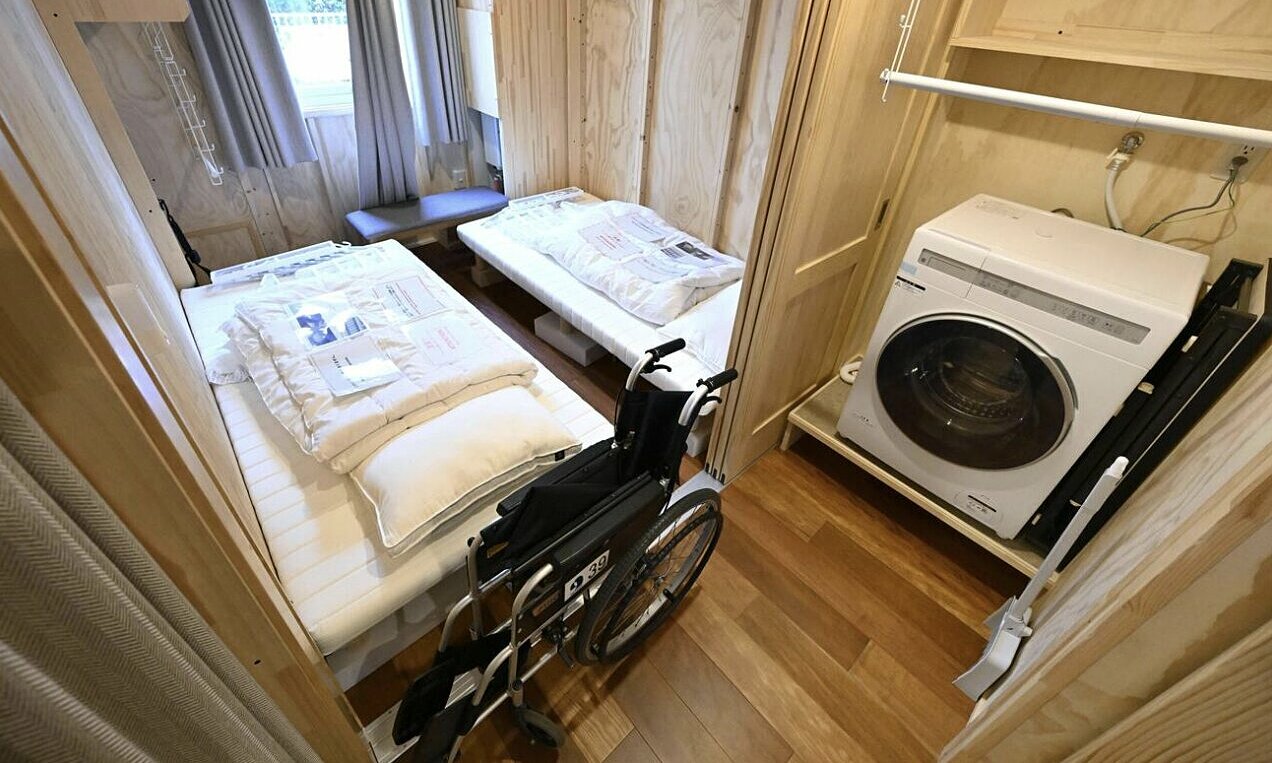 |
A corner of an athlete's room in a container home at Garden Pier, Nagoya, Japan. Photo: Kyodo |
A total of 200 container-style homes have been installed, expected to host approximately 2,000 people during ASIAD, which opens on 19/9. For the Asian Para Games in october, around 1,000 people will continue to use this area.
The container housing plan resulted from a decision not to build a new Athletes' Village. The organizing committee initially planned to construct accommodation based on a traditional model, but rising construction and material costs led to a change in plans. Japan then shifted to a combination of container homes, cruise ships, and existing hotels to house the delegations.
A cruise ship with a capacity of approximately 4,000 people is stationed in the Nagoya port area. In total, two locations provide about 6,000 accommodation spots. After the games, the container homes are slated for reuse across Japan, including for disaster response purposes.
When introduced in april, the organizing committee stated that the homes were designed to be compact yet functional. One unit measures approximately 70 m2, according to TV Aichi, and is designed for multiple athletes. Inside, there is a kitchen area, refrigerator, bathroom, and toilet. The bathroom features a shower cabin but no bathtub. The design also considers the needs of athletes with disabilities.
Members of the athletes' committee who visited the facilities also gave positive feedback. Para badminton athlete Noriko Ito felt she "could live" there. Para judo athlete Makoto Hirose acknowledged the compact size but stated it did not feel cramped and believed athletes could live comfortably.
The debate intensified following heavy rains in Nagoya in early september. Approximately 400 athletes and officials staying in the container homes had to be temporarily evacuated to higher ground due to flooding. No injuries were reported, and they later returned to their accommodation. Some competition venues also experienced roof leaks.
Despite these incidents, the experiences of a few delegations should not be generalized to the entire ASIAD 2026 accommodation system. The organizing committee affirms that suitable accommodation has been arranged for registered athletes and officials, refuting claims of serious issues with housing provision. The Olympic Council of Asia (OCA) and the Aichi-Nagoya 2026 Organizing Committee announced on 29/8 that all athletes and officials registered by the deadline would receive accommodation suitable for a sporting event.
The container housing complex offers more than just bedrooms. The organizing committee has set up delegation headquarters, a service center, and dining areas at Garden Pier. An outdoor social area for athletes has been built to host welcome ceremonies and Japanese cultural introduction programs. The medical area includes cold stone baths, while the fitness center operates 24 hours, and a store sells essential items for athletes.
The organizing committee also uses shuttle buses between Garden Pier and the cruise ship area at Kinjo Pier, connecting the two accommodation points. The goal is to create an alternative accommodation cluster to the traditional Athletes' Village model, while also fostering opportunities for delegations to interact.
ASIAD 2026 is expected to gather over 11,000 athletes from 45 countries and territories. Japan has the largest contingent with 932 athletes, followed by Trung Quoc (815), Han Quoc (792), Thai Lan (694), and Hong Kong (581). The Vietnam sports delegation ranks 13th with 349 athletes, aiming for four or more gold medals. Athletes will compete in 469 events across 43 sports.
Hoang An (according to Nikkan, Sanspo)