In the final on 15/8, Carlsen faced 19-year-old Belarusian talent Denis Lazavik. The world's top player won both sets with identical 3-1 scores to claim his second consecutive esports world cup title.
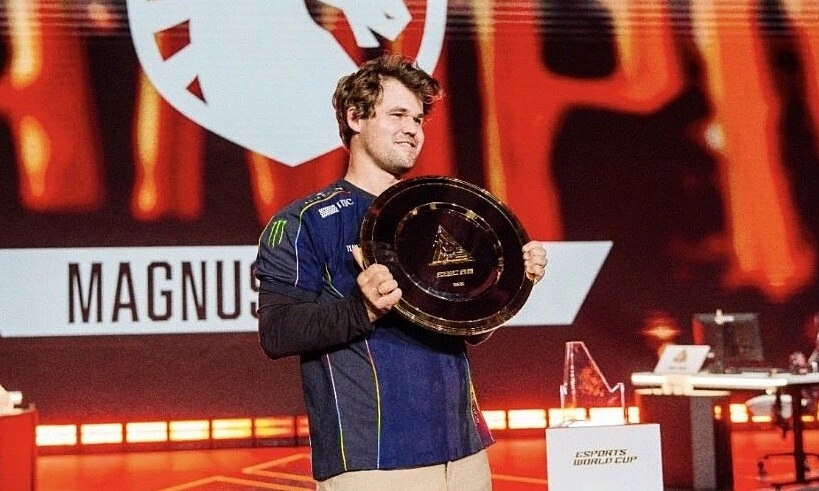 |
Carlsen raises the cup after winning the chess event at the esports world cup 2026 in Paris, France on 15/8/2026. Photo: FBNV
This year's tournament took place in paris from 11/8 to 15/8, after the original venue in Riyadh, Saudi Arabia, was changed due to conflict in the Middle East. The chess event featured 25 players, including notable names such as Hikaru Nakamura, Alireza Firouzja, Nodirbek Abdusattorov, Arjun Erigaisi, Ian Nepomniachtchi, and Le Quang Liem.
Carlsen started in the group stage, advancing from group B without a single loss. He defeated Andrey Esipenko 1.5-0.5 and Hans Moke Niemann 1.5-0.5, securing his spot in the knockout rounds. In the quarterfinals, he beat Nihal Sarin 2.5-0.5, before overcoming Firouzja 4-1 in the semifinals.
Lazavik also had an impressive run. The 19-year-old player eliminated Nodirbek Abdusattorov 3-2 in the quarterfinals, then defeated Hikaru Nakamura 3.5-1.5 in the semifinals to reach the final. After that match, Lazavik stated he would support Firouzja in the other semifinal, hoping to avoid Carlsen in the final. However, Firouzja proved no match for Carlsen, and neither did Lazavik.
The final was contested in a best-of-three-set format. The first two sets consisted of four games each, with a deciding two-game set if each side won one set. Carlsen did not require a third set. He defeated Lazavik 3-1 in the first set and repeated the score in the second to conclude the match.
Carlsen not only won but also maintained a high quality of play throughout the tournament. His 20-game undefeated streak is a remarkable achievement in a competition featuring many strong players. With a time control of 10 minutes per side and no increment, games demanded both rapid calculation and quick decision-making. Despite this, Carlsen achieved an accuracy rate of 99.2% in line with computer recommendations.
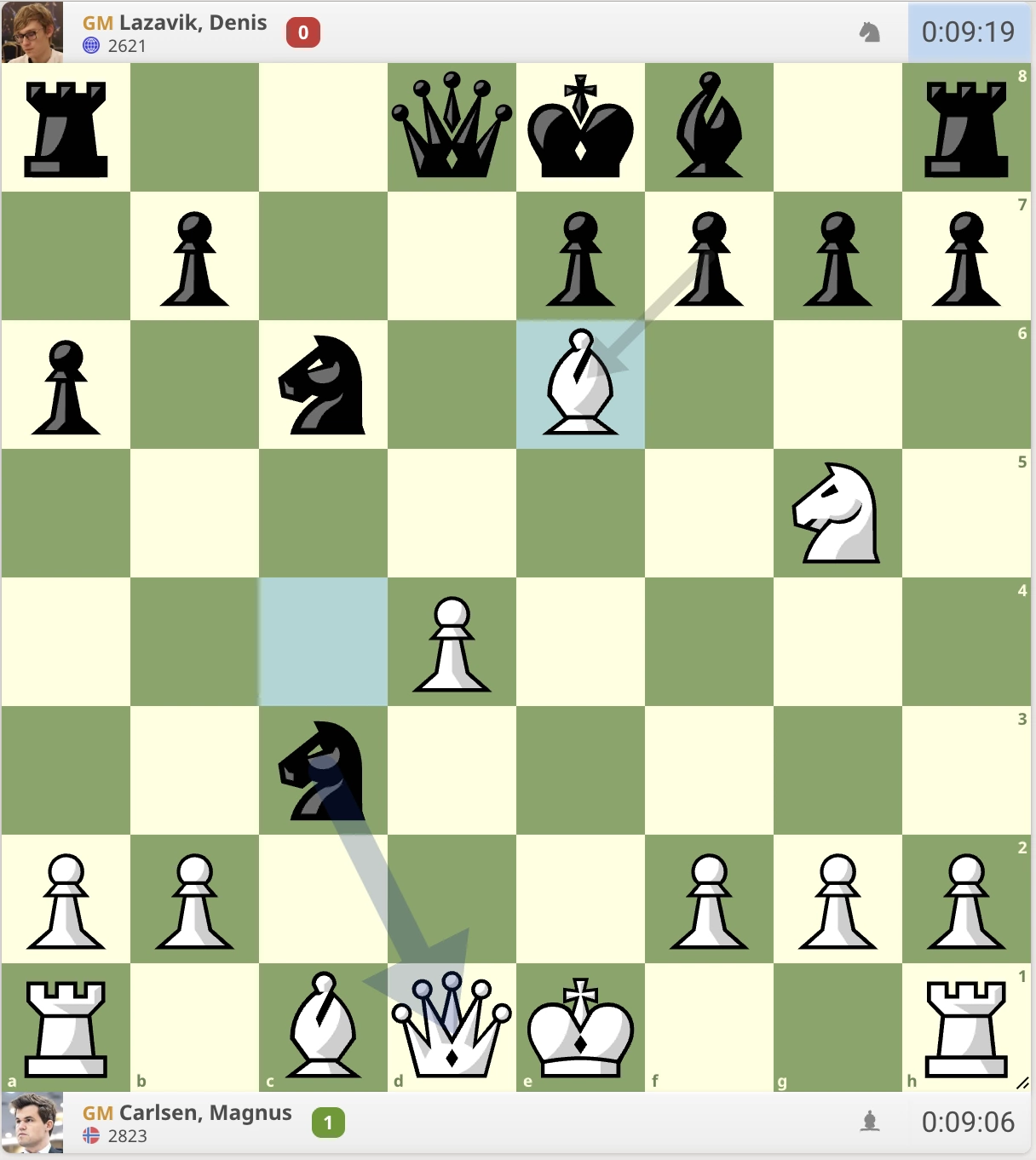 |
Carlsen (white pieces) sacrifices his queen to attack the black king in the final game of the final against Lazavik.
In rapid chess, Carlsen has long been known for his intuitive handling of complex positions. He often makes moves quickly, putting significant pressure on his opponents' clocks. His performance in paris demonstrates that this strength remains undiminished.
The final match highlighted this style. In the last game, Carlsen made a bold queen sacrifice early in the opening, then navigated the middlegame with high precision. The 35-year-old played this game as a spectacular finish to the tournament, rather than merely preserving his advantage. After the queen sacrifice, he even smiled subtly.
Last year, he defeated Alireza Firouzja in the final to become the first champion of the chess event at the esports world cup. Carlsen also received 250,000 USD in prize money then.
This year, the champion's prize remained 250,000 USD, from a total prize pool of 1.5 million USD for the chess event. Lazavik received 190,000 USD as the runner-up, while Nakamura finished third with 145,000 USD.
While Carlsen faced a tough semifinal against Nakamura last year before an easier final against Firouzja, his journey this year was more convincing. The Norwegian player did not lose any games throughout the entire tournament, a contrast to the three games he lost the previous year.
Carlsen has less interest in classical chess and will also miss the chess olympiad in one month. However, this has improved his rapid and blitz chess skills. He admits he no longer calculates as fast as many younger players but believes his understanding of chess still surpasses the rest.
"One day, someone will surpass me," he said before the final against Lazavik. "But that day is not today."
Xuan Binh