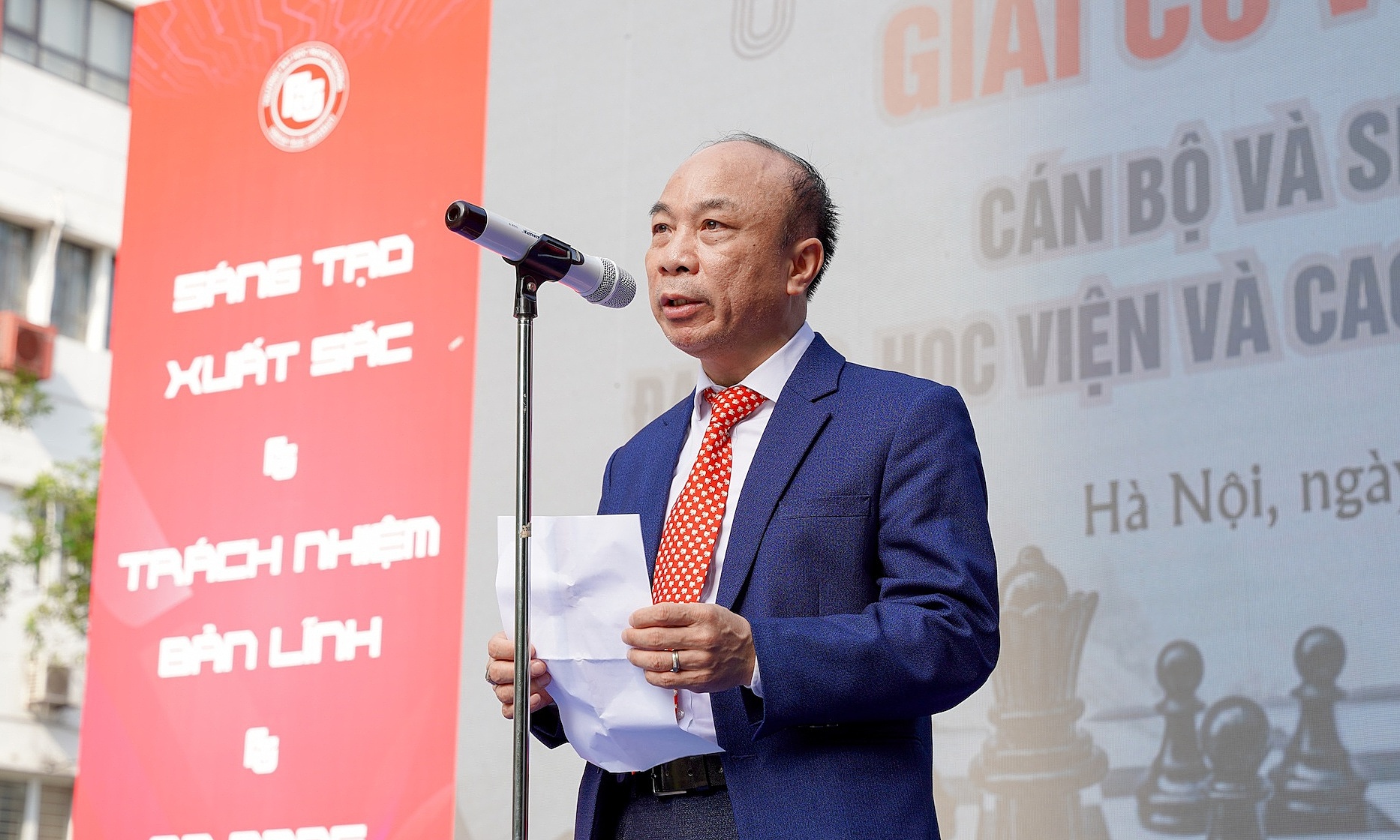
Pham Le Thao Nguyen, born in 1987 in Can Tho, has been Vietnam's top female chess player on FIDE for most of the past 10 years. She ranked 50th in the world in 2012 and achieved a career-high Elo rating of 2,426 in early 2013.
Recently, Thao Nguyen and the second-ranked player Luong Phuong Hanh were excluded from the 2026 Chess Olympiad due to a rushed and inconsistent selection and registration process. The Chess Olympiad is the world's largest team competition, organized by the International Chess Federation (FIDE) once every two years. This year's event will take place from 15/9 to 27/9 in Samarkand, with approximately 200 countries and territories participating.
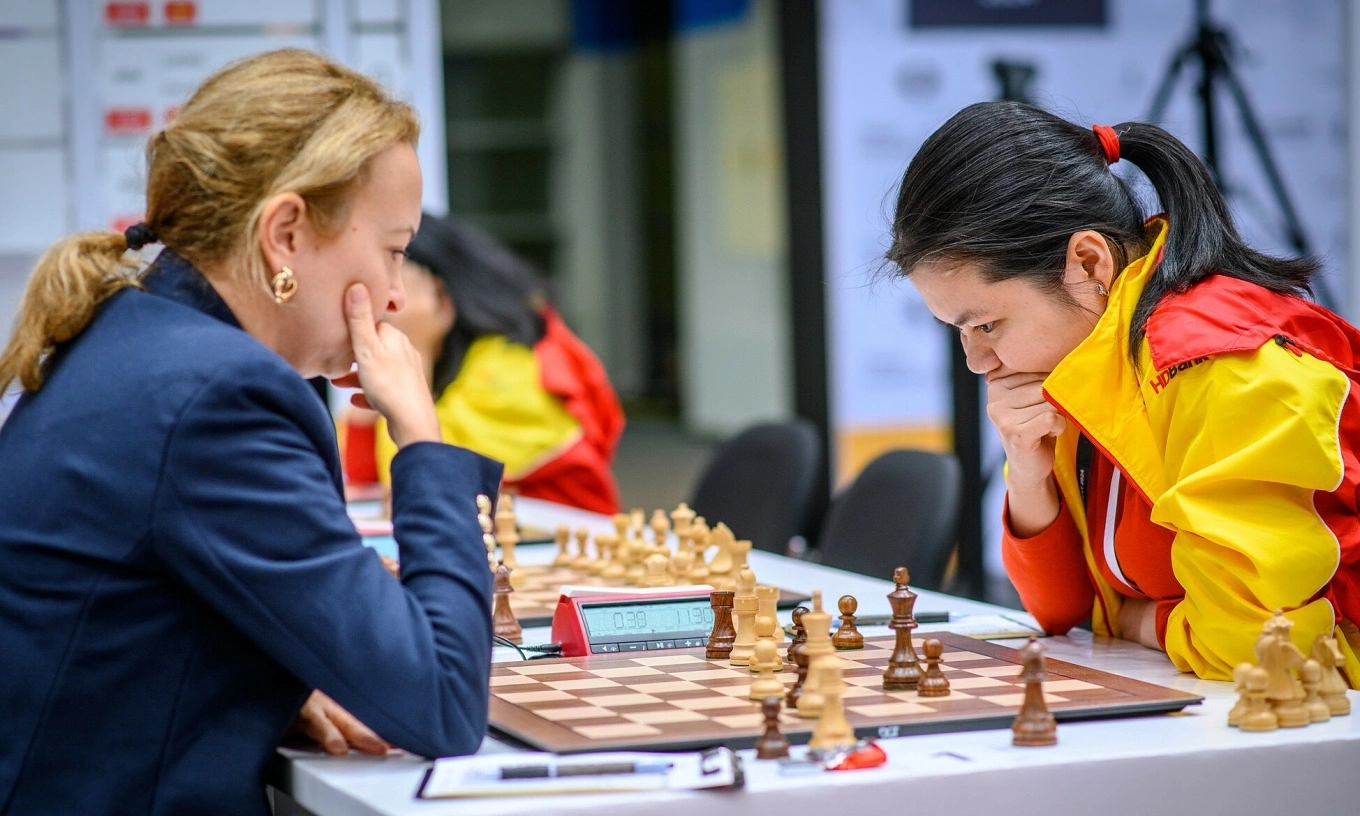 |
Thao Nguyen (right) winning against Antoaneta Stefanova in round 9 of the Women's Chess Olympiad in Budapest, Hungary on 20/9/2024. Photo: FIDE |
The challenges faced by Vietnamese chess players extend beyond selection processes. Last week, Truong Son, Thao Nguyen's husband, confirmed his retirement from standard chess for the national team after more than 20 years. He cited limited international playing opportunities as a reason for his declining performance. Thao Nguyen emphasizes the need for top Vietnamese players to compete regularly to maintain their skill level and Elo ratings.
"There is no fixed number," Thao Nguyen explains regarding the ideal number of tournaments. "However, athletes in strong developmental stages often play many tournaments, averaging about 8-10 events per year for men and 6-8 for women. The quantity of tournaments also depends on their quality. If a tournament is high-quality, fewer events are not an issue, as strong opponents and in-depth preparation can compensate."
Financial burdens are a significant obstacle for Vietnamese players participating in international competitions. For individual tournaments, athletes often bear all expenses or receive limited local support. Major costs include airfare, accommodation, and administrative procedures. Grandmasters (GM) and Women Grandmasters (WGM) are typically exempt from registration fees by organizers.
Training expenses are lower, primarily involving computers, software, and books. While self-training incurs minimal coaching costs, hiring a skilled expert can cost as much as tournament participation. Thao Nguyen estimates that one international tournament typically costs her between 1,000 and 3,000 USD, depending on the event's quality and location. Considering an average of six tournaments per year, she believes a player needs approximately 10,000-12,000 USD annually for competition costs alone.
State funding for chess players in Vietnam is limited, primarily covering major regional multi-sport events. "According to my data, over the past 10 years, only three SEA Games and one Asiad had all expenses covered by the sports department, as per state regulations, including travel, accommodation, and living costs," Thao Nguyen states. For previous Olympiads, the department might have provided pocket money, with organizers covering accommodation and HDBank sponsoring travel. For all other tournaments, whether team or individual events like the Asian championships, FIDE World Cups, or world rapid and blitz championships, Thao Nguyen has had to seek local funding or pay for everything herself.
This means that state support is often only partial, requiring players to cover the remaining costs. "If local authorities do not support or only partially support, athletes must cover the shortfall," Thao Nguyen explains. "In many cases, if an athlete wants to participate in a tournament, they must pay all expenses themselves."
Infrequent international competition significantly impacts a player's professional development. Playing less reduces match sharpness and makes it difficult to stay updated with opening trends and modern strategies. Additionally, the pressure at each tournament increases compared to playing regularly, affecting a player's confidence. If a player does not compete for a year, FIDE classifies them as "inactive". This not only risks a decline in skill but also jeopardizes opportunities to participate in certain FIDE events that require a minimum number of games played recently. For national teams, inactive players' Elo ratings are not included in the average team Elo, potentially lowering the country's ranking.
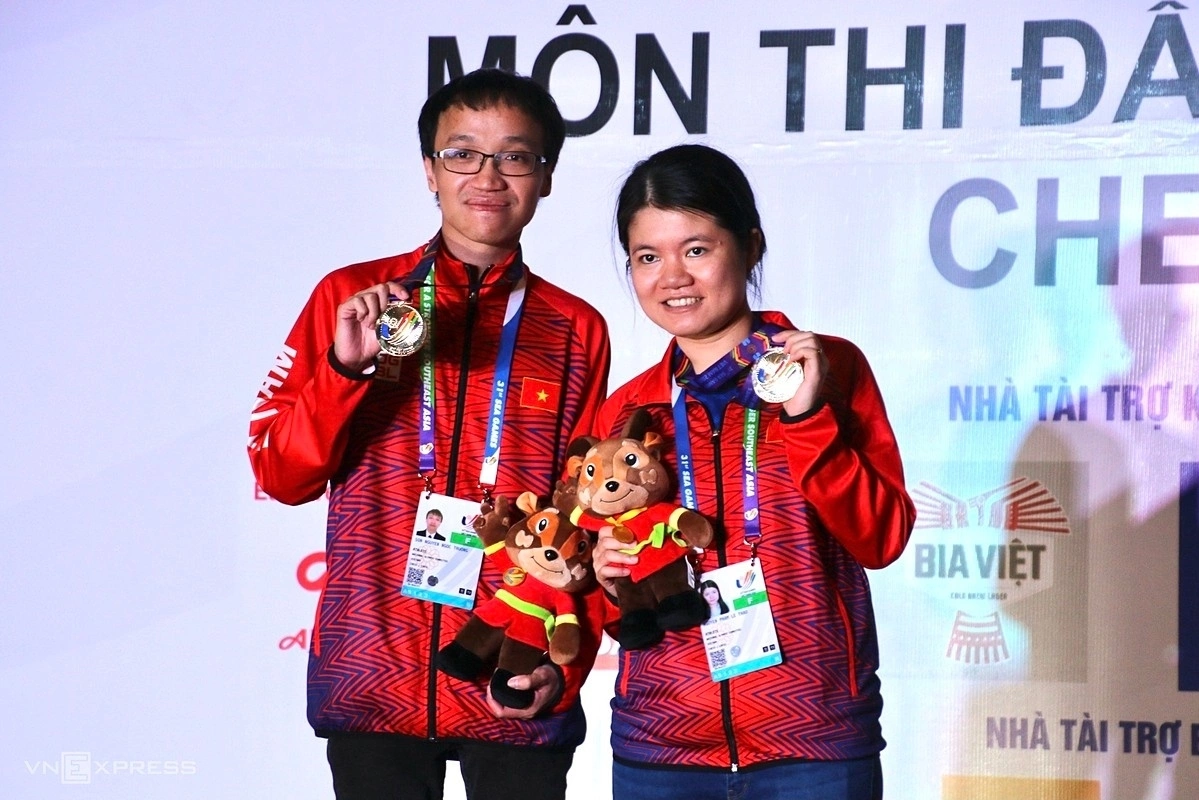 |
Truong Son and Thao Nguyen celebrating after receiving their SEA Games 31 gold medals in Quang Ninh on 17/5/2022. Photo: Anh Thu |
Thao Nguyen identifies two main reasons why Asian, particularly Southeast Asian, players struggle to maintain high Elo ratings compared to their European counterparts. First, there are fewer playing opportunities, as Europe boasts a rich system of individual and team tournaments. Second, the Elo base in Asia and Southeast Asia is significantly lower than in Europe. This makes it harder for athletes competing in Asia to increase their Elo, while the risk of losing Elo points is higher.
Comparing the playing environments, Thao Nguyen notes a stark difference between Vietnam and countries like the United States, India, or Europe. Vietnam has fewer Elo-rated tournaments. In previous years, open tournaments were limited, mainly including the HDBank Open and some recent closed events in Hanoi and Quang Ninh organized by Grandmaster Bui Vinh. When Vietnamese players wish to compete in countries with higher Elo bases, they often face higher costs due to geographical factors. Thao Nguyen acknowledges that missing competition opportunities due to lack of funds or procedural issues has been a frequent occurrence, undoubtedly affecting a player's development.
The primary income sources for top Vietnamese chess players are often insufficient for a sustainable career. "For me, if I only focus on playing, my main income comes from my local salary and prize money or performance-based bonuses," Thao Nguyen states. "I don't think prize money is enough to live on long-term, unless an athlete is among the world's elite, perhaps top 30-40 men or top 20-30 women." Even a strong player in Vietnam cannot solely rely on chess for a living. The current support for athletes is barely adequate, leaving little surplus to reinvest in professional development. Consequently, many athletes seek additional work, such as teaching or other side jobs, to supplement their income. As players start families and age, expenses increase, creating more financial challenges compared to their younger, single years.
Despite the challenges, Thao Nguyen has never considered abandoning professional chess. "I have never thought about quitting," she says. "However, I accept that there will come a time when age makes maintaining form difficult, and practical conditions no longer allow me to continue playing as I do now." Many top Vietnamese chess players currently teach chess to earn extra income. Thao Nguyen anticipates that she will likely do the same in the coming years when she plays less.
Thao Nguyen points to significant differences in how chess powerhouses like China, India, and Uzbekistan manage their national teams compared to Vietnam. She believes these countries have superior athlete training systems and highly qualified coaching staff, including veteran players or foreign experts. They also provide support for top athletes and young talents, which elevates the overall quality of their national teams. A clear example is India, which in the past two years implemented a funding support system for their top 10 male and top 10 female players based on Elo ratings.
| In 2024, the All India Chess Federation (AICF) announced a plan to invest 65 crore rupees (approximately 6,8 million USD) to comprehensively develop the country's chess ecosystem. This support package targets not only top players but also extends from grassroots levels to the national team. A notable feature is a two-year contract program for young players aged U7 to U19, with direct support ranging from 20,000 to 50,000 rupees (210 to 526 USD). AICF also allocates an annual prize budget for India's 20 highest-ranked FIDE players, comprising 10 men and 10 women. Additionally, the federation provides financial aid to state federations, establishes a chess development fund, creates a high-performance training center called the National Chess Arena, and implements its own domestic rating system. The plan also focuses on developing women's chess, expanding the Smart Girl program with at least 50 events annually, and dedicating 33% quotas for women in various areas. AICF encourages chess content creators, organizes corporate tournaments, and promotes chess in schools. AICF President Nitin Narang aims to bring chess to every family and transform India into a "nation of Grandmasters". |
Xuan Binh