To understand the complexity of professional tournaments in Argentina, it is necessary to look back at the continuous fluctuations of the country's national championship from its professional beginnings to the present.
From 1931 to 1966, the Argentine national championship consisted of a single division, played in a double round-robin format, with the champion determined by the highest points. This format resembled many national leagues worldwide today.
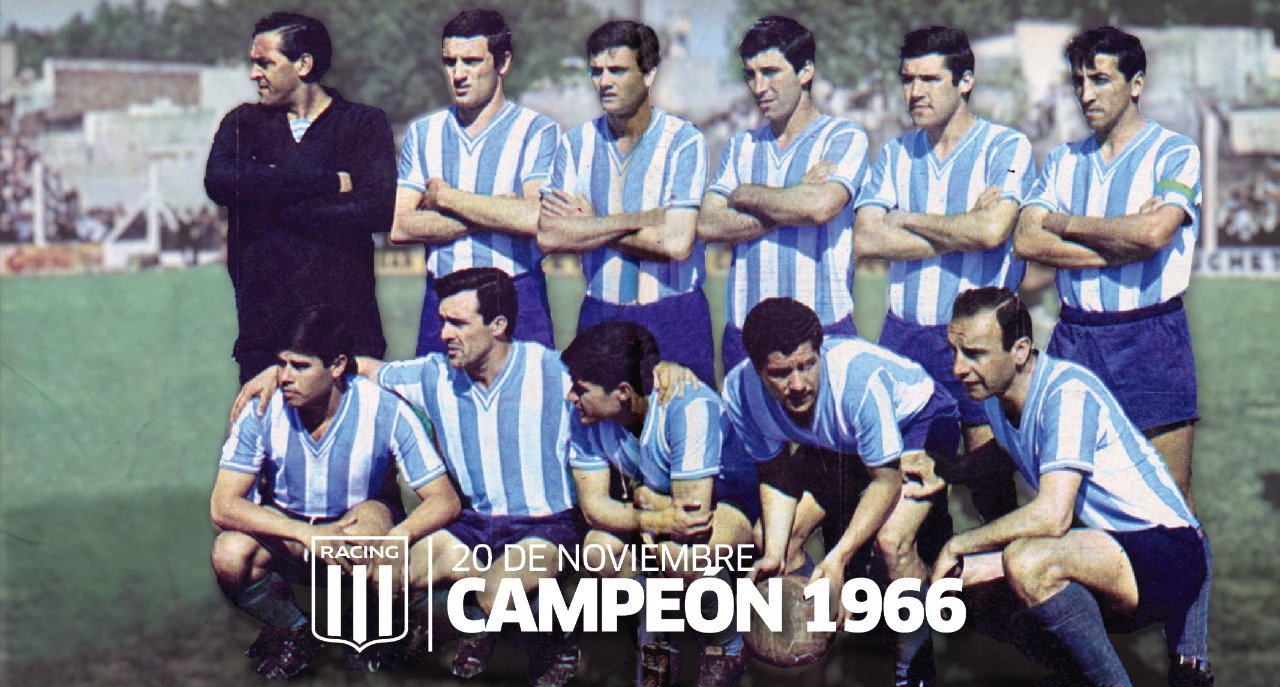 |
Racing Club won the Argentine championship in 1966 in a season with 20 teams playing a double round-robin format. Photo: Racing Club
From 1967 to 1985, the league was organized into two separate competitions within the same calendar year: Metropolitano (for major teams from Buenos Aires and those from the old league) and Nacional (expanded to include smaller, provincial teams). Some years, the Metropolitano was divided into two groups, with the top two from each group advancing to the semifinals to compete for the championship. Other years, it was a single group played in a one- or two-round format. The Nacional also varied, sometimes played as a single round-robin, other times divided into groups for playoffs to determine the champion.
There was a period when these two competitions were closely intertwined: the Metropolitano classification results determined which teams participated in the Nacional, which entered secondary competitions, or which secured their place in the league. This system aimed to give smaller teams a chance to compete with larger ones, ushering in an era where provincial teams like Estudiantes and Velez Sarsfield challenged the dominance of the "Big Five": River Plate, Boca Juniors, Independiente, Racing, and San Lorenzo.
In 1983, the average points system, which had been abolished for 20 years, was reintroduced in the Metropolitano for relegation purposes. This raised questions about whether administrators intended to help big clubs avoid relegation, even when playing poorly that season.
From 1985 to 1991, following the reform ideas of legendary Argentine coach Carlos Bilardo, the country's national championship adopted a European-style season, starting mid-year and extending to the middle of the following year. Argentina became the first South American nation to implement such a schedule. Concurrently, the national championship reverted to a single division with a double round-robin format, similar to the 1931-1966 period.
From 1991 to 2012, the Argentine national championship maintained a single division but was split into two stages, marking the introduction of the famous Apertura (opening) and Clausura (closing) system. Each stage had its own champion.
In 1991, the Apertura champions, Newell’s Old Boys, and the Clausura champions, Boca Juniors, played a final match at the end of the season to determine the overall champion. This saw Boca defeated by Newell’s despite being undefeated throughout the Clausura season, sparking controversy. A year later, this final format was retained between Newell’s and River Plate, but both were recognized as champions. This was the last year in this period that the decisive final match existed.
From 2012 to 2014, the Apertura and Clausura tournaments were renamed Torneo Inicial (first tournament) and Torneo Final (final tournament). While maintaining the same format, there were no longer champions for each stage. Instead, the top two teams from each stage clashed in a final match called Copa Campeonato (or Superfinal) to find a single champion.
However, the Copa Campeonato match only existed for two years: 2013 and 2014. In 2013, after the 2012-2013 season, it was recognized as an Argentine national championship title. By 2014, the Argentine Football Association (AFA) considered it a separate title, while the national championship was awarded to the two leading teams of the Inicial and Final stages.
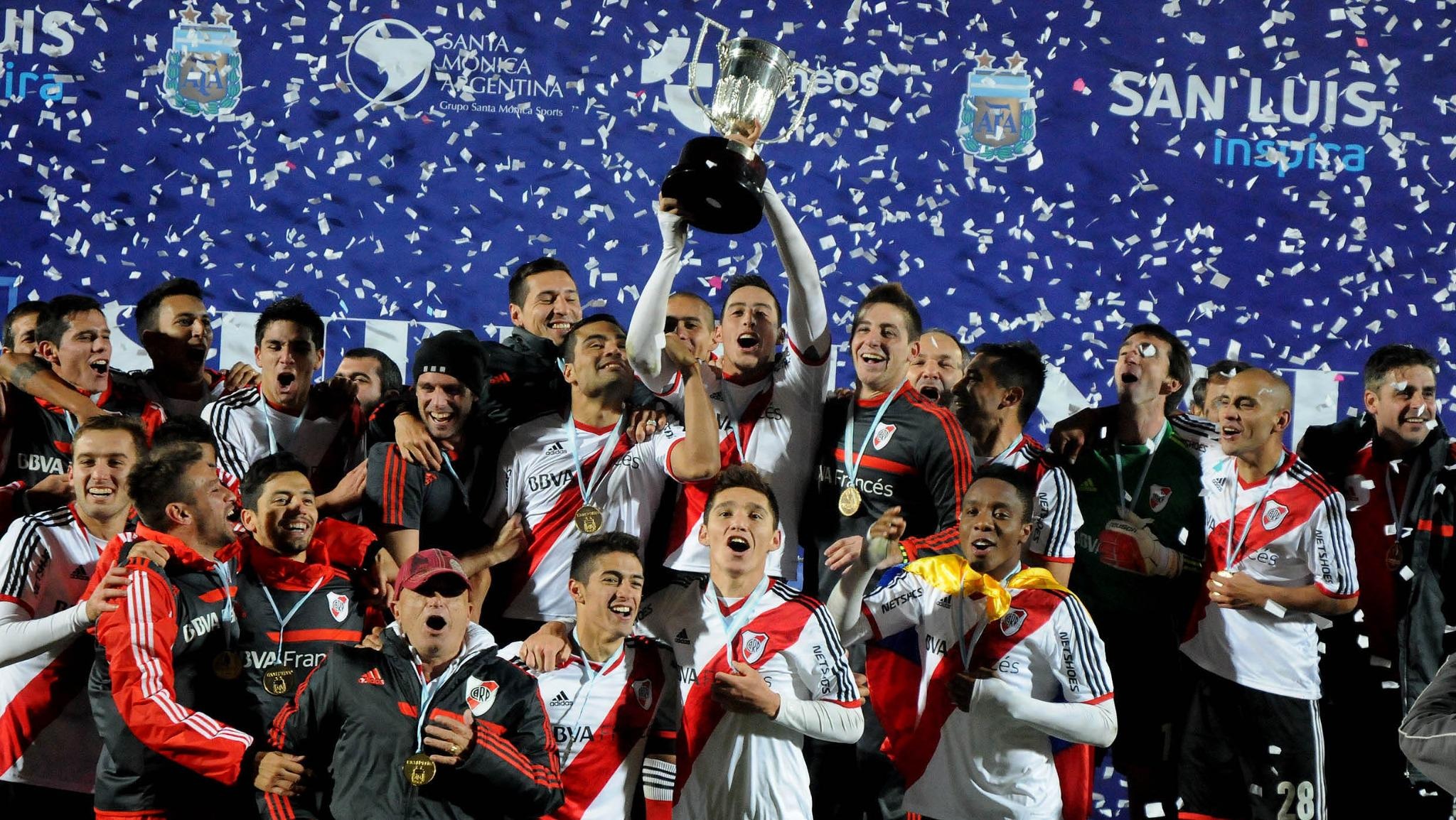 |
River Plate won the 2014 Argentine championship after defeating San Lorenzo one-zero in the 2014 Copa Campeonato match. Photo: AFA
The first transition year, 2014, still featured 20 teams competing in a single double round-robin group, but matches were condensed from August to December, meaning it no longer spanned two calendar years. A single champion was determined by the highest points. That year's tournament was named Torneo de Transicion (transition tournament).
2015 continued the transition, with the Argentine national championship running from the beginning to the end of the year. The number of teams increased from 20 to 30, an expansion idea that had emerged in the 2012-2013 season but faced opposition. Additional teams were drawn from lower divisions. The format involved 30 rounds, meaning each team played a single round-robin (29 matches) plus an additional derby match. The team with the highest points won the entire season.
In the first half of 2016, the 30 teams were divided into two groups (Zone A and Zone B). Each team played 14 single round-robin matches within its group and two additional home-and-away derby matches against rivals from the other group, known as "inter-zone derbies". At the end of the season, the top two teams from each group played a final match to determine the single champion of the season.
From 8/2016 to 6/2017, the 30 teams now competed in a single group. Each team played a single round-robin (29 matches), plus an additional derby match against its biggest rival, called "Fecha de Clasicos" (derby round). The team with the most points won the entire season.
From 8/2017 to 6/2018, for the first time since its establishment, the Argentine national championship was no longer organized by the AFA. The federation at that time only managed national teams. An independent legal entity was created to replace it, named "Superliga Argentina", which was also the name of the tournament. The league consisted of only 28 teams, with each team playing a single round-robin and no longer featuring the "Fecha de Clasicos" derby match. The team with the most points won the entire season.
From 8/2018 to 6/2019, the Superliga Argentina was reduced to 26 teams, following the same format as the previous season. In the final two months of that season, a new competition called Copa de la Superliga was introduced as part of the national championship, but with its own title. It was played in a knockout format: the top 6 teams from the Superliga Argentina were granted direct entry to the round of 16, while the remaining 20 teams were paired to play from the first preliminary round to qualify for the round of 16. The winning team directly qualified for the group stage of the Copa Libertadores, a tournament equivalent to Europe's Champions League.
From 7/2019 to 5/2020, the Superliga Argentina was again reduced to 24 teams with the format remaining unchanged. When teams were about to enter the Copa de la Superliga stage, the Covid-19 pandemic erupted. The AFA intervened and decided to cancel the tournament.
Before the pandemic, the AFA had intended to dissolve the Superliga Argentina entity and resume organizing the national championship. The pandemic accelerated this process, and subsequently, a new organization established by the AFA replaced it, named Liga Profesional de Futbol.
From 2021 to 2024, under the name AFA Liga Profesional de Futbol, the Argentine national championship featured 26 teams in the first year and then 28 teams. Except for 2023, which took place in the first half of the calendar year, the other years were held in the second half. The format was a single round-robin, and a single champion was determined.
The current 2025 season runs from the beginning to the end of the year. The Argentine national championship retains traditional elements while also adopting the MLS model. Specifically, the league is divided into two parts (two tournaments): Torneo Apertura and Torneo Clausura, with each tournament further divided into smaller stages.
In the initial stage of each tournament, 30 teams are drawn into two groups of 15 teams and play a single round-robin within their group. Additionally, each team plays two inter-zone matches: one derby against a fixed rival in the other group and one match against a drawn opponent. The top 8 teams from each group advance to the round of 16 (from the round of 16 to the final, all matches are single-elimination), somewhat similar to the MLS Cup.
Each Apertura and Clausura tournament crowns a respective champion. In this season's Apertura, Platense was crowned champion after defeating Huracan one-zero in the final. In the current Clausura, the round of 16 is still underway.
Concurrently, the entire league also has a cumulative points table based on performance in the initial stage of the Apertura and Clausura (i.e., single round-robin plus two inter-zone matches). Thanks to this cumulative points table, Angel Di Maria's Rosario Central was recently surprisingly awarded the "Campeon de Liga" title by the AFA, which can be loosely translated as the regular season champion. A wave of opposition arose because this title did not initially exist.
 |
Di Maria and Rosario Central leaders received the Campeon de Liga cup, a title newly created by the AFA this season. Photo: AFA
Rosario quickly added this title to its trophy room, considering it the 2025 national championship. The very next day, Rosario lost one-zero to Estudiantes in the Clausura round of 16. This means that despite the two titles initially set, Rosario did not win either tournament but still secured an Argentine championship.
8 tournaments in one year
Why simplify when you can complicate? That seems to be the motto of Argentine football administrators. Beyond the complexity of the national championship, Argentina's other domestic cups are interwoven and overlapping like a "flea market".
First, after the Apertura and Clausura conclude, the champions of these two tournaments will play each other in the Trofeo de Campeones de la Liga Profesional, organized by the AFA, also known as the Professional League Champions' Cup.
Next is the Copa Argentina, a separate national cup competition similar to England's FA Cup or Spain's Copa del Rey, but also organized by the AFA. The tournament is structured with two upper and lower brackets. Teams in each bracket play knockout matches, and the two deepest advancing teams from each bracket meet in the final. This 2025 season, Independiente Rivadavia has already been crowned champion.
The winner of the Trofeo de Campeones de la Liga Profesional will compete with the Copa Argentina champion for the Argentine Super Cup, named Supercopa Argentina, also established by the AFA. For comparison, this match is similar to European Super Cup matches between the national league champion and the national cup winner.
Furthermore, because in 2022 the AFA "accidentally" committed to the United Arab Emirates (UAE) Sports Council to host the Supercopa Argentina in Abu Dhabi under an agreement until 2026, the AFA created an additional tournament called Supercopa Internacional, or International Super Cup. This title is contested between the winner of the Trofeo de Campeones de la Liga Profesional and the regular season champion (Campeon de Liga). This year, Rosario Central secured the first spot and will know its opponent after the Trofeo de Campeones winner is determined.
In total, for 2025 alone, professional football in Argentina will feature and award 7 championship titles: Torneo Apertura (Platense champion), Torneo Clausura (undetermined), Campeon de Liga (awarded to Rosario Central), Trofeo de Campeones de la Liga Profesional (undetermined), Copa Argentina (Independiente Rivadavia champion), Supercopa Argentina (undetermined), and Supercopa Internacional (undetermined).
But the AFA is not stopping there. Recently, the federation announced that from the 2026 season, it will create a new competition called Recopa de Campeones, for the champions of the Copa Argentina, Supercopa Argentina, and Supercopa Internacional. Since there are only three teams, to pair matches, the runners-up of each tournament may participate.
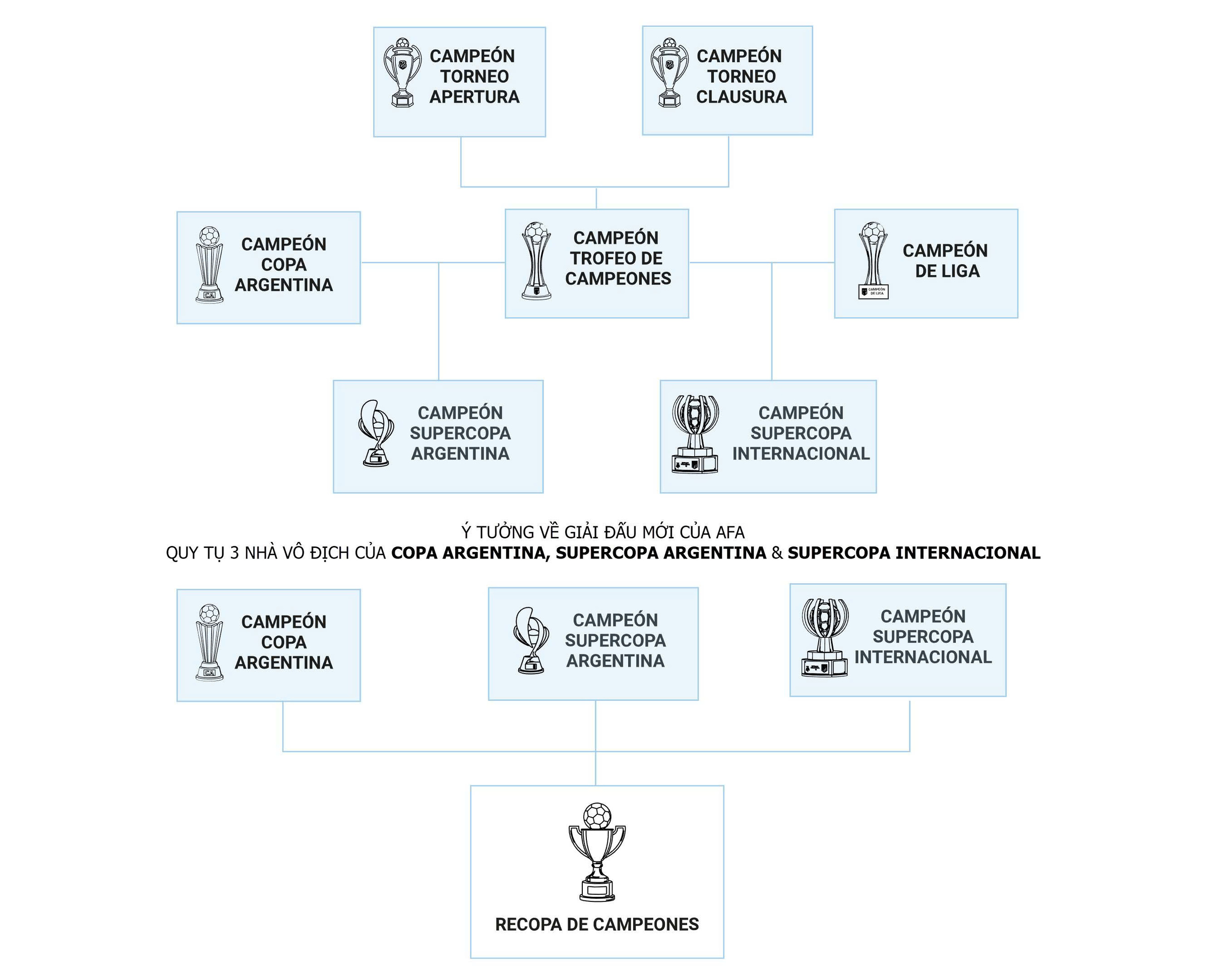 |
The complex competition system of Argentine football from 2026, with 7 titles awarded in the main season, and an 8th title contested between three main season champions.
Thus, by 2026, Argentine football will have a total of 8 titles awarded in a year. "No one understands anything, everything changes constantly", said journalist Andres Burgo, author of several books on Argentine football, to AFP. "The only logic is to build power for the leaders".
The overlapping formats seem to serve only commercial purposes and make Argentine domestic football increasingly difficult to follow, risking fan disengagement. "It's like a maze", Tomas Menconi, a 33-year-old River Plate fan, told AFP. "Before, there were just two tournaments, Apertura and Clausura, 20 teams, very clear. Now I can't keep track. Domestic titles are losing value".
Besides the lack of a single national champion each year, Argentine fans frequently criticize the declining quality of domestic leagues. Argentine clubs have not won the Copa Libertadores since 2018, ceding dominance to their Brazilian rivals.
AFA President Claudio Tapia, who has been in power since 2017, last week defended the Argentine football model on the social media platform X. He argued that these established tournaments are popular, foster unity, promote competition, and aid in development.
However, Mr. Tapia himself admitted in April that the AFA might have fallen short in its communication efforts to explain the reasons behind the increase in matches and the proliferation of tournaments, a general trend in global football today.
Hoang Thong compiled