 |
Elise Christie at the 2017 BBC Sports Personality of the Year awards at Liverpool Echo Arena, Liverpool, United Kingdom. Photo: PA |
Elise Christie, a former Scottish athlete, was once the face of winter sports in the United Kingdom, expected to win the nation's first olympic gold medal on ice in decades. However, across three Olympic Games and six gold medal attempts, Christie's legacy is marked by disqualifications and a prolonged mental health crisis.
Christie entered the Sochi 2014 olympics as a world champion and a 10-time European champion. Despite her accolades, she faced disqualification in three events.
Four years later, at the PyeongChang 2018 olympics, she again fell and was eliminated from two more events. These failures occurred when she was considered a strong gold medal contender, turning each fall into a focal point for criticism. Following the races in South Korea, Christie endured a barrage of online attacks. She later stated that these attacks severely damaged her mental health.
In an interview with Telegraph, Christie described her emotional state upon retirement as feeling numb. She recalled a passionate love for sports as a teenager, but by the time she hung up her skates, the joy had vanished. "What did I do besides skate in circles on the ice?" she questioned.
Despite excelling in school and possessing other skills, the 36-year-old former athlete admitted she struggled to fill out her resume after leaving elite sports.
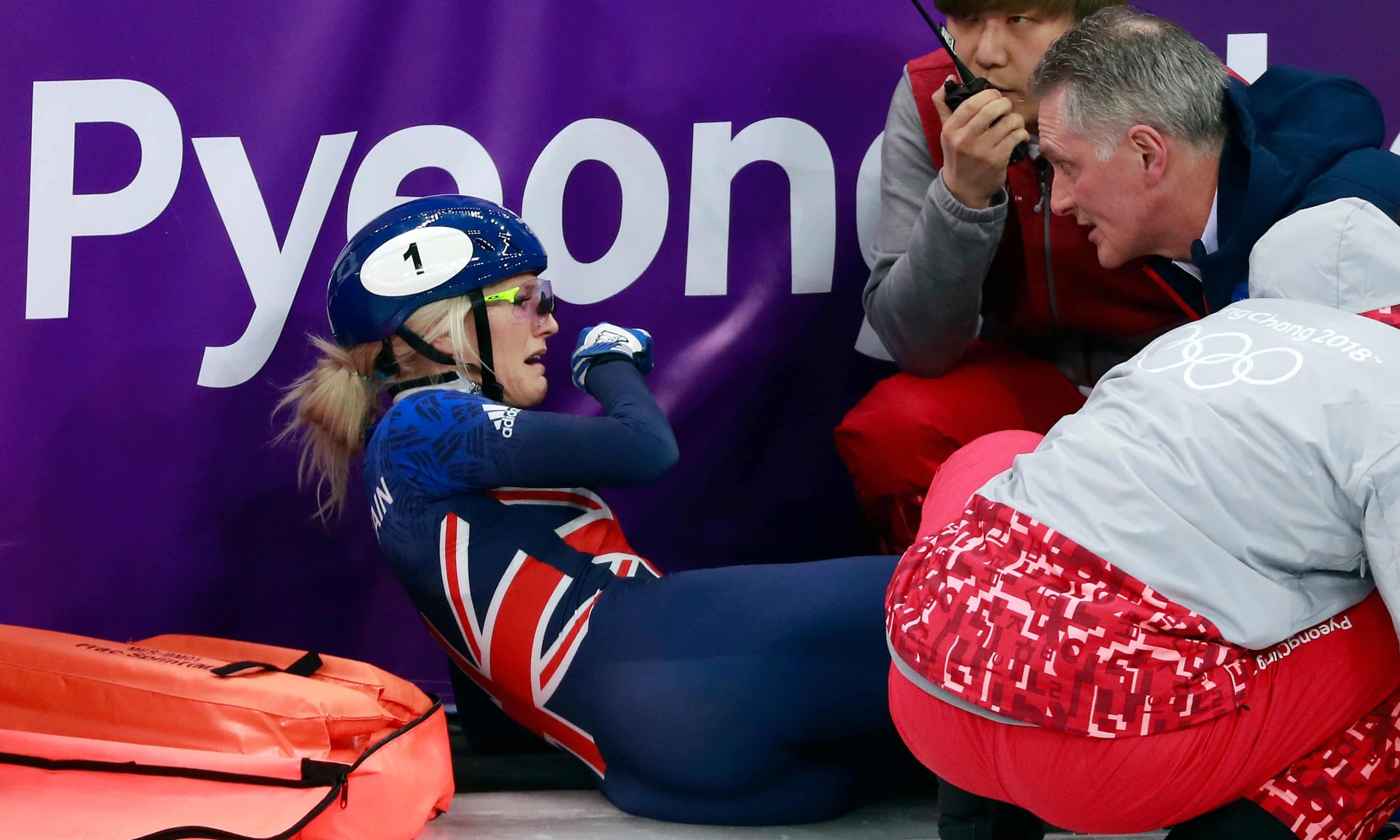 |
Elise Christie fell at the PyeongChang 2018 olympics, South Korea on 17/2/2018. Photo: EPA |
After 2018, her funding was cut. Christie held onto hope for a comeback at the Beijing 2022 olympics, even hinting at self-funding her way to the Milan-Cortina 2026 olympics. However, an ankle injury prevented her from qualifying for Beijing. At 31 years old, she decided to retire.
The period that followed involved a struggle to make ends meet. Christie worked shift jobs at the airport, sometimes starting a 10-hour shift immediately after landing from a flight at 3 am. She worked as a sales clerk and pizza delivery driver, also taking on extra shifts at Nottingham market on weekends. At times, she slept in her car between shifts. "I'm here to get paid, just like you all," she told colleagues who expressed surprise at seeing an ex-olympic athlete behind a bakery counter.
Christie revealed that after three Olympic Games, she accumulated significant debt. She calculated that 700 subscriptions on an adult social media platform would yield approximately USD 6,800, precisely the prize money she received for winning the world championship in 2017. The disparity between 17 years dedicated to sports and her income after retirement led her to explore a new path.
Her decision to open an account on this social media platform came during a difficult period. The platform positions itself as a way for content creators to connect directly with fans. However, users often post sensitive content. Christie admitted to a long period of consideration before deciding to join.
"I'm trying to get to a point where I don't have to do it anymore, but finances are not easy," she stated. "Some close friends supported me, but others stopped speaking to me because of this choice."
 |
Elise Christie on social media. Photo: IGNV |
Christie described the decision as a response to public criticism. After facing severe backlash for her Olympic performance, she wondered what could be worse than the attacks she had already endured. "You broke my heart. I loved that sport, and everything I did was for a medal," she said, recalling the period of public scrutiny while representing her country.
Christie's mental health reached a critical point. She was diagnosed with bipolar disorder. After the 2018 olympics, the dismissal of her coach, Nick Gooch, coupled with her breakup from then-boyfriend, Hungarian athlete Shaolin Sandor Liu, plunged her into crisis. Christie admitted to self-harming to the extent of needing hospitalization. "I didn't want to commit suicide, but I saw no reason to exist," she recounted.
Her life's challenges extended beyond the ice rink. In 2012, Christie escaped a house fire, rescued by firefighters through a window. Her lungs suffered severe damage, requiring one day in the intensive care unit. In her 2021 memoir, she revealed being drugged and raped in Nottingham after the Vancouver 2010 olympics. Despite these traumas, Christie continued to compete for many years, winning continental and world titles.
When she stopped competing, she felt disoriented. The transition from a sponsored environment with a support team to an independent life was jarring. Christie noted that if she had been a 100m sprint athlete, her income story might have been different. However, opportunities for sponsorship are more limited in short-track speed skating.
Currently, Christie works as an activities coordinator in Dundee, her hometown in Scotland, to be closer to family and to have her mother help care for her two-year-old daughter, Millie. She credits her time in a rehabilitation center with helping her achieve stability. There, she met Connor Thomson, who later became her daughter's father. Christie now states that she no longer views an olympic medal as the sole measure of her worth.
She hopes to return to sports in a support role in the future, and she has plans to open a gym with a childcare area for working mothers. Christie believes savings from the adult platform could help her realize this ambition.
Christie's story highlights the vast gap between the glamour of the Olympics and the reality after retirement. 10 European titles and one world championship did not shield her from debt and psychological crisis. When the Olympic spotlight faded, Christie faced a completely different life, marked by financial instability and mental collapse.
Hoang An (according to Telegraph)