The SEA Games gathers top athletes from 11 nations in the region. Held in odd-numbered years, the event features numerous sports from the Olympic and ASIAD systems, as well as some unique to the host country.
The 11 participating nations are: Vietnam, Thailand, Indonesia, Malaysia, Singapore, Philippines, Myanmar, Cambodia, Laos, Brunei, and Timor Leste. These countries are members of the Southeast Asian Sports Federation, which coordinates and oversees the games.
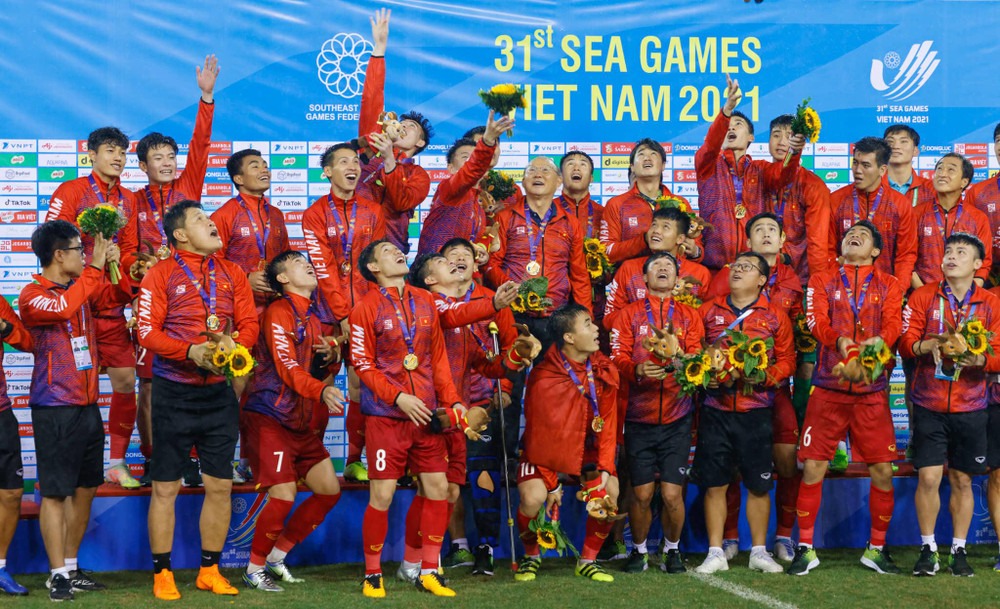 |
Vietnam's U23 team celebrates their gold medal at the 31st SEA Games, held on home soil in 2021. *Photo: Lam Thoa* |
The concept for the SEA Games originated in May 1958. Delegates from Southeast Asian peninsula nations, attending the 1958 Asian Games in Tokyo, Japan, convened and resolved to establish a regional sports organization. Luang Sukhum Nayaoradit, then Vice President of the Thai Olympic Committee, named this new entity the SEAP Games.
In December 1959, Thailand hosted the inaugural Southeast Asian Peninsular Games (SEAP Games), featuring 12 sports. The first games in Bangkok involved 800 officials and athletes, a number now comparable to a single national delegation. Thailand contributed 194 officials and athletes to this event.
Vietnam first participated in the SEAP Games in 1989, at the 15th edition held in Kuala Lumpur, Malaysia. Previously, from 1959 to 1975, South Vietnam had also competed. Following national reunification, Vietnam's sports returned to the regional stage in 1989 and have participated consistently since.
In 1977, the games expanded and were renamed the SEA Games after Indonesia and the Philippines were invited to join. This transformation made it an event for the entire Southeast Asian region, a name it has kept ever since. Timor Leste became the 11th member nation in 2003.
Typically spanning 10 to 14 days, the SEA Games allows host nations to introduce additional sports where they have strengths, fostering diversity and a unique identity for each event. Participation varies, with approximately 5,000 to 12,000 athletes and officials attending, depending on the host's selected number of sports.
With over 60 years of development, the SEA Games has evolved into a symbol of regional camaraderie. It serves as a vital platform for Southeast Asian sports to flourish and assert their unique identity.
Vy Anh