This move follows complaints from many national federations about the risk of financial losses due to high operating costs, particularly in the United States, a co-host nation for the tournament.
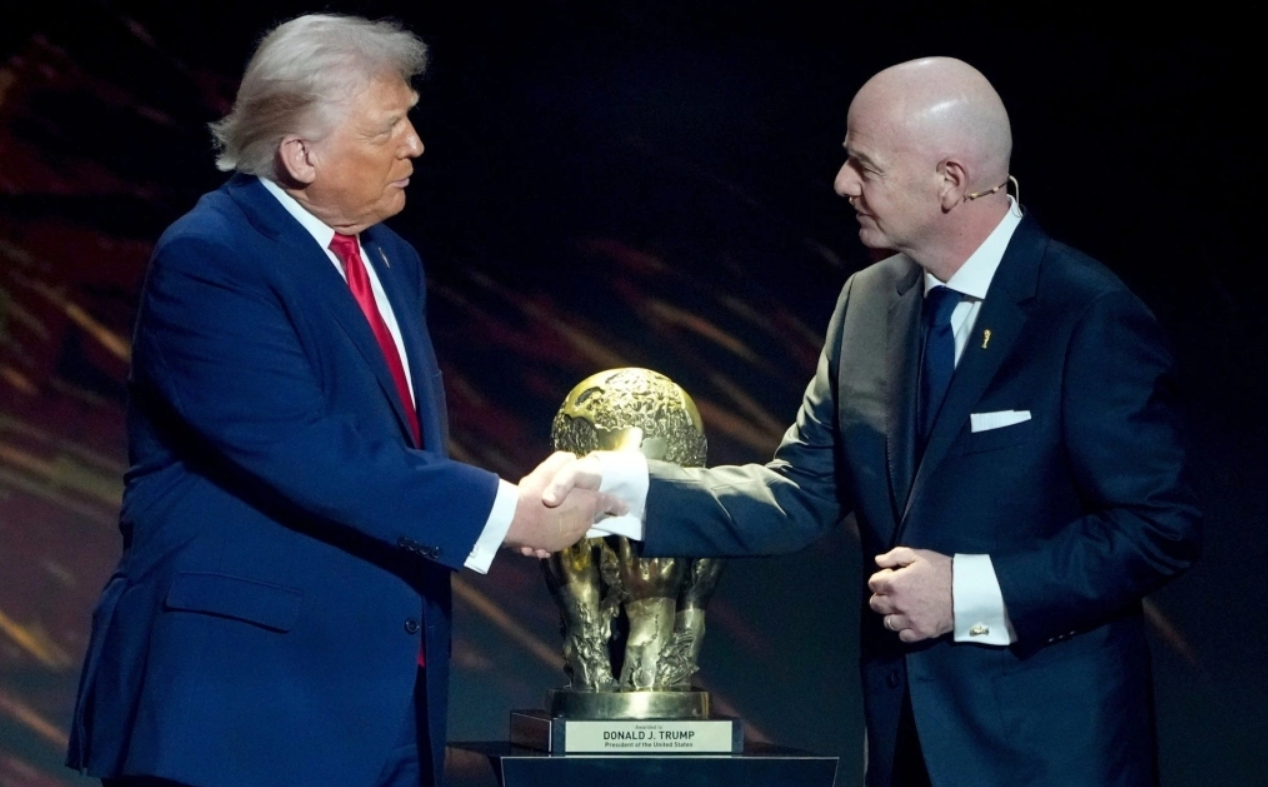 |
FIFA President Gianni Infantino (right) shakes hands with United States President Donald Trump during the World Cup 2026 group stage draw at the Kennedy Center, Washington D.C., United States on 5/12/2025. Photo: AP
Previously, FIFA announced a record prize fund of USD 727 million for the expanded 48-team World Cup. Under this plan, each participating team was set to receive a minimum of USD 10,5 million, with the champion getting USD 50 million. However, following recent discussions, these allocations are expected to be further increased.
Beyond prize money, FIFA also plans to increase development funding for its 211 member federations, exceeding the projected USD 2,7 billion for the next four-year cycle. Initially, each federation was set to receive USD 5 million, while six continental federations would receive USD 60 million; these amounts are also slated for an increase.
A FIFA representative stated that the organization is discussing with federations globally to expand revenue streams and increase financial support. This includes prize money for teams participating in World Cup 2026 and funds for football development.
FIFA projects revenues of USD 13 billion for the four-year cycle culminating in World Cup 2026, with the tournament itself contributing approximately USD 9 billion. This strong financial foundation is seen as a factor allowing the organization to increase spending.
However, many federations, especially in Europe like the English Football Association, argue that the current prize money is insufficient to cover costs if their teams do not advance deep into the tournament. Under the previous structure, prize money increased negligibly through each round, only rising significantly from the semifinals onward, leaving many teams facing potential financial losses.
In addition to high operating costs in the United States, the tax burden also presents a significant issue. While FIFA is tax-exempt, participating teams are subject to federal, state, and local taxes at varying rates. For example, Florida does not levy state tax, whereas New Jersey applies a rate of 10,75% and California up to 13,3%.
According to The Guardian, FIFA has listened to feedback from the federations and will soon announce adjustment details following the FIFA Council meeting in Vancouver.
World Cup 2026 will take place from 11/6 to 19/7 in the United States, Canada, and Mexico. This marks the first time in history that 48 teams will participate, a significant increase from the previous 32, with a total of 104 matches expected. The tournament will be hosted in approximately 16 cities, most of which are in the United States. While the expansion offers more national teams a chance to compete, it has also sparked debate regarding the quality of play and the travel burden due to vast geographical distances.
By Hong Duy (via The Guardian)