The Asia-Pacific region saw a three-fold increase in financial losses from cross-border online scams last year, reaching 114 billion USD, according to a United Nations report published last month. This surge stems from an increasingly interconnected, transnational, and technologically sophisticated criminal economy, where gangs share expertise in money laundering, human trafficking, and data collection.
Online scam operations, traditionally reliant on trafficked labor, guarded compounds, and large-scale call centers, are poised to become more dangerous. Criminals are now leveraging autonomous AI—systems capable of independently performing a sequence of tasks to achieve a goal, rather than merely responding to individual human prompts—to automate parts of their fraudulent activities.
Unlike earlier AI applications, such as scriptwriting, message translation, or deepfake generation, autonomous AI systems can execute multiple tasks sequentially with minimal human intervention. This capability facilitates faster, less costly, and more personalized scams, making them significantly harder for authorities to trace.
 |
Photo: AFP
Jonno Newman, a cybercrime expert at TRM Labs, a platform specializing in blockchain data analysis and tracing, believes the complexity of scam networks in the region could increase exponentially as criminals effectively exploit autonomous AI.
According to Newman, gangs are investing heavily in training autonomous AI agents. These agents can leverage years of data accumulated by previous-generation large language models to target numerous victims across multiple languages. "Instead of one person, they can use a bot to do the work of ten," Newman stated. "Then, they no longer need large-scale 'fortresses'; the scam network can be set up and operated remotely from anywhere. The scale and reach of AI-operated scam networks will be enormous. It will become a pandemic."
Evidence of decentralization is already emerging. Authorities in various countries, from Malaysia and China to the Philippines, have arrested dozens of individuals accused of working for scam centers directly from their homes, rather than from notorious dens in Myanmar or Cambodia.
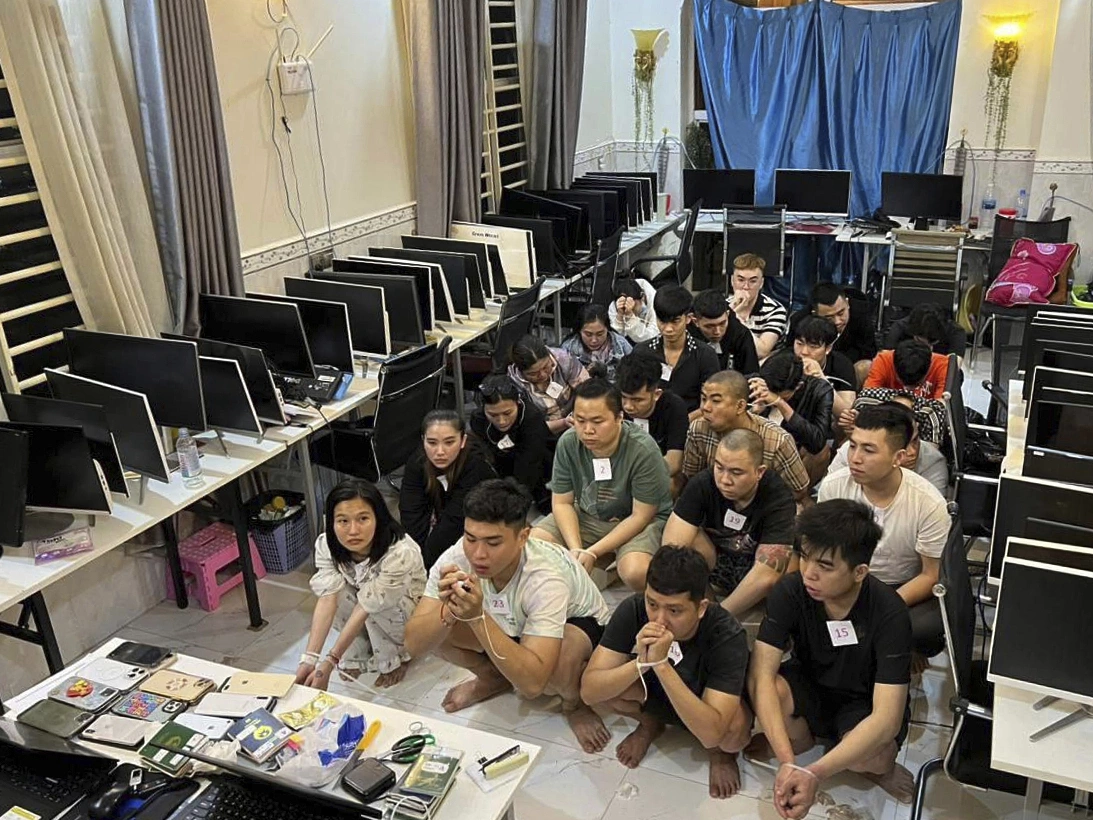 |
Photo: AKP
Newman warns that this shift to autonomous AI could leave governments and agencies caught off guard, as their current understanding of scam operations may quickly become obsolete. He explained, "Previously, in phone scams, for instance, you could easily spot typical signs, like scammers claiming a broken camera prevented video calls. Now, AI can create highly convincing deepfakes while monitoring victims' context and background, including where they live and even their habits."
Despite these challenges, Newman emphasizes that authorities are not entirely without recourse. They must accelerate the application of AI to detect and neutralize online scam networks. He also stressed the critical need for strengthened cross-border cooperation between governments and the private sector to cut off resources, such as Internet connectivity and power supplies, for identified or suspected scam networks.
"Cooperation and partnerships between the public and private sectors are vital; otherwise, we won't be able to keep pace with scams using autonomous AI," Newman concluded. "What's important is how we use technology for defense."
Huyen Le (According to SCMP, AFP)