A video shared on social media on August 11 depicted numerous cars and debris floating down a severely flooded street in Northern China's Hebei province, as heavy rains persisted.
A series of cars floating amidst flooded streets in Hebei province, China on August 11. *Video: X/Cryptoleek*
Typhoon Doksuri, the most powerful storm to hit China this year, had weakened after making landfall in the eastern province of Zhejiang on August 9. However, the typhoon's weakened low-pressure system continued to draw significant tropical moisture inland, triggering widespread heavy rainfall across Central and Northern China.
Hebei province, bordering the capital Beijing, was placed on high alert for flash floods, landslides, and other geological hazards. Authorities deployed 623 work teams to mountainous areas and equipped over 2,100 high-risk villages with satellite phones or messaging devices to ensure emergency communication.
Beijing recorded an average rainfall of 23,5 mm from noon on August 11 to 8:00 AM on August 12, with Miyun district experiencing the heaviest downpour at 199,6 mm. The city responded by closing 151 tourist attractions and 157 campsites, in addition to suspending operations for over 4,100 homestay accommodations in rural areas.
A total of 250 bus routes were temporarily suspended, while trains on 10 subway lines were instructed to reduce speed. All scenic boat services were also halted.
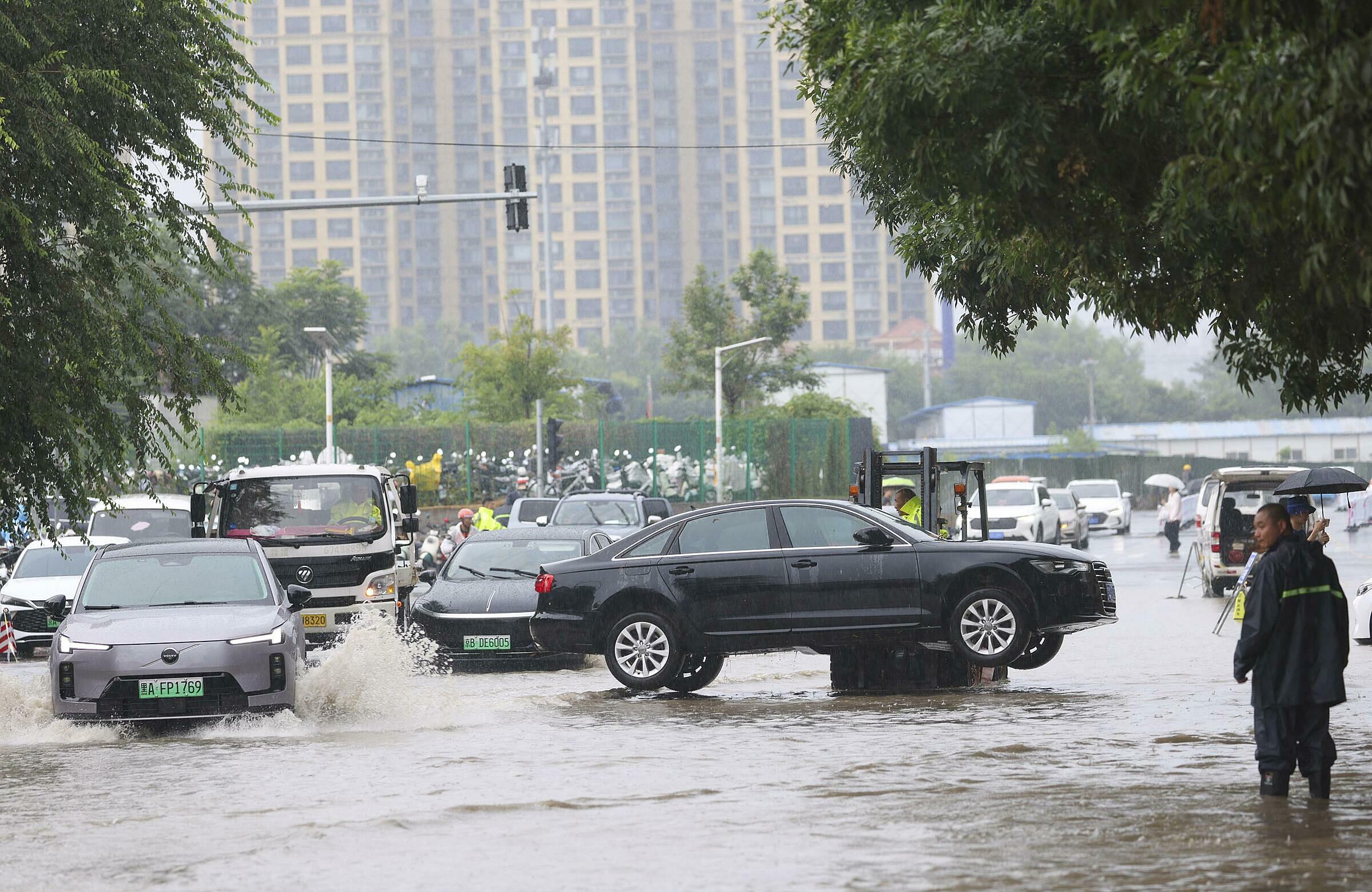 |
Flooded streets in Chaoyang district, Beijing on August 11. *Photo: AFP*
More than 5,000 elderly individuals were relocated from care facilities, and approximately 1,800 residents living near mountainous construction sites or riverside areas were also evacuated.
In Central China's Henan province, officials elevated the heavy rain warning to its highest level on the morning of August 12, as torrential downpours continued across a wide area. Forecasts indicated heavy rain would persist until the morning of August 13, with some areas potentially receiving up to 350 mm of rainfall within a 24-hour period.
Affected areas in Henan temporarily suspended schooling, business operations, and non-essential outdoor activities. State media advised residents to avoid deep floodwaters and to evacuate immediately if their vehicles stalled in the current.
Many other parts of Central China also recorded historic rainfall. Wugang city in Henan province received 209,5 mm of rain in one day, while neighboring Xiangyang city in Hubei province recorded 169,1 mm. According to state media, these figures represent the highest one-day rainfall ever recorded for August in these two localities.
A showroom in Zhangjiagang city, Jiangsu province, was inundated, sweeping many display vehicles outside. *Video: Shanghai Daily*
China, the world's second-largest economy, is increasingly contending with extreme weather events that cause significant damage, which scientists link to climate change. This year has been particularly challenging due to the emergence of El Nino, leading to rising temperatures and more frequent, intense storms.
Huyen Le (According to Guardian, Reuters, Xinhua)