"Ukrainian forces conducted a special operation targeting the Novorossiysk naval base, the Black Sea Fleet's last major stronghold located over 300 km from the front line," President Volodymyr Zelensky stated today. This operation utilized a variety of weapons, including Palianytsia jet suicide unmanned aerial vehicles, Neptune anti-ship missiles, and unmanned surface vessels. Targets included air defense positions, port facilities, and infrastructure at the Russian naval port.
Zelensky warned that the Russian fleet and its supporting infrastructure "will not be safe as long as Moscow prolongs the conflict." This attack follows a pattern of Ukraine's recent efforts to target Russian energy facilities, from oil refineries and storage depots to export ports, oil tankers, and pipeline infrastructure. Kyiv aims to degrade Moscow's oil and fuel processing and export capabilities, thereby pressuring President Vladimir Putin into negotiations.
Russian officials confirmed Ukraine launched an attack on Krasnodar province on the night of 11/8 and early 12/8. Governor Veniamin Kondratyev stated the area experienced a large-scale attack with "hundreds of unmanned aerial vehicles" targeting Novorossiysk, along with Anapa, Gelendzhik, and Temryuksky regions. Residents of Novorossiysk reported multiple consecutive explosions as Russian air defense systems engaged targets. Kondratyev reported that an 8-year-old boy was killed and 8 people were injured in the attack. Falling drone debris also damaged 21 residential buildings and 4 businesses.
Satellite data from NASA's Fire Information for Resource Management System (FIRMS) showed multiple heat signatures in the Novorossiysk port area. Fires were concentrated near the grain export port and naval base, adjacent to Transneft's Sheskharis oil terminal. The data also revealed several heat signatures at the Novorossiysk naval port, including some locations close to the coast. MT Anderson, an open-source data tracker on X, noted that this area previously gathered many naval vessels, but the specific number at the time of the attack was unknown.
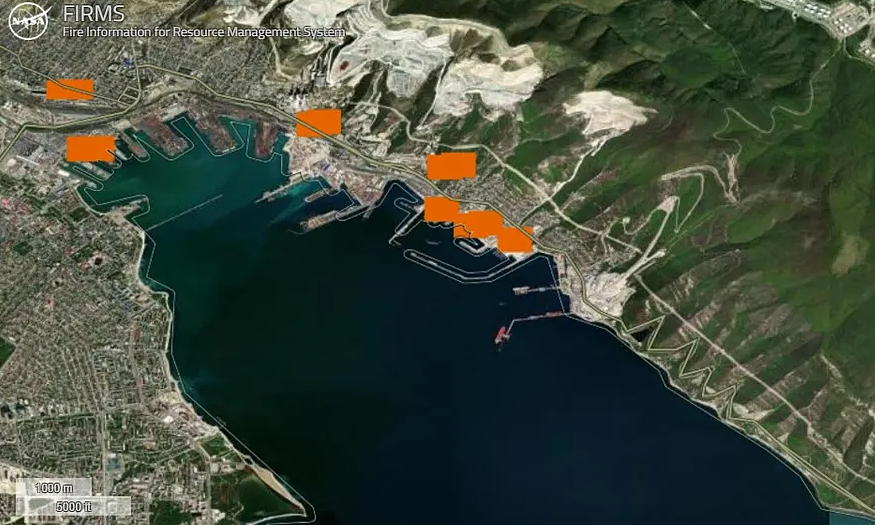 |
Locations of fires at Novorossiysk port on 12/8. Graphics: NASA |
Reuters, citing informed sources, revealed that two of Russia's largest grain export terminals at the port suspended operations after the attack. These include the Novorossiysk terminal, with an export capacity of 8,5 million tons annually, and the NKHP terminal, with a 7,1 million-ton capacity.
Novorossiysk is one of the largest ports in the Black Sea, serving as a primary gateway for crude oil and oil product exports in southern Russia. It also functions as a reserve base for the Russian Navy's Black Sea Fleet, with most of the fleet having relocated here to avoid attacks on the Sevastopol naval base in Crimea. The city is an important oil export hub for Russia, featuring the Sheskharis terminal and facilities of the Caspian Pipeline Consortium (CPC), which primarily transports Kazakh oil to international markets. Oil loading at Novorossiysk averaged over 821,000 barrels per day in July.
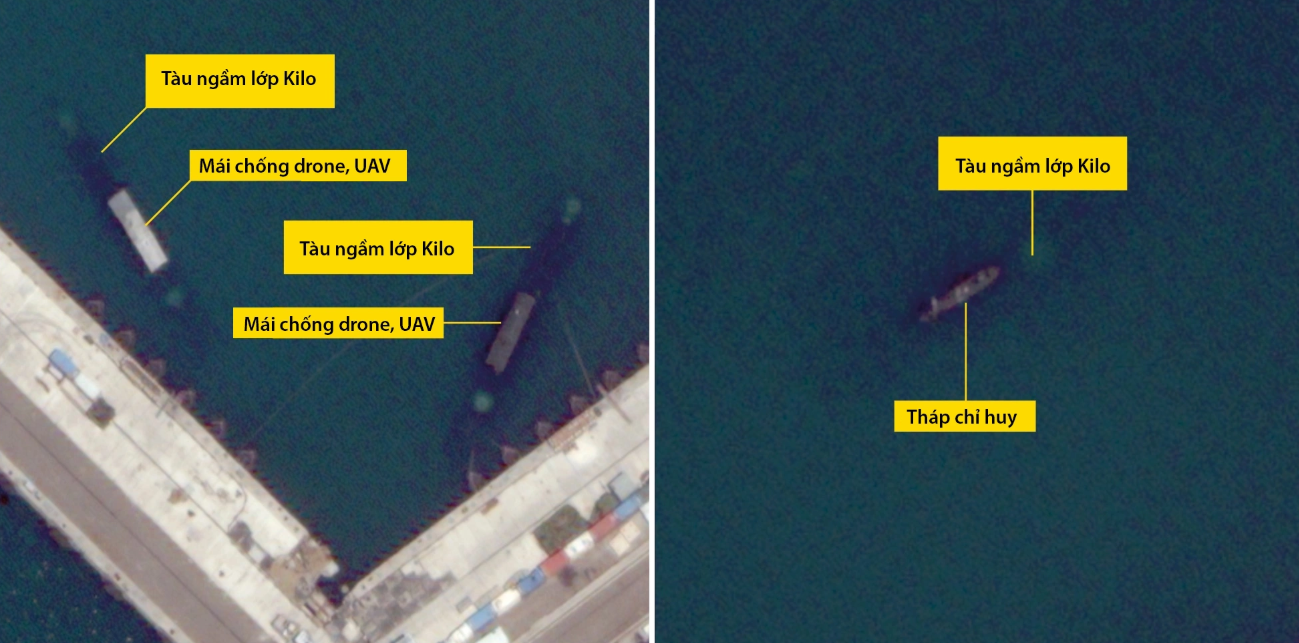 |
Kilo-class submarine at Novorossiysk base in a photo taken on 13/6. Photo: British Ministry of Defense |
The CPC also includes stakes from US oil and gas corporations Chevron and Exxon. According to the Financial Times, Ukrainian forces stopped attacks on oil tankers serving CPC after US Vice President JD Vance asked Kyiv to avoid these targets.
Beyond Novorossiysk, many other areas in southern Russia and Crimea also experienced a series of attacks during the night. The Russian Ministry of Defense announced on the same day that air defense units shot down 502 Ukrainian unmanned aerial vehicles last night and this morning across Belgorod, Bryansk, Kaluga, Kursk, Lipetsk, Oryol, Krasnodar provinces, Crimea, and the Black Sea.
Thanh Danh (Reuters, Kyiv Independent, Maritime-Executive)