The Gyirong border gate was the first area hit by a devastating flash flood on 26/8. The flood originated from a massive ice block collapsing from Langtang Lirung peak in the Himalayas into the Trishuli river, on the Nepal-China border. The force of the flash flood swept away everything in its path.
When the dozens of meters-high torrent struck, hundreds of people were processing paperwork at the Gyirong border gate, located opposite Nepal's Rasuwa border gate. They fled in panic, but had almost no chance against the high-speed water, which carried immense amounts of earth and rocks.
Surveillance camera footage shows the flood completely destroyed the sturdy border gate, swept away the adjacent parking lot, and buried those attempting to escape.
Moment a flash flood swept through the checkpoint, washing away the parking lot at Gyirong border gate on 26/8. *Video: CCTV*
Ren Wei, executive vice chairman of the Tibet Autonomous Region, confirmed on the evening of 6/9 that 43 people died and 519 are missing after the flash flood on the Chinese side, including about 261 foreigners. In Nepal, the flash flood resulted in over 1,270 deaths and more than 4,700 missing people.
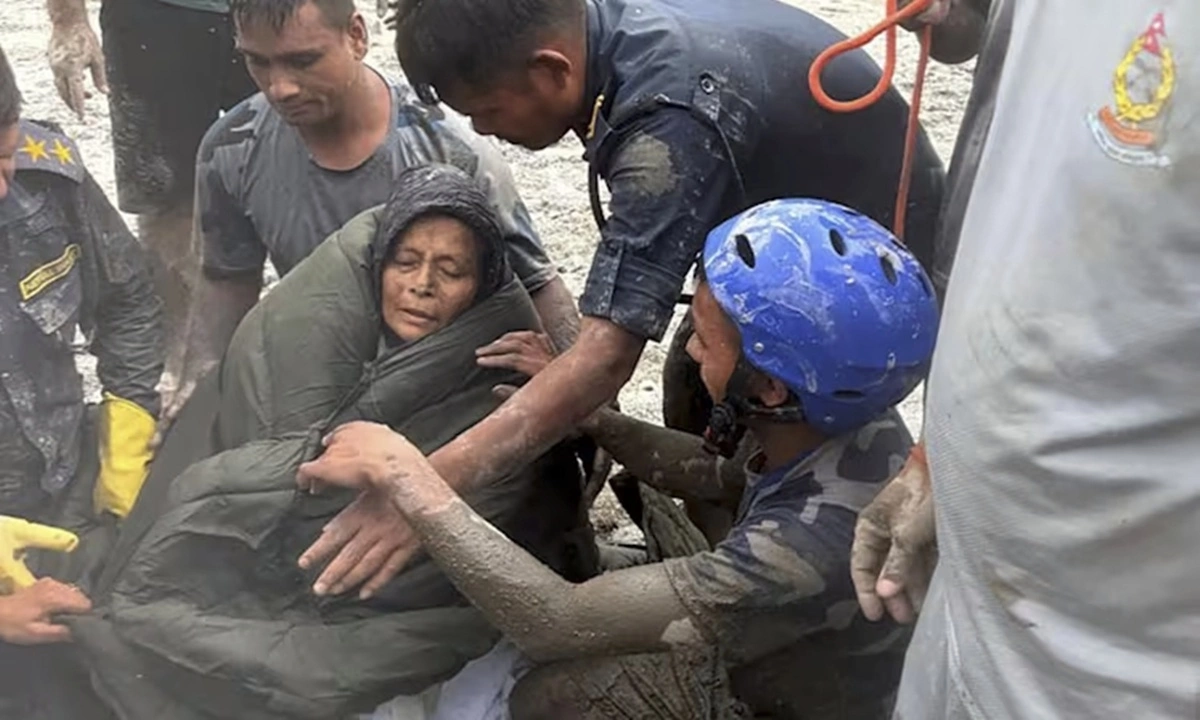
Despite active search efforts in recent days, Chinese rescue forces have not found any survivors at the Gyirong border gate area, which was almost completely flattened.
Chinese authorities have deployed dozens of excavators and bulldozers working around the clock in recent days to build a temporary road along the riverbank. This road replaces the completely destroyed route, allowing vehicles to access the Gyirong border gate.
To reach the Gyirong border gate, a 12-member international press delegation, invited by China for a site survey on 6/9, traveled for about 8 h by car from the capital Chengguan to Dingri, a city near the Nepal border. They had to cross mountain passes at altitudes up to 4,000 m.
From Dingri, the delegation took another 6 h to descend to the border gate, situated at an altitude of about 1,800 m. The narrow, two-lane road leading to the gate wound through mountain ranges with numerous sharp turns.
The road was only cleared on 2/9, seven days after the disaster, allowing thousands of rescue personnel and heavy machinery to enter the area. Previously, only a few rescue teams could reach the scene on foot, by boat, or by air.
The 5-story checkpoint building, featuring distinctive Chinese architecture, has now completely vanished after the torrent swept through. All that remains are traces of the building's foundation.
"When we started digging, all I saw was the remaining foundation. The entire structure above was swept away by the flood. Witnessing that scene was truly heartbreaking. Many Chinese people lost their precious lives in this disaster", said Zhang Xiao Jun, a rescue worker.
The Gyirong border gate area devastated by a flash flood in a video released on 27/8. *Video: PLA*
The border gate area previously housed tourist company offices, a supermarket, and a bridge connecting China with Nepal, but all were flattened and buried under layers of earth and rocks.
"The biggest challenge is the site conditions, with an immense amount of mud burying everything. There are also many large rocks, along with the risk of a second flash flood. The geology of this area is not truly stable", said Yang Qi Qiao, a rescue team commander who has been working at the scene since 28/8.
He stated that the rescue team had to trek across mountains and navigate difficult terrain to reach the most heavily damaged areas.
Video recreating the path of the Nepal flash flood. *Video: BBC*
Officials also warned of the continued risk of landslides around the glacier area on Langtang Lirung mountain in Nepal.
Last month's disaster may prompt China and Nepal to enhance disaster risk monitoring, data sharing, and the development of early warning systems, especially as climate change makes natural disasters increasingly unpredictable and frequent. However, the current priority remains the search for victims.
Chinese authorities have not yet publicly released the identities or the number of people present at the border gate at the time of the disaster.
Pu Wei Dong, executive deputy director of the Tibet Public Security Department, stated that over 60 experts are continuously working at three mobile laboratories to identify recovered bodies. Authorities are also cross-referencing immigration data and mobile location tracking to identify missing persons.
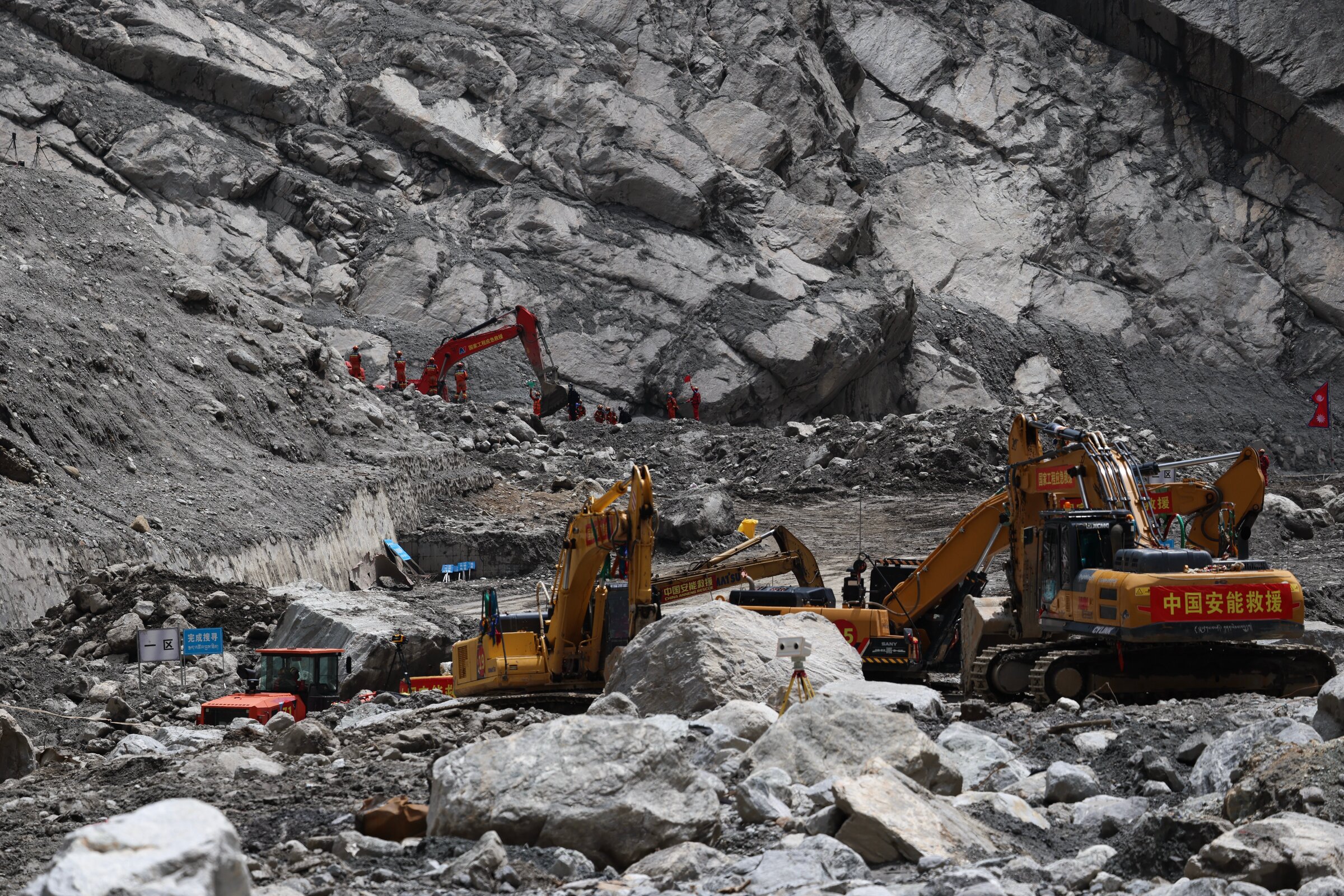 |
Rescue team working at the Gyirong border gate scene on 6/9. *Photo: AP*
Over the past 11 days, rescue operations have been repeatedly slowed or halted due to the risk of secondary disasters, such as landslides and the breach of dammed lakes formed after the flood. Heavy rain and rugged mountainous terrain also occasionally made helicopter access to the scene difficult.
"The current approach is to excavate, search, and clear one layer before moving to the next. We are digging extremely carefully, sifting through each layer of earth and rocks in the hope of finding victims' bodies", said team leader Yang Qi Qiao.
Thanh Tam (*According to CNN, Reuters, AFP*)