Over the past two weeks, Russia has intensified its missile and drone attacks on Odesa, Ukraine's largest port city in the south. Each time explosions reverberate, Tetiana Rybak can do only one thing: lie in bed and wait. She is unable to walk or descend to a shelter.
Recently, she asked a social worker to seal her apartment windows with festive red wrapping paper, old military posters, and a copy of the Lord's Prayer. This way, she no longer has to see Russian drones flying past her home.
Ukrainian president Volodymyr Zelensky stated on 22/12 that Russia's attacks on Odesa aim to sever Ukraine's access to the Black Sea. He acknowledged that the situation in Odesa is currently "very difficult".
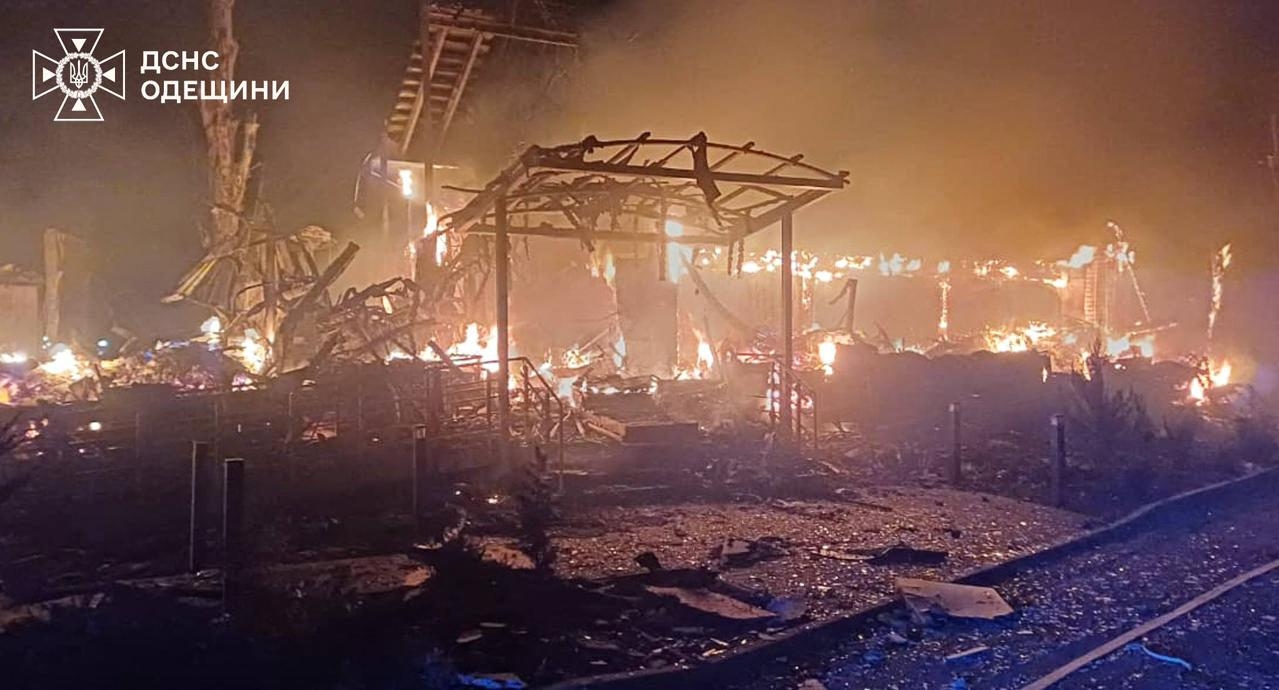 |
A building ablaze after a Russian attack on Odesa, Ukraine, in a photo published on 25/12. Photo: AFP
This month, Rybak's home was without electricity for 9 days. For 4 of those days, she also lacked heating gas and clean water. A social worker had to carry water up seven floors for her.
Tetiana Rybak, who has lived with a disability for many years, wears two pairs of socks, two pairs of warm trousers, a sweater, and a thick cotton bathrobe. She then huddles under two layers of blankets to stay warm.
"Mentally, no one can endure this. I have completely broken down. Just last night, when the power went out and the attack began, the air raid sirens were terrifyingly loud. But what was more frightening was that the doors and windows rattled violently, and I lay still, unable to run anywhere or hide," she said.
While other major Ukrainian cities typically experience intermittent bombardments, Odesa has been under almost continuous attack since the early morning of 12/12. Russia primarily targets the city's ports and power infrastructure.
When electricity, gas, and water are cut for days, residents seek out government aid centers or grocery stores to charge their phones. They place bags of milk, eggs, and sour cream on windowsills to keep them cold, and cook outdoors on makeshift stoves. Some install large generators in their yards for neighbors to share.
"The focus of the war may have shifted to Odesa," Ukrainian deputy prime minister Oleksii Kuleba said last week, warning that attacks could escalate as Russia seeks to weaken Ukraine's economy.
Russian president Vladimir Putin previously stated that Moscow intends to limit Ukraine's access to the Black Sea in response to recent drone boat attacks on Russia's fleet. Kyiv asserts these vessels are part of a "shadow fleet" used to help Moscow circumvent oil sanctions.
Odesa's port has long been an economic pillar for Ukraine. Dubbed the "pearl by the sea", Odesa is Ukraine's third most populous city, after Kyiv and Kharkov. Its Black Sea ports, including Odesa, the two neighboring ports of Pivdennyi and Chornomorsk, and the port of Mykolaiv to the east, handled over 70% of Ukraine's exports before the conflict.
Odesa's role as a commercial hub has grown in recent years, as ports in Zaporizhzhia, Kherson, and Mykolaiv came under Russian control. Since the conflict began, Ukraine has remained among the top 5 global exporters of wheat and corn, largely through Odesa's port.
Since the conflict erupted, Ukrainians have united against Russian attacks and pressure. Their resilience has been praised so much that it has become almost a given.
However, after a week without electricity due to continuous Russian attacks, some Odesa residents have lost patience.
"I just want this insane conflict to end. We are so tired. When will this actually stop?" said Valentyna Avdiienko, a 72-year-old resident.
 |
A man looks at a devastated building after a Russian attack on Odesa on 13/12. Photo: AFP
For those who once lived under the Soviet Union, this war is even more heartbreaking, as it pits Ukrainians against Russians they once considered brothers. Mahadan Farkhiiev, a 73-year-old resident and former Soviet soldier, said he no longer speaks to his brother and sister living in Russia.
Farkhiiev currently lives in Odesa with his wife Anastasiia and their 42-year-old son Andrii, who has cerebral palsy. Each time shelling occurs, they can only wait for the explosions to end. "Where are we supposed to run now?" he asked.
Olha Demydova, a social worker for the charity Culture of Democracy, said she often visits and encourages families like Farkhiiev's.
"When there's no electricity, no heating, no clean water, you think it's the end, the apocalypse. But then you realize it cannot be like that. You cannot give up, you have to keep surviving, and everything will get better," Demydova said.
For Rybak, she never imagined her life would turn out this way. She used to be a social worker caring for those in need and thought she was prepared for any contingency. But she became unable to walk in 2023 due to complications from kidney surgery.
She always thought her three sons and daughter could help her in old age. However, she rarely sees her sons, as all are fighting on the front lines. Last year, her daughter left Ukraine due to immense psychological pressure.
Rybak recounted that she used to be able to sleep through air raid sirens, but no longer can. Recent alarms sometimes last up to 10 hours.
"All I want now is a little peace, just a little. My health is fading, I feel like I'm at zero. There's no strength left," she said.
By Thanh Tam (Source: Al Jazeera, BBC)