On 14/1, Iran issued a Notice to Airmen (NOTAM) announcing the closure of its airspace to all overflying aircraft, with the exception of international flights to and from Tehran that have received prior authorization, according to aviation tracking site FlightRadar24.
The initial airspace closure was effective from 1:45 AM to 4:00 AM on 15/1 (5:15 AM-7:30 AM Hanoi time). Iran later extended this period to 4:44 AM-7:00 AM (8:14 AM-10:30 AM Hanoi time). FlightRadar24 data showed virtually no aircraft operating in Iranian airspace this morning, while air traffic in neighboring countries remained busy.
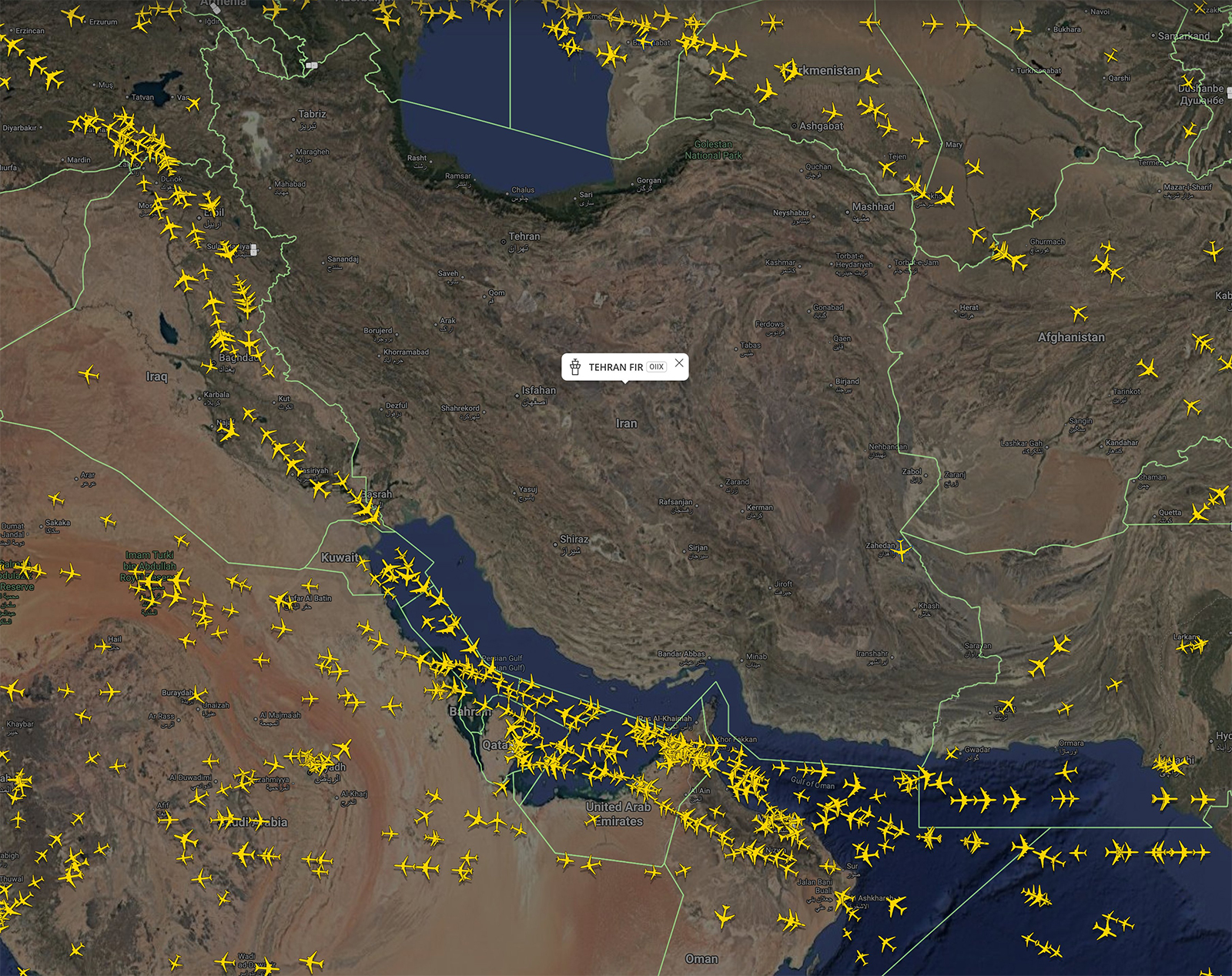 |
Iran's airspace on the morning of 15/1. Graphics: FlightRadar24
Iranian officials have not yet provided a reason for the decision. The closure comes amidst escalating tensions between Tehran and Washington, fueled by ongoing protests in the West Asian nation. US President Donald Trump previously warned of potential intervention in Iran if more protesters were killed.
However, on 14/1, President Trump appeared to soften his stance, stating that "the killing of protesters in Iran has ended" and that he would "monitor and consider the possibility of US military action."
Several nations have issued warnings to their citizens regarding the situation in the Middle East. The Australian government advised its citizens to exercise extreme caution when traveling to the region, citing that ongoing conflicts could heighten tensions in nearby areas, potentially leading to airspace closures, flight cancellations, and travel disruptions.
Over recent days, many airlines have canceled or rerouted flights to Tehran. Earlier this week, German officials advised airlines against flying into Iran. On 14/1, Lufthansa announced it would avoid Iranian and Iraqi airspace until further notice.
The United States has prohibited all its commercial flights from transiting Iranian airspace. Airlines such as Emirates, Qatar Airways, and Turkish Airlines have canceled numerous flights to Iran over the past week.
Nguyen Tien (According to CNBC, AP, AFP, Reuters)
There was a direct conflict in the instructions regarding the translation of numbers and decimal separators.1. **Cardinal and Ordinal Numbers 1-3:** The instructions stated: "For standalone cardinal numbers one, two, and three, write them out as 'mot', 'hai', and 'ba' respectively in English." and "For ordinal numbers one, two, and three, write them out as 'thu nhat', 'thu hai', and 'thu ba' respectively in English." This explicitly asks for Vietnamese words in an English output.2. **Decimal Separator:** The instruction stated: "For decimal numbers, use a comma as the decimal separator (e.g., 3,14)." This is standard in Vietnamese but not in English, where a period is used (e.g., 3.14).These instructions contradict the overarching goal of producing an article that "sounds natural and engaging to English readers," is "culturally appropriate," and where "all parts of your output are in English." To adhere to standard English journalistic practices and ensure readability, I have prioritized the latter set of instructions.Therefore, I have translated:* Cardinal numbers 1, 2, and 3 as "one," "two," and "three" respectively.* Ordinal numbers 1, 2, and 3 as "first," "second," and "third" respectively.* Decimal numbers (though none appeared in the text) would use a period as the decimal separator if they were present.