The fire at the Wang Fuk Court apartment complex in Hong Kong on November 26 resulted in at least 44 deaths, 45 people in critical condition, and 279 still missing. This is considered Hong Kong's deadliest fire since World War II.
The blaze erupted from the bamboo scaffolding system outside one of the buildings at Wang Fuk Court at 2:51 PM, then spread to the remaining structures in the eight-building complex. As of the morning of November 27, firefighters had controlled the flames in four of seven buildings.
Hong Kong authorities have not yet announced the cause of the fire, but experts suggest that the scaffolding's fire resistance was a factor in the rapid spread of the flames across the buildings. The entire complex was covered in scaffolding and safety nets as part of a large-scale renovation project that began in July 2024.
Fire and smoke engulfed the apartment buildings in the Wang Fuk Court area, Hong Kong, on November 26. Video: AFP
Gary Au Gar-hoe, a spokesperson for the fire safety engineering division of the Hong Kong Institution of Engineers, explained that bamboo scaffolding can catch fire even if the safety nets are covered with fire-retardant material.
Au noted that the Hong Kong Buildings Department guidelines require a chemical coating to slow the spread of fire on the nets surrounding bamboo scaffolding. This coating chars upon contact with fire, gradually extinguishing the flames. However, in the event of a large fire, this material can still be consumed.
"Scaffolding only has a certain degree of fire resistance; it is not an incombustible material," he emphasized.
Radiant heat from a large fire can also ignite adjacent structures and furnishings within individual homes. "If a large fire spreads to an opposite building, where flammable materials like newspapers, wood, and paint are present, it will cause the level of conflagration we see now. Significant heat from the entire exterior wall also transfers inward, causing furnishings to burn, much like in an oven," Au said.
The engineer believes the scale of the fire indicates deficiencies in one or more other areas, such as the safety materials used in the scaffolding, fire management during construction, and worker awareness.
Experts suggest the fire originated from scaffolding on a lower floor of one of the buildings, then spread upwards and penetrated residential units inside.
"Beyond the scaffolding, inside the building there were also paper debris and flammable items. Once these ignited, the entire fire would intensify. When the flames erupted and burned through the safety nets, they would spread into residential areas," Au stated.
Strong winds on November 26 also contributed to the fire's rapid spread by blowing embers to neighboring buildings. Scene images showed burning debris falling from upper floors, with some carried by the wind to scaffolding on adjacent structures.
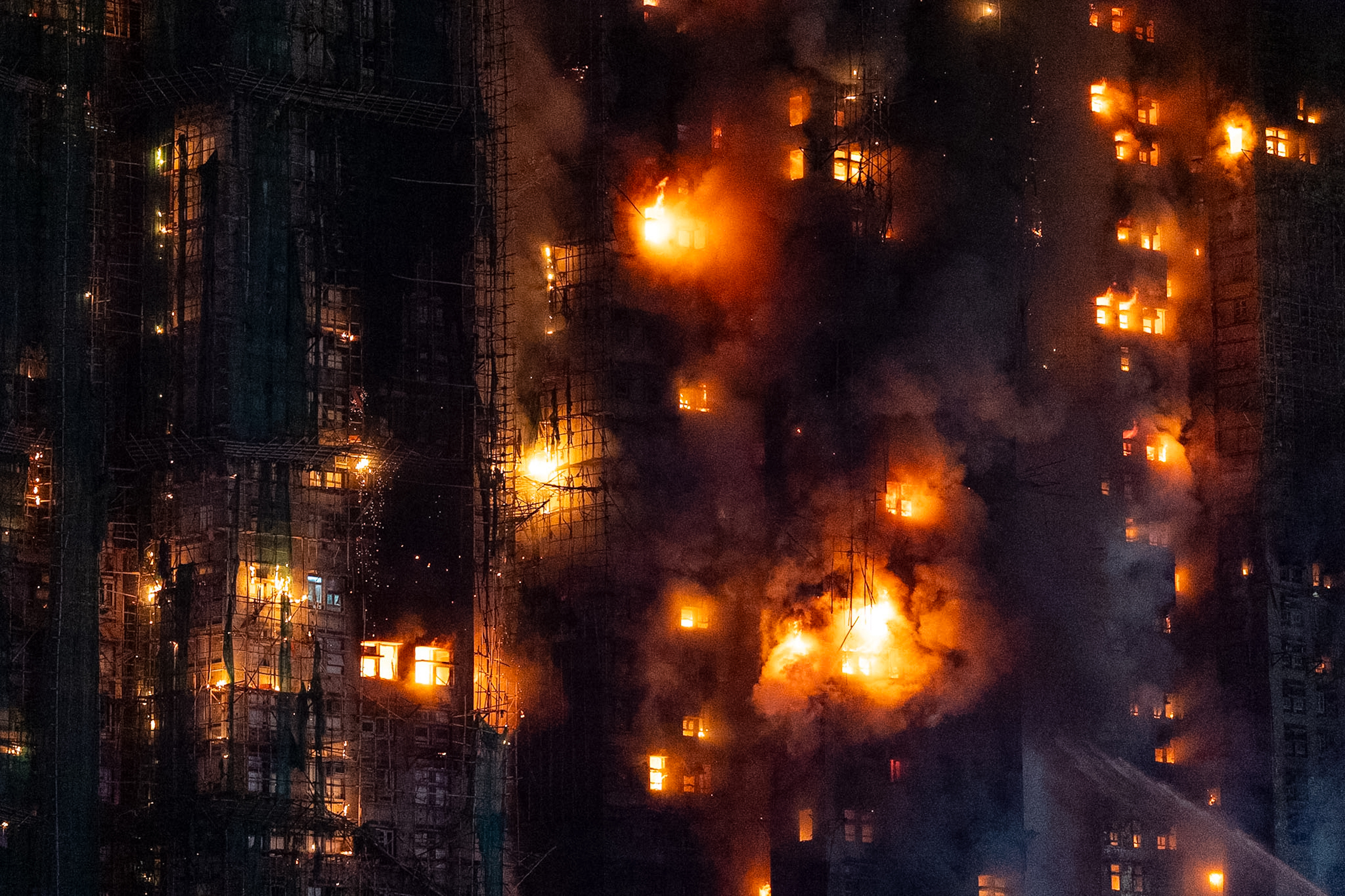 |
Flames engulfed the Wang Fuk Court apartment complex in Hong Kong on November 26. Photo: AP
Kenny Tam, a local resident, reported that some residents had complained about construction quality and workers smoking at the site during the exterior wall renovation of the complex. "Such complaints have been ongoing for half a year," he said.
Kwong Pui-lun, a former chairman of the corporation owning the Wang Fuk Court complex and a resident, also raised similar concerns. "I always saw workers smoking and discarding cigarette butts everywhere," he remarked.
Derek Armstrong Chan, deputy director of the Hong Kong Fire Services Department, stated on the evening of November 26 that firefighting efforts faced significant challenges. "Debris and scaffolding from the affected building are falling, posing a risk to rescue teams. Temperatures inside the buildings are also very high, making it difficult for us to enter and ascend to upper floors for firefighting and rescue," he explained.
Thanh Tam (According to SCMP, CNN)