On 1/12, Ukraine's Sternenko Community Foundation released a video depicting a Sting interceptor drone engaging a Russian Geran-2 suicide drone. The Geran-2 aircraft was seen carrying a launch rail and a short-range R-60 air-to-air missile on its back.
On the same day, Ukrainian electronic warfare specialist Serhiy Beskrestnov shared photos of a Geran-2 wreckage, showing an R-60 missile still mounted on its launch rail, appearing intact. Beskrestnov stated, "They are integrating air-to-air missiles onto Geran-2 unmanned aerial vehicles (UAVs) to shoot down helicopters and aircraft on interception missions."
A Geran UAV carrying a launch rail and an R-60 air-to-air missile in a video released on 1/12. Video: Sternenko Community Foundation
The R-60 is a short-range, infrared-guided missile developed by the Soviet Union. It entered service in 1970 and began mass production three years later. Upon its introduction, it was considered one of the lightest and most maneuverable air-to-air missiles globally.
Each R-60 missile measures over 2 meters in length, weighs 44 kg, and has a maximum range of approximately 8 km. It carries a 3 kg continuous-rod fragmentation warhead. The original R-60 could only engage targets directly in front of the aircraft. However, the R-60M variant, introduced in 1982, could track heat sources with an off-boresight angle of up to 20 degrees.
The precise firing and target detection mechanisms for Geran-2 UAVs equipped with air-to-air missiles remain unclear. Western and Ukrainian experts speculate that these drones utilize a remote control system, incorporating radio links with repeaters and a 4G SIM for additional connectivity.
Joseph Trevithick, editor for the American military publication War Zone, commented, "Mounting R-60 missiles on the Geran-2 UAVs' backs enhances their tracking capabilities. Target data will come from external radar or sensors, and pilots can directly scan using integrated onboard sensor systems."
These air-to-air missile-equipped Geran UAVs could deploy independently or in formations, particularly in frontline areas. Their mission would be to deter unexpected Ukrainian air assaults and coordinate with other UAVs in larger combined attack operations.
The American expert warned, "It remains uncertain when air-to-air Geran UAVs will be capable of striking Ukrainian fixed-wing aircraft or helicopters with R-60 missiles. Nevertheless, their emergence introduces a new risk factor Ukraine must address when deploying interceptor forces."
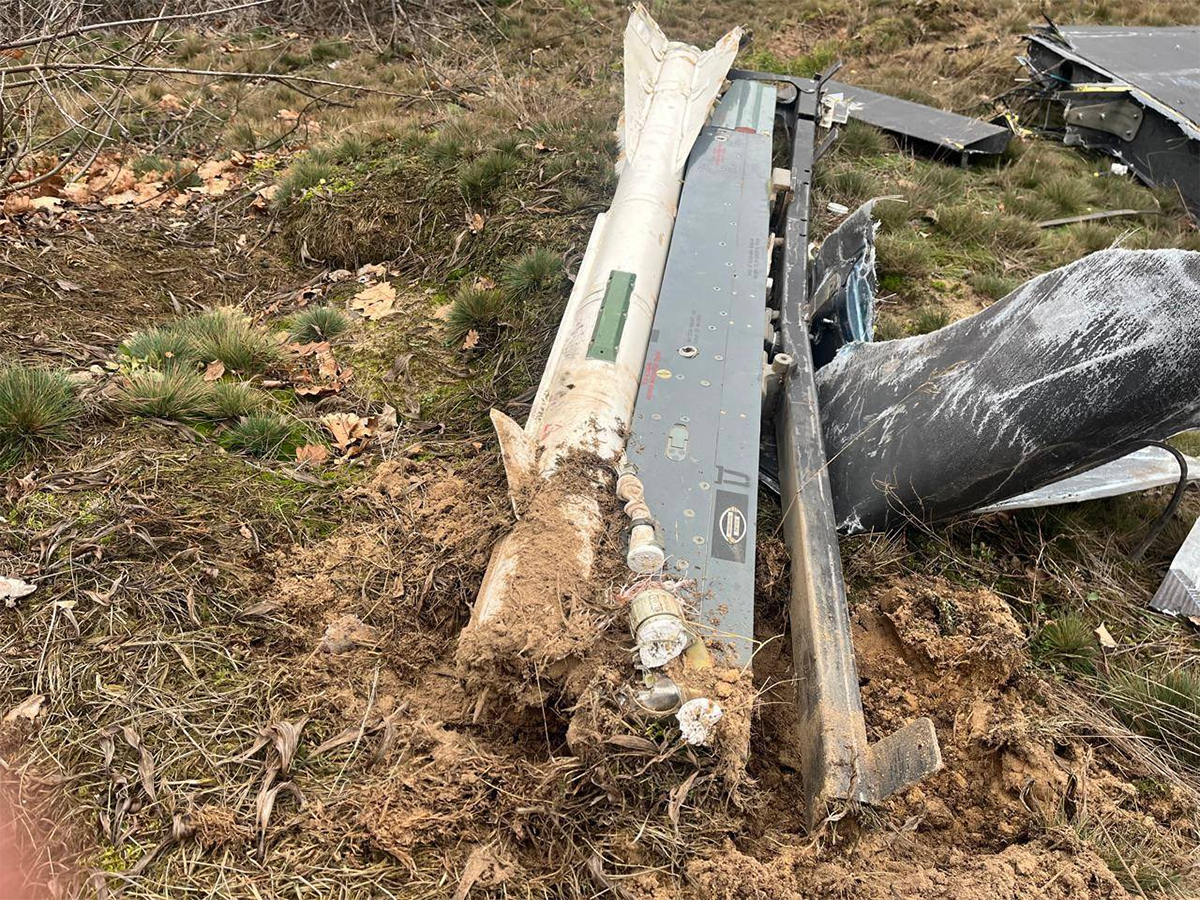 |
Launch rail and R-60 missile on Geran UAV wreckage in a photo released on 1/12. Photo: Facebook/Serhy Beskrestnov
Beyond ground-based air defense units, Ukraine frequently deploys fighter jets, propeller aircraft, and helicopters to counter Russia's long-range UAVs.
Last week, Ukraine's Deputy Minister of Defense, Yury Myronenko, stated that Russia is employing human-controlled Geran-2 UAVs to target fighter aircraft on interception missions. These drones connect with their operating crews via a network of antenna stations in Russian-controlled territories and Belarus.
He remarked, "These real-time controlled Geran UAVs are challenging to counter. Russian pilots can respond to evolving situations, even hunting and attacking Ukrainian fighter jets and helicopters engaged in UAV interception. This not only diminishes Ukraine's air defense reaction time but also generates new problems."
Nguyen Tien (According to AP, AFP, War Zone)