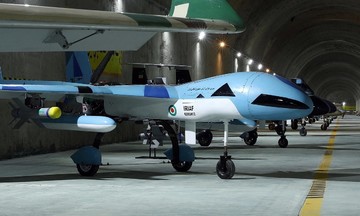
Rubikon Center, an elite unmanned aerial vehicle (UAV) unit of the Russian Ministry of Defense, released a video today showing a suicide unmanned aerial vehicle flying along a parking apron at Kanatovo military airfield, east of Kropyvnytsky, the capital of Kirovograd province in central Ukraine, earlier this week.
The aircraft targeted an object resembling an F-16 fighter jet, located in a fortified area. "The attack destroyed an F-16ADV fighter aircraft model, used for training Ukrainian technicians," Rubikon Center stated.
The Ukrainian military has not commented on this information.
Kanatovo airfield is approximately 170 km from Russian-controlled territory in Kherson province.
Russian forces have repeatedly deployed unmanned aerial vehicles to attack targets in Kirovograd province. The most recent incident occurred on 24/1, when two Geran suicide aircraft struck Ukrainian Mi-24 and Mi-8 attack helicopters parked at a field airfield south of Malaya Viska settlement, approximately 230-240 km from the front line.
"Such attacks could force the Ukrainian air force to retreat further west. Russian unmanned aerial vehicle operators achieve this with relatively inexpensive equipment," commented Iznanka, a social media account linked to the Russian military.
Serhiy Beskrestnov, an electronic warfare expert and advisor to the Ukrainian Ministry of Defense, believes Russia used Geran-2 models controlled directly in real-time via Starlink satellite internet connection. This method provides them with high jamming resistance and allows them to fly continuously at low altitudes to evade Ukraine's air defense network.
Russian media reported that their military previously used expensive missiles to attack Ukrainian aircraft in Kirovohrad province. Remotely controlled unmanned aerial vehicles using Starlink connections allow Russia to hunt enemy aircraft in real-time, blurring the concept of a "deep rear."
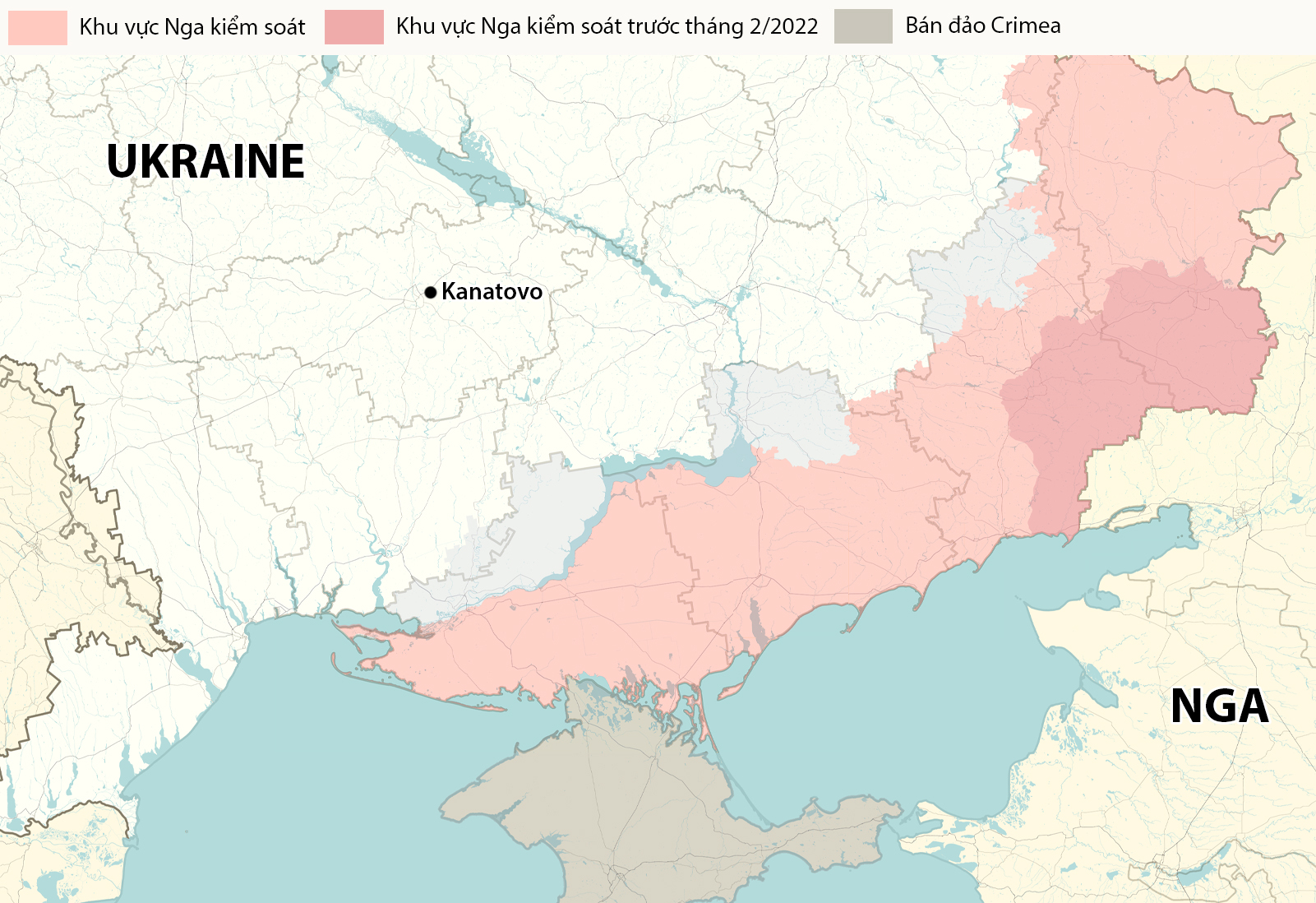 |
Location of Kanatovo airfield. Graphic: RYV |
Ukraine has lost at least four F-16s since it began operating the fighter jet in 8/2024. The Russian military has also repeatedly used suicide unmanned aerial vehicles and ballistic missiles to strike the bases of Ukraine's F-16 fleet. The Ukrainian air force command implicitly acknowledged airfield strikes but refused to disclose damages.
Beyond attacks on their bases, Ukrainian F-16s frequently face Russian interception fire during nearly every sortie. The most dangerous threats include MiG-31, Su-35S fighter jets and Su-57 stealth fighter aircraft. "They can patrol at high altitudes, waiting for us to appear before launching an attack," a Ukrainian pilot stated.
The threat from Russian fighter jets compels Ukrainian F-16s to fly low, close to the ground. This tactic allows Ukrainian fighter aircraft to utilize terrain masking and limit direct line-of-sight to Russian fighter jet radar and air defense systems. However, this significantly reduces radar observation capabilities and weapon range, also making the aircraft less maneuverable against incoming missiles.
Nguyen Tien (According to RIA Novosti, AP, AFP)