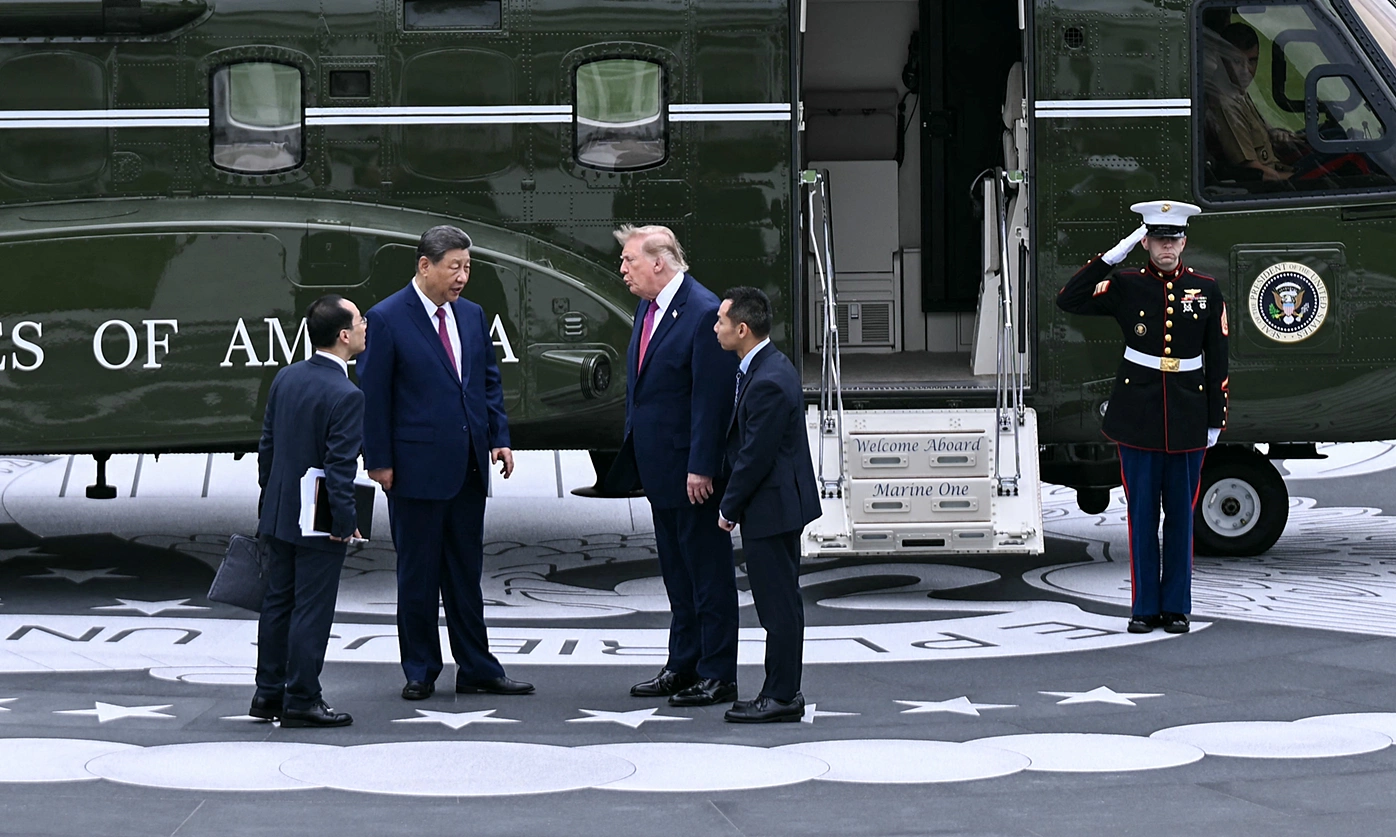
Subtle touches, laughter, and firm handshakes marked the start of the summit between Chinese President Xi Jinping and US President Donald Trump in Washington on 23/9.
While no groundbreaking results were announced after the discussions, the diplomatic rituals and communication gestures between the leaders of the two superpowers garnered significant attention.
President Trump extended the most formal courtesies to President Xi, personally greeting him at the airport. He welcomed the Chinese president at the White House with military honors before their talks, followed by a state dinner featuring toasts and "homegrown" ice cream.
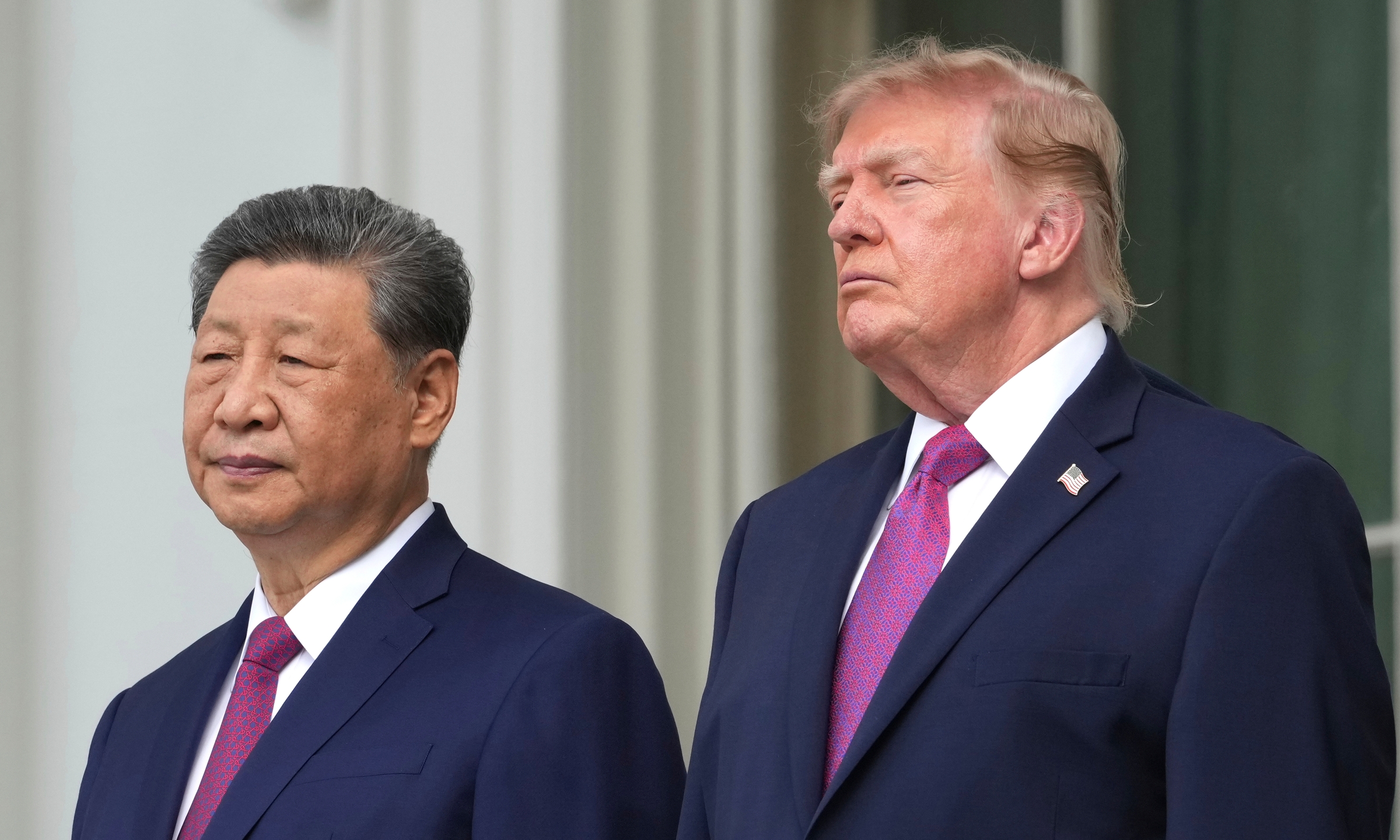 |
US President Donald Trump and Chinese President Xi Jinping watch military aircraft fly in formation over the White House during the welcoming ceremony on 24/9. Photo: AP
Patti Wood, a body language expert at Emory University, US, suggested that the handshakes and speeches by Presidents Trump and Xi conveyed an unspoken rivalry for status between the leaders of the two global powers.
Their interactions began with a rare arrival ceremony at Andrews Joint Base on 23/9, where President Trump personally met President Xi at the foot of the aircraft stairs. Trump displayed warmth during this symbolic gesture, slightly tilting his head while interacting with President Xi, an action indicating approachability and a willingness to listen.
When greeting and shaking hands with First Lady Peng Liyuan, Trump leaned forward, creating a warm and less rigid atmosphere.
Wood noted that throughout the ceremony, President Xi maintained a natural posture and gait. "I did not see him change anything from his usual demeanor during previous foreign visits", Wood said.
US President Donald Trump welcomes Chinese President Xi Jinping at Andrews Joint Base on 23/9. Video: Reuters, CNA
"This demonstrates confidence, not being intimidated by the host", the body language expert remarked. Maintaining his usual dignified demeanor was also a way for President Xi to assert equal status with the US.
Lillian Glass, author of several books on communication in the US, observed that the most interesting body language occurred when the two leaders walked together. Presidents Trump and Xi often walked close to each other, sometimes slightly turning their upper bodies towards the other while moving. Instead of maintaining distance, their movements indicated a relaxed and proactively interactive style.
The unspoken message from the handshakes
At the White House reception on the morning of 24/9, the atmosphere became more formal, as Trump sought to assert his position as the "master of the game".
When the two leaders met at the White House, President Xi slightly bowed his head, following Chinese cultural tradition. President Trump, however, immediately extended his hand for a handshake without reciprocating the bow, Wood noted.
She described this welcome as distinctly "Trump style", seemingly paying little heed to diplomatic protocols, etiquette, or Chinese cultural norms.
"President Xi maintained a composed and formal demeanor, completely unaffected by Trump's actions", Wood commented. "There was no indication he was impacted or rattled by them".
During the handshake, Trump lightly patted President Xi's bicep. According to Wood, repeatedly patting someone's hand or back is characteristic of the US President's greeting style, signifying a superior position and implying "I am on a higher level".
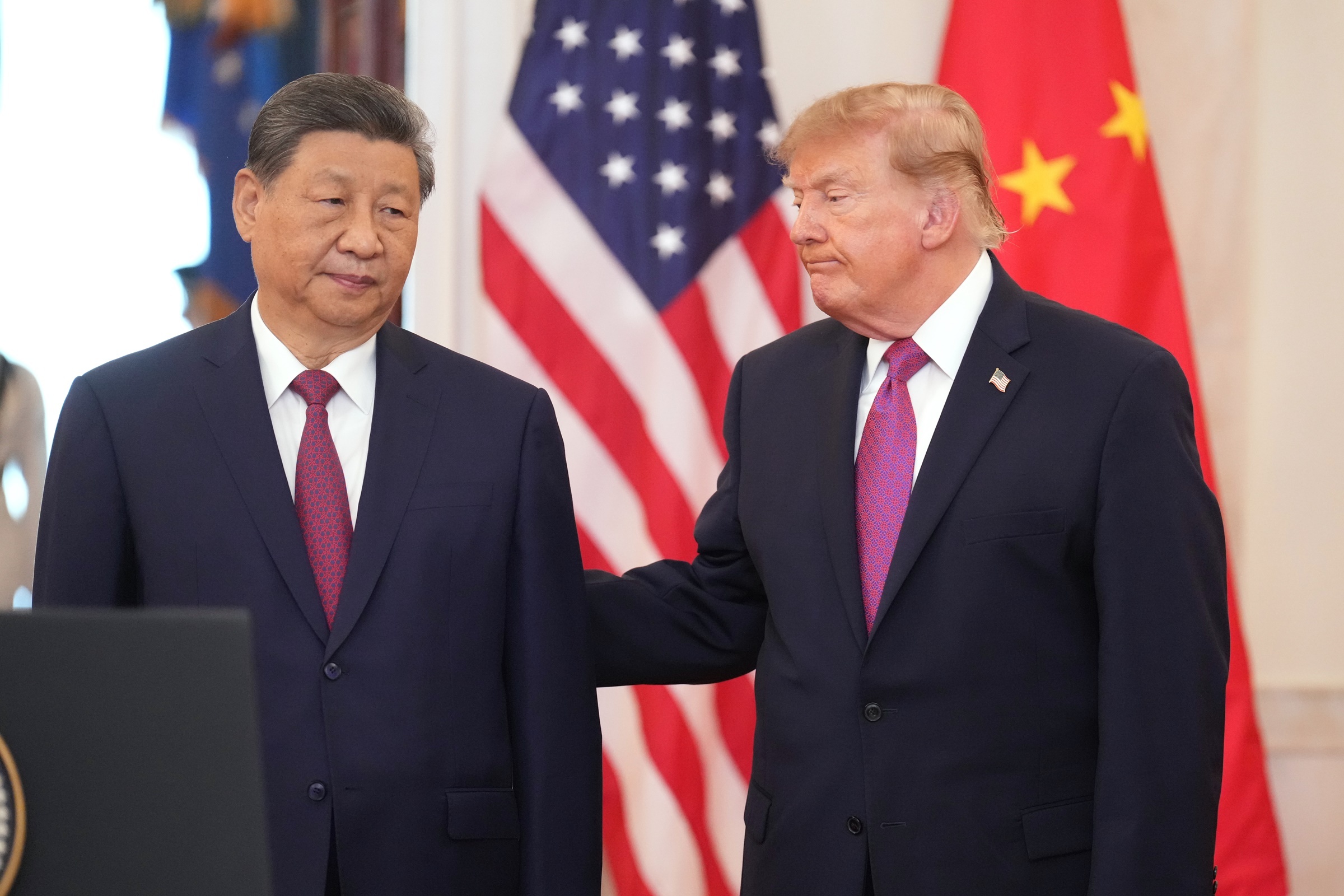 |
Trump pats President Xi's back during the welcoming ceremony in the Grand Foyer of the White House on 24/9. Photo: AP
She explained that a back pat in US culture is sometimes seen as a warm and friendly gesture, but this only holds true if the two individuals have a close personal relationship. In formal or non-private settings, such an action still implies asserting dominance over the other person.
However, cameras also captured President Xi reciprocating with a light pat on President Trump's back.
Wood suggested this handshake was "like a symbolic rivalry", further explaining that President Xi's back pat was a way to neutralize any perceived assertiveness from his counterpart.
Another moment that drew attention was when President Trump led President Xi along a White House corridor, stopping at the Presidential Hall of Fame, where both leaders viewed framed photographs.
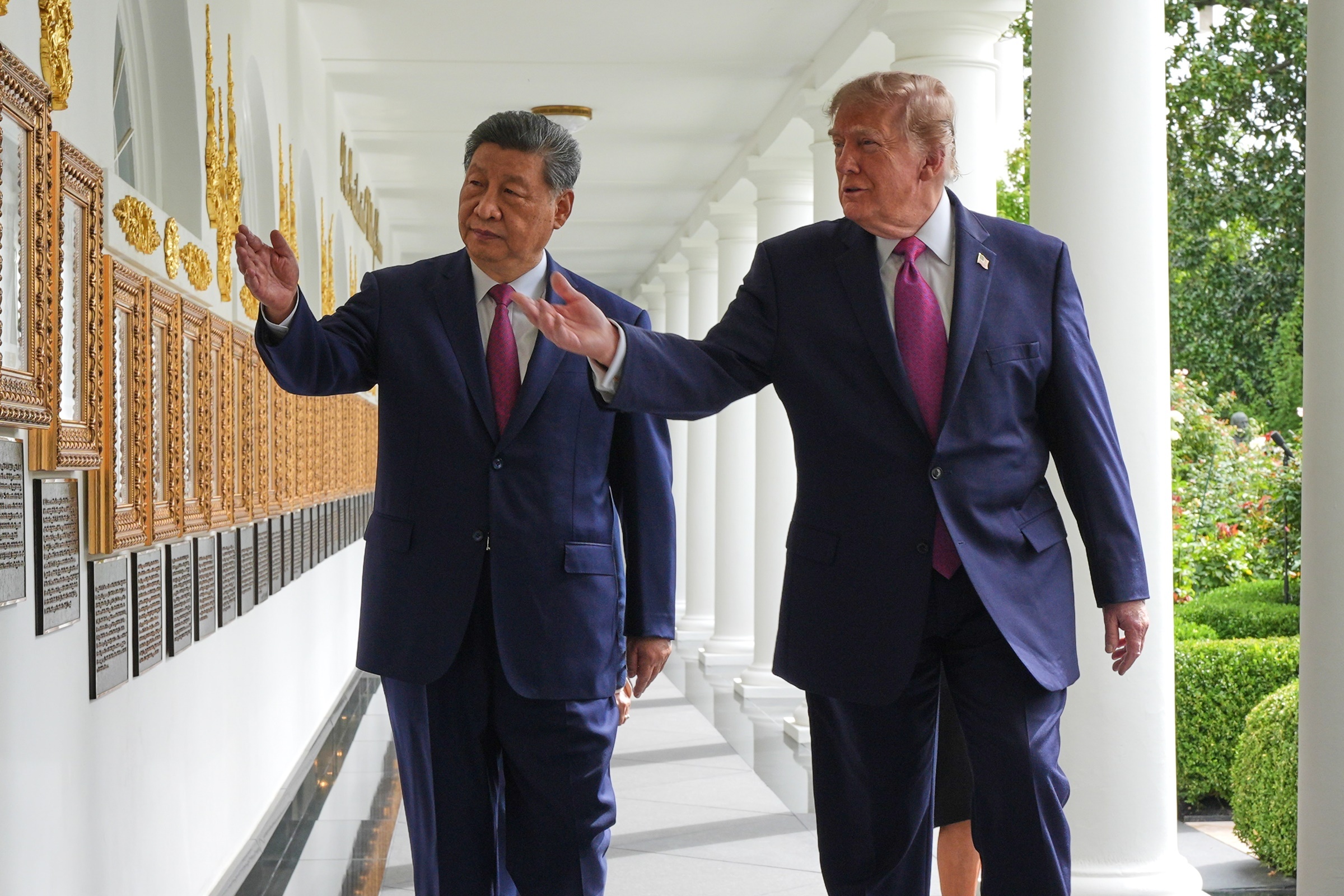 |
Trump and Xi walk along a White House corridor on 24/9. Photo: AP
Trump pointed to his own portrait, then to the spot for former president Joe Biden. However, that position did not display a photo of Biden but rather an automatic signing pen.
President Trump had often stated that this automatic signing pen, not Biden, truly ran the country. President Xi chuckled during that interaction, while Trump continued to lightly tap the Chinese President's elbow, seemingly showing satisfaction.
President Xi laughs as Trump introduces a signing pen as the representation for former president Biden. Video: Youtube/Diario AS
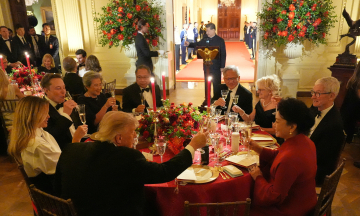
On the evening of 24/9, President Trump hosted a state dinner for President Xi at the White House. The event brought together leading technology executives: Nvidia CEO Jensen Huang, Meta CEO Mark Zuckerberg, Apple Chairman Tim Cook, SpaceX and Tesla CEO Elon Musk, and OpenAI CEO Sam Altman.
Speaking at the dinner, Trump addressed the tech moguls, recalling the milestone when Chinese diplomats first visited the US 158 years ago to meet intellectuals like Henry David Thoreau and prominent US political figures.
"Tonight, we revive the spirit of that first encounter on US soil as we gather with today's leading figures in business, culture, and government", he stated.
Trump and Xi watch a military performance at the White House. Video: Ivory
The US President also praised his relationship with the Chinese leader. "President Xi and I both understand that both sides represent different systems, but the bond between our two peoples remains strong, and we have never been more harmonious", he declared.
At the dinner, President Xi also mentioned that the talks with President Trump during the visit had achieved "common ground on many issues", suggesting Washington and Beijing should seek a new method of cooperation.
President Xi did not deny the competitive situation between the two superpowers, but emphasized they must "demonstrate the role of responsible major powers". The two phrases he mentioned during the talks and reiterated at the state dinner were: "constructive and stable".
According to BBC analyst Laura Bicker, these "warm" words from President Xi also conveyed the message that China stands on equal footing with the US, and both sides need to manage this relationship in a balanced way.
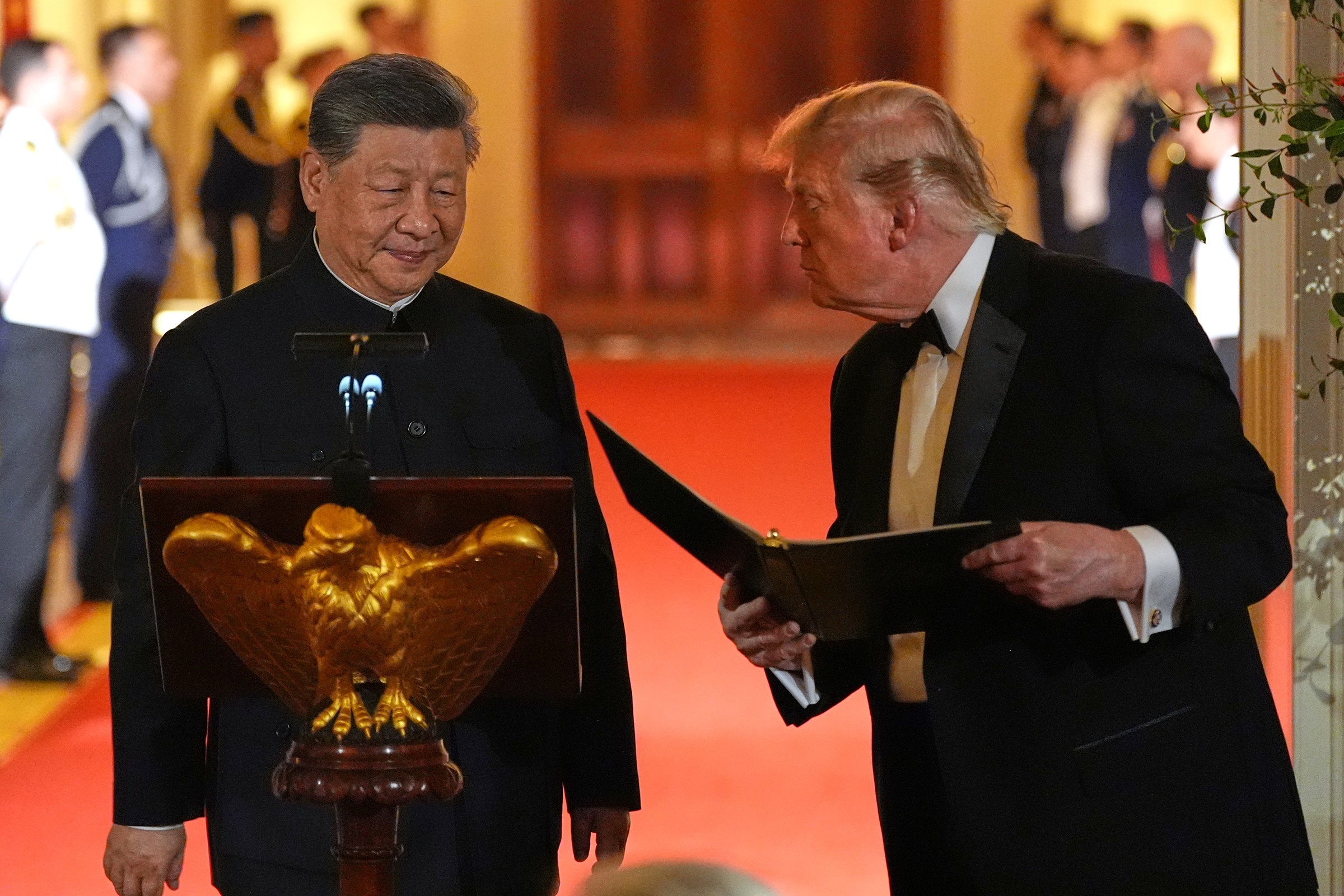 |
President Trump converses with President Xi during the state dinner in the East Room, White House, on the evening of 24/9. Photo: AP
Despite the friendly demeanor displayed by both leaders, experts remain skeptical about the US and China reaching lasting, stable agreements on a range of issues.
In the artificial intelligence (AI) race, the US has imposed strict export controls on chips, semiconductors, software, and chip manufacturing equipment to slow China's development.
US Treasury Secretary Scott Bessent stated that the tariff truce agreed upon by Trump and Xi in Korea last year, originally set to expire in november, has been extended until february next year.
According to Robert Tait, a commentator from the Guardian, the extension indicates Trump remains unsatisfied with trade concessions from President Xi. It also suggests a desire to maintain pressure for a better deal if the two leaders meet again at the G20 summit in Miami in december. China is on track to record a 1 trillion USD trade surplus with the US for the second consecutive year.