US Secretary of Defense Pete Hegseth announced the establishment of the Autonomous Warfare Command (AutoWarCom) on 30/9, stating, "The pace of war is changing faster than support processes."
AutoWarCom will focus on developing and providing autonomous weapons and artificial intelligence (AI)-integrated robotics for the US military. The command will be led by a four-star general, indicating its critical role in future US military operations.
Hegseth emphasized, "The revolution in autonomous systems and robotics significantly impacts equipment, doctrine, organization, and assumptions that have governed combat operations for decades. Enduring change must be integrated into the military command structure."
 |
Hegseth speaking at Quantico base in Virginia, US on 30/9. Photo: AP |
Secretary Hegseth highlighted lessons from the Ukraine conflict as a key motivator for establishing AutoWarCom. He noted that the supporting initiative, named Agincourt, will streamline the new command's operations and overhaul how the US military procures, tests, and deploys unmanned vehicles, including drones, and similar weaponry.
He added, "Affordable computing power, artificial intelligence, and advanced commercial manufacturing have made high-precision, low-cost strikes widespread."
During his "State of the Force" address, Secretary Hegseth also revealed other organizational changes, including the creation of an office for religious affairs.
The US rarely establishes new commands, with the most recent being Space Command in 2019. The US military currently operates 11 combatant commands, each responsible for distinct missions and global regions.
AutoWarCom's establishment reflects the Pentagon's strategic shift from costly conventional weaponry to more affordable, AI-integrated autonomous systems, which have demonstrated effectiveness in recent conflicts, such as the war in Ukraine.
Facing conventional military superiority from Russia, Ukraine has increasingly utilized unmanned systems for reconnaissance and attack missions. These systems enable remote target engagement and reduce risks to soldiers, with drones estimated to be responsible for 70% of Russian forces' casualties.
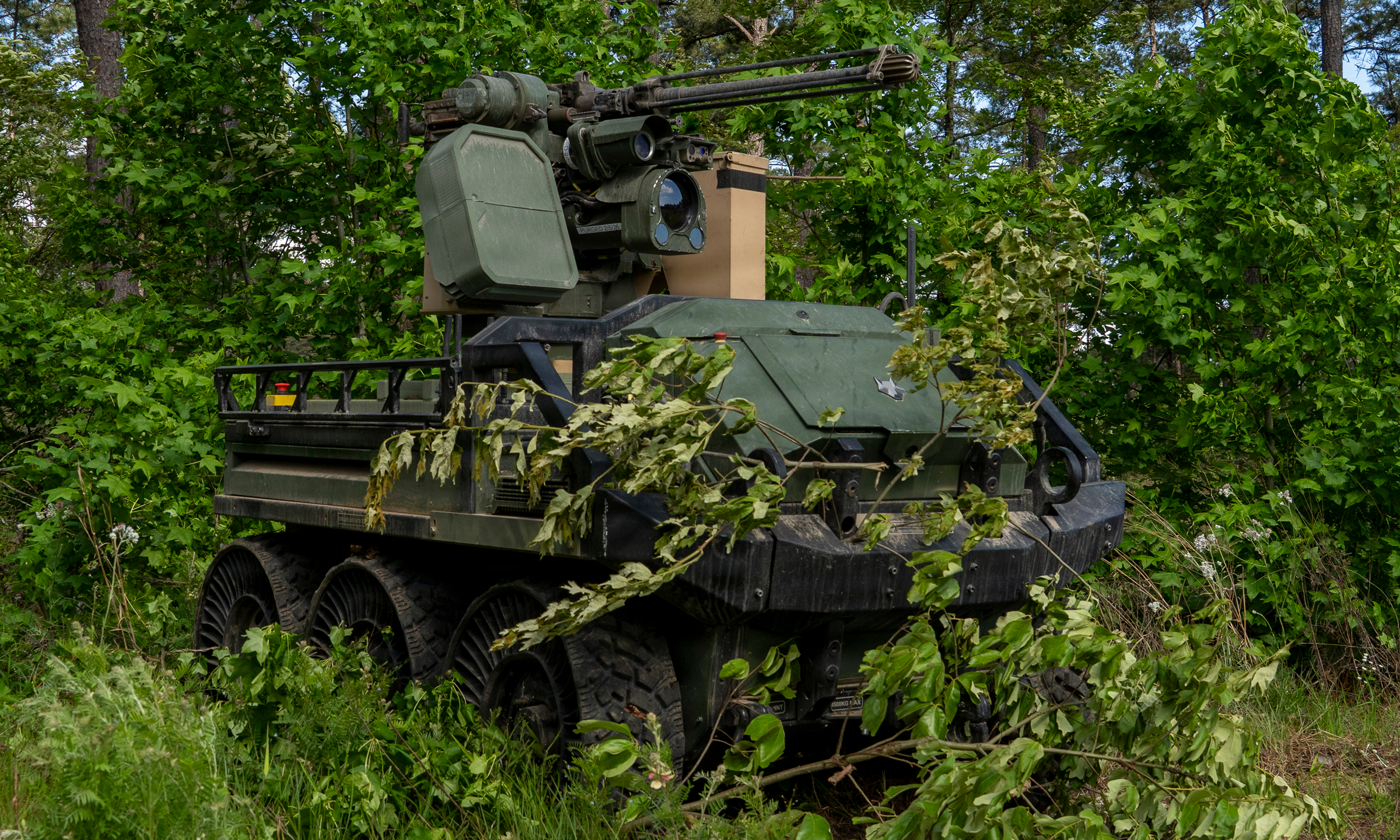 |
US Hunter Wolf ground drone during an exercise at Fort Polk in Louisiana in April. Photo: US Army |
For years, the US military has acquired some of the world's most expensive systems, supported by a substantial defense budget. However, the Pentagon acknowledges this approach is unsustainable. Hegseth stated, "We need both quality and quantity."
In recent years, the Pentagon has made strides in drone technology, including the establishment of a dedicated force to counter these vehicles.
By Pham Giang (Reuters, CNN)