


The 25-page 2026 National Defense Strategy (NDS) document, released by the Pentagon on 23/1, outlines a significant shift in US defense policy. It states: "As US forces focus on national homeland defense, with an emphasis on the Indo-Pacific region, our allies and partners elsewhere will assume primary responsibility for their defense. US forces will continue to play a vital, but more limited, supporting role."
This shift extends to the Korean Peninsula. The US states that "South Korea is capable of assuming key responsibility for deterring North Korea, with significant but more limited support from the US."
The NDS explicitly states: "This adjustment in the balance of responsibility aligns with US interests in modifying the deployment of US forces on the Korean Peninsula."
The US currently maintains 28,500 troops in South Korea under a joint defense mechanism to counter military threats from North Korea. Seoul has also increased its defense budget by 7.5% this year.
In the Indo-Pacific region, the Pentagon's focus is on ensuring that China cannot dominate the US or its allies.
The Pentagon document emphasizes: "This objective does not necessitate a life-or-death war. Instead, a stable peace, with conditions favorable to the US yet acceptable to China, is entirely achievable."
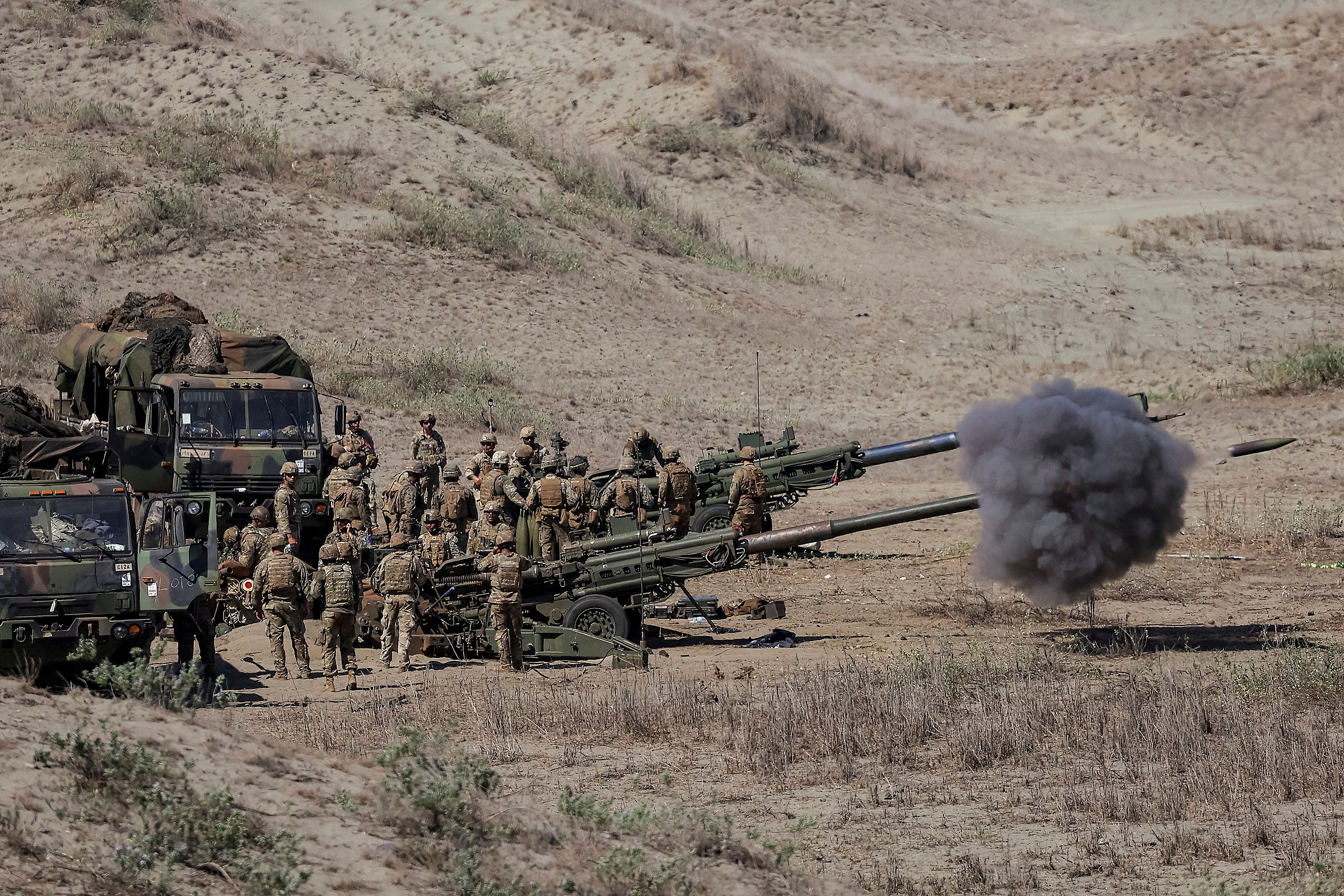 |
US soldiers during a joint exercise with the Philippines in Laoag city, Ilocos Norte province, Philippines in 5/2024. Photo: Reuters |
Regarding Iran, the NDS notes the country recently "suffered setbacks" but is working to rebuild its military and remains open to "resuming tests to acquire nuclear weapons." The document suggests that even as US troops are deployed to the region, "model ally" Israel could be further empowered to defend itself.
For Europe, the US assesses Russia remains a "persistent, but manageable threat" to NATO member states on the eastern flank. The document asserts that NATO allies possess superior strength and are therefore "well-positioned to bear primary responsibility for conventional defense in Europe."
The Pentagon plans to offer President Trump options to "ensure US military and commercial access to critical regions" in various parts of the world, including Greenland.
US President Donald Trump recently angered NATO members by stating he would control Greenland, an autonomous territory of Denmark. However, in a speech in Davos this week, Trump somewhat assuaged European allies by pledging not to use force to acquire the island.
The NDS, a crucial policy-shaping document released by each new US administration, is based on the National Security Strategy (NSS) Trump unveiled last year. The NSS outlined that the US would reassert its dominant position in the Western Hemisphere, build military strength in the Indo-Pacific, and potentially reassess its relationship with Europe.
Trump's National Security Strategy had generated strong opposition from European countries by stating that the continent faced the risk of "civilizational obliteration" and could someday lose its status as a reliable US ally.
The Trump administration's NDS is reportedly softer in tone regarding Russia and China compared to the Biden administration's strategy. Under President Joe Biden, the NDS described China as the most serious challenge to Washington and Russia as an "acute threat."
This new document also criticizes the previous administration for neglecting border security, linking it to "waves of illegal immigrants" and widespread drug trafficking.
Consequently, the strategy asserts: "Border security is national security. Therefore, the Pentagon will prioritize efforts to secure borders, repel all forms of infiltration, and deport illegal immigrants."
Huyen Le (According to AFP, Reuters)



