Japan's Ministry of Health, Labour and Welfare announced on 30/11 that a total of 6,244 foreign workers sustained serious injuries requiring 4 or more days off work or died due to workplace accidents in 2024. This marks the highest number ever recorded. The number of fatalities from workplace accidents also reached a record 39 individuals.
Among these incidents, vietnamese workers experienced the highest number of accidents, with 1,594 cases. They were followed by filipino workers with 878 cases, indonesian workers with 757 cases, and brazilian workers with 673 cases.
Most accidents occurred in the manufacturing sector, totaling 2,979 incidents, followed by the construction industry with 1,165 incidents. The most common type of accident involved workers getting caught or entangled in machinery, accounting for 1,441 cases. Falls were the second most frequent cause, with 797 cases.
The number of foreign worker casualties from workplace accidents has risen annually since 2019, when the Ministry of Health, Labour and Welfare adopted its current statistical method. At that time, the figure was below 4,000.
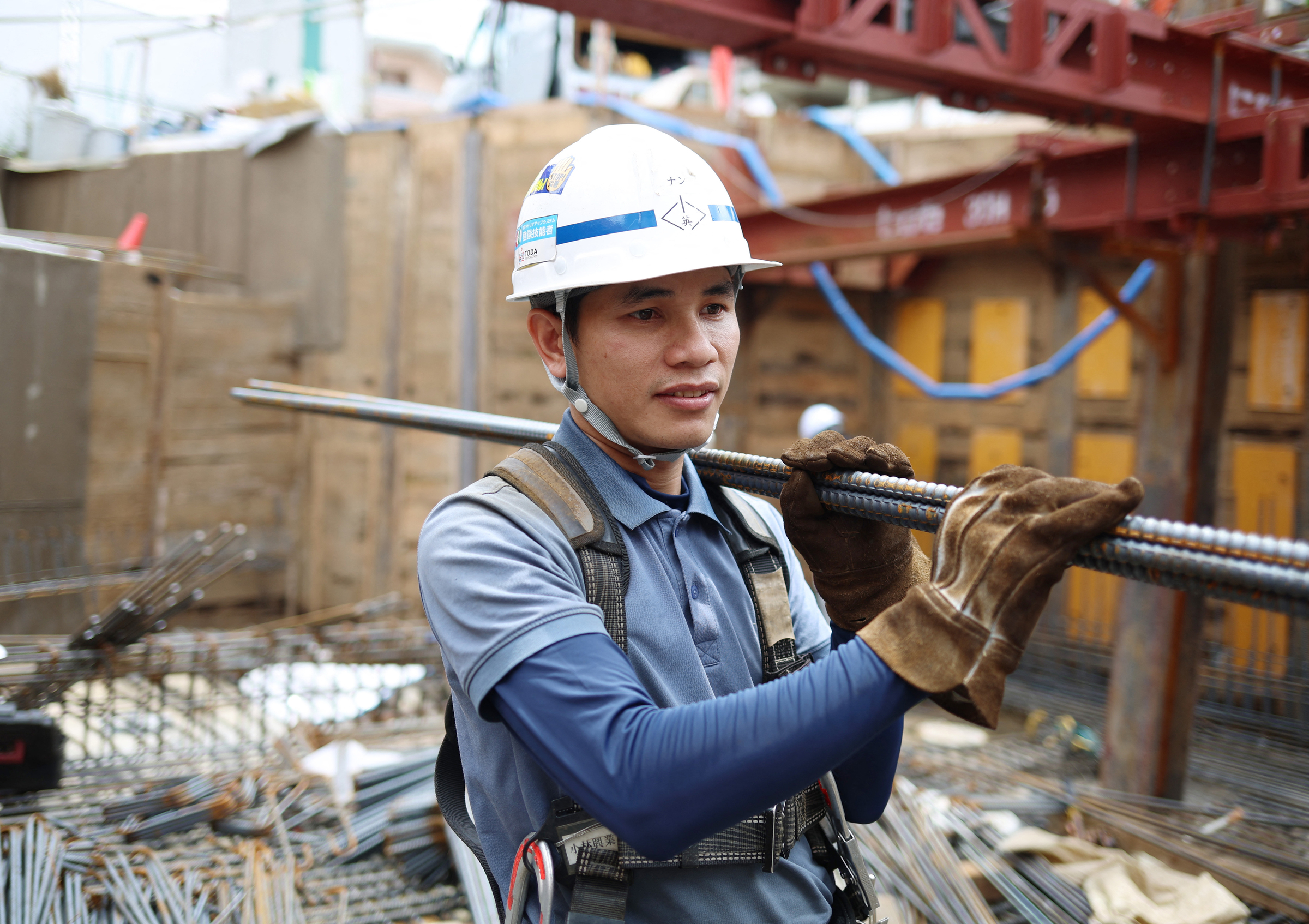 |
Vietnamese workers at a construction site in Setagaya, Tokyo, japan's capital, in 2023. Photo: AFP |
The rate of workplace accidents per 1,000 personnel, including japanese workers, was 2,35. However, this rate increased to 2,71 when only foreign workers were considered. Technical intern trainees recorded an especially high accident rate of 3,98 incidents per 1,000 personnel. Specified skilled workers also registered a rate of 3,91 incidents per 1,000 personnel.
"A lack of safety training and communication issues are believed to be the causes of this increasing trend", a japanese Ministry of Health, Labour and Welfare official stated.
The japanese government aims to reduce the accident rate among foreign workers to below the national average. By 2027, at least one-half of all businesses are expected to provide workplace safety training programs.
Yoshihisa Saito, an associate professor at Kobe University, explained that foreign workers face a higher risk of workplace accidents because technical intern trainees and specified skilled workers often undertake jobs considered hazardous.
"They are recruited with limited japanese language proficiency. Many may not even be able to apply for workers' compensation without support", Saito noted.
Duc Trung (According to Kyodo, Mainichi)