The United States is prioritizing a diplomatic approach to resolving its tensions with Iran, according to White House envoy for Middle East affairs Steve Witkoff. Speaking at a seminar hosted by the Israel-America Council in Florida on 15/1, Witkoff revealed that President Donald Trump had sent a warning signal to Iran and ordered advisors to directly contact officials in Tehran to discuss the ongoing protest situation in the Middle Eastern nation.
When asked about the next steps, envoy Witkoff stated the US favors diplomatic solutions over military ones. "I hope a diplomatic solution can be achieved on four key issues," he said.
Witkoff believes Iran may be willing to compromise on these four aspects: its nuclear program, its ballistic missile arsenal, the amount of enriched nuclear material Tehran possesses, and the Iran-backed proxy militias in the region.
"If they want to reintegrate into the international community, and we can resolve those four issues diplomatically, that would be an excellent solution. The alternative would be a bad option," Witkoff said, apparently hinting at a scenario of US military intervention in Iran.
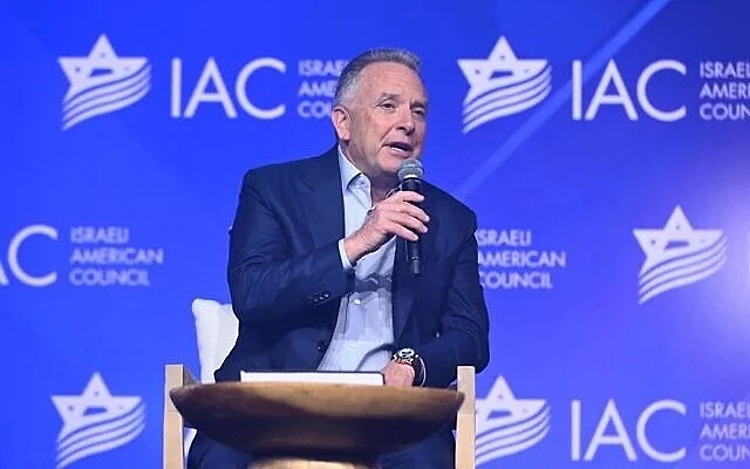 |
White House envoy for Middle East affairs Steve Witkoff speaks on 15/1 in Florida. *Photo: IAC*
Iran has not yet commented on the statement. Tensions between Washington and Tehran escalated amid concerns over protests occurring in Iran since late last year. Iranian officials stated at least 109 security force members were killed, but have not released statistics on casualties in the protests. Meanwhile, human rights groups claim at least 2,677 people have died. President Trump had previously warned of potential intervention in Iran if more protesters were killed.
By 15/1, protests in Iran appeared to have subsided. In the capital Tehran, witnesses reported recent mornings showed no signs of fires set the previous night or bricks and stones on the streets.
Diplomatic sources revealed Egypt, Oman, Saudi Arabia, and Qatar had, in the past 48 hours, attempted to convince US President Donald Trump that a military intervention in Iran would shake the global economy and destabilize an already volatile region. This effort reportedly led Trump to cancel a planned attack on Iran at the last minute. Meanwhile, military sources indicated at least one US aircraft carrier was still en route to the Middle East, apparently poised for action if Trump issued a new order.
During an emergency meeting at the United Nations Security Council on 15/1, Iran's deputy ambassador to the UN, Hossein Darzi, sharply criticized Washington for "directly engaging to escalate unrest in Iran into violence." He further stated, "Under the false pretext of concern for the Iranian people and human rights declarations, the US is attempting to portray itself as a friend of the Iranian people, while laying the groundwork for political instability and military intervention under humanitarian rhetoric."