Bridgestone has spent 18 years researching and developing highly practical airless tires. After multiple generations of testing, the global tire manufacturer announced the technology is now ready. However, mainstream consumers won't be able to purchase these tires soon, as their initial commercial application is far from the definition of a high-performance model.
Bridgestone is deploying its new AirFree tires on a fleet of autonomous vehicles in Higashiomi, Japan. These elongated vehicles, similar to golf carts, are used to transport elderly residents around the town. Consequently, the tires are not subjected to excessive operating pressure. This deployment marks the first time AirFree tires have been integrated into daily commercial service, moving beyond limited-time trials.
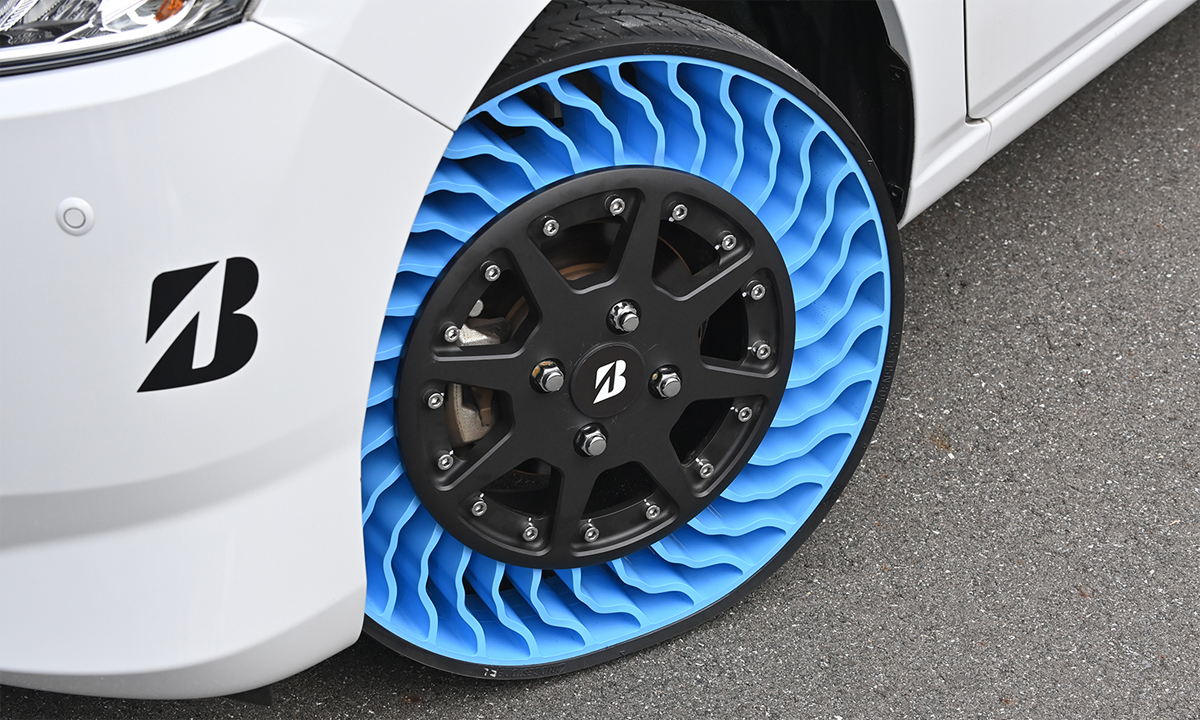 |
Bridgestone's airless tires have been researched and developed over the past 18 years. *Photo: Bridgestone*
An 18-Year Development Journey
Bridgestone developed its first airless tire in 2008 and introduced the third-generation version in 2023. The technology currently used on vehicles in Japan is the culmination of 18 years of continuous refinement. Rather than relying on rigid materials that could compromise ride comfort, AirFree tires incorporate a recyclable compound. This material is durable enough to handle daily loads without causing uncomfortable jolts for passengers.
The tire's structure features thermoplastic spokes, encased by a thin rubber tread that makes contact with the road. Masaki Ota, a Bridgestone engineer, stated that the breakthrough came when the development team ceased attempts to rigidify the material. Instead, they opted for a flexible plastic and a structure designed to distribute load more evenly across the entire tire.
Not Yet for Mainstream Cars
During a media demonstration earlier this week, vehicles equipped with the airless tires operated at a maximum speed of approximately 20 km/h. According to Nikkei Asia, these tires are currently only suitable for relatively slow-moving vehicles.
Consequently, AirFree tires cannot yet completely replace traditional rubber tires on mainstream automobiles. Until this technology achieves its next significant advancement, airless tires will be limited to low-speed vehicle fleets operating in controlled environments.
Regarding aesthetics, Bridgestone refers to the tire's color as "Empowering Blue". The company stated that this vibrant shade was selected to improve visibility during both daytime and twilight hours.
Bridgestone has not yet committed to a mass production timeline. The company is exploring a business model that combines tire sales with accompanying services, such as recycling. Furthermore, Bridgestone is developing tires for lunar autonomous vehicles, featuring a metal structure based on the AirFree design.
Michelin's airless tires during testing. *Video: Michelin*
Globally, Bridgestone is not the sole company researching and developing airless tires, which represent one of several puncture-proof technologies for automobiles. Hankook, a South Korean tire manufacturer, previously showcased this technology at the CES 2022 Consumer Electronics Show with its i-Flex concept, integrated with Hyundai's Plug&Drive module.
Prior to this, in 6/2019, Chevrolet tested Uptis airless tires on its Bolt EV electric vehicle. Uptis was a joint development by Michelin and General Motors.
My Anh