Traffic police recently announced plans to fine drivers failing to maintain safe distances on the North-South Expressway, specifically the Phap Van to Nghi Son section. This initiative has raised concerns among drivers, who find it challenging to consistently maintain safe distances due to other vehicles frequently "filling the gap." A key question arises: how will fault be determined if a reduced distance leads to a collision?
The Traffic Police Department clarified that a driver whose safe following distance is encroached upon by another vehicle does not automatically constitute a violation. In such situations, authorities will use surveillance camera systems, road signs, and professional investigative measures to determine the circumstances.
To illustrate this, Lawyer Dang Thanh Chung of the Hanoi Bar Association presented a scenario: Vehicle 1 maintains a safe, legal distance from Vehicle 3. Vehicle 2 then abruptly cuts in between them. If Vehicle 2 brakes suddenly, causing Vehicle 1 to collide despite an immediate reaction, how would responsibility be assigned?
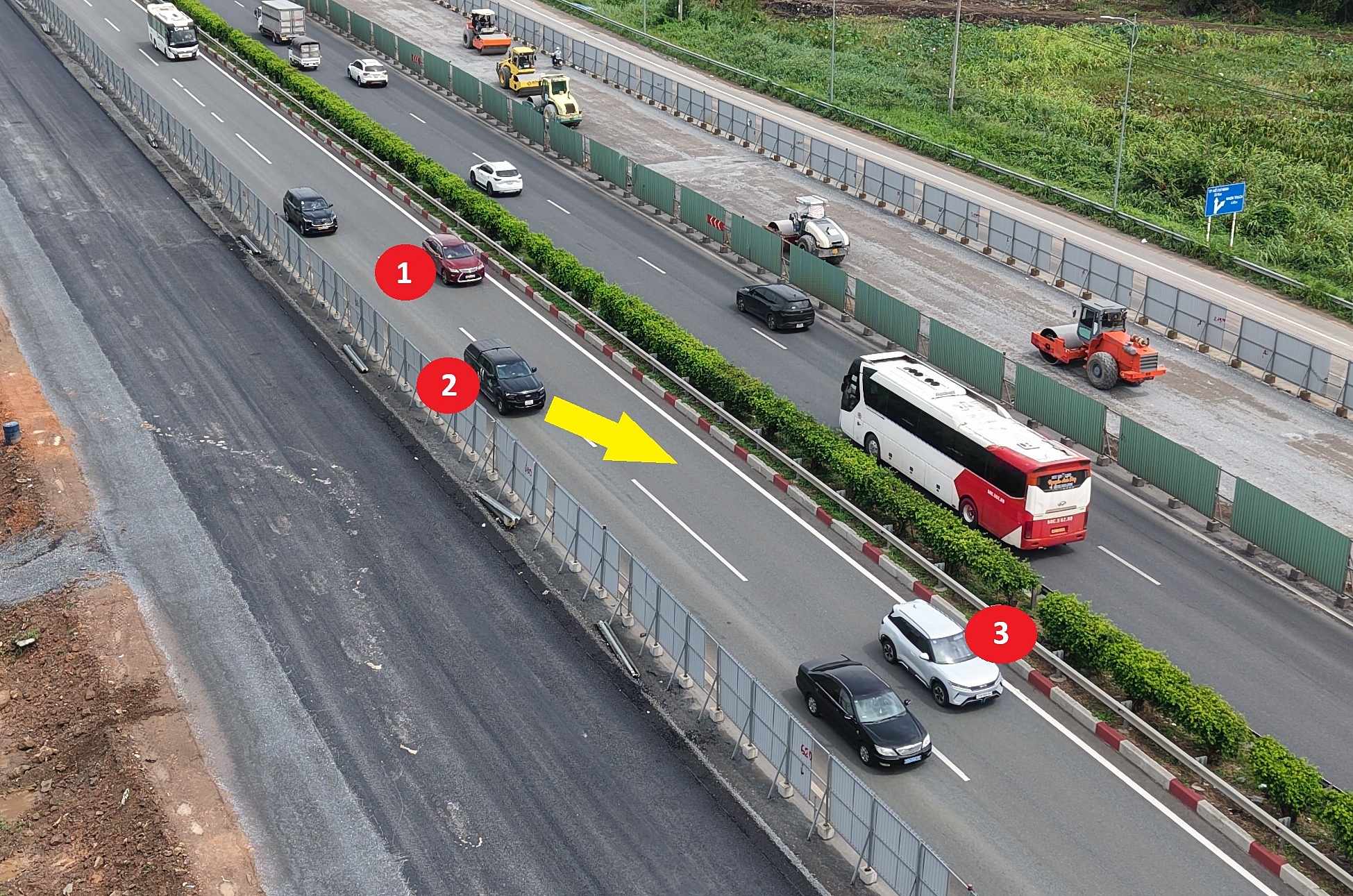 |
Hypothetical scenario: vehicle 2 fills the gap. Photo: Tran Quynh
According to the Road Traffic Order and Safety Law 2024, vehicles changing lanes must maintain a safe distance from other vehicles. This distance can vary based on the speed limit applicable to that expressway section. Therefore, Vehicle 2's action in the scenario, driving without complying with safe distance regulations from the vehicle immediately ahead on an expressway, is a violation.
If Vehicle 1's driver maintained the correct speed and reacted immediately by braking when the vehicle ahead braked, they should provide dashcam footage. This evidence, combined with traffic police information such as surveillance camera footage and traffic signs, will help determine any violations.
In this specific scenario, "filling the gap" is a violation of not maintaining a safe following distance. This means Vehicle 2 failed to maintain distance from Vehicle 3. Decree 168/2024 imposes fines of 4-6 million VND and deducts two points from a driver's license. If such an action causes a traffic accident, fines increase to 20-22 million VND, with 10 points deducted from the driver's license.
However, even without Vehicle 3, Vehicle 2 changing lanes too abruptly in front of Vehicle 1 could still constitute a lane change violation. Decree 238/2026, which amends and supplements Decree 168/2024, expands the offense's definition. It adds the phrase "or changing lanes without ensuring a safe distance from vehicles in front, behind, or to the sides" to the regulations on penalizing lane change violations. This decree became effective on 15/8.
This expanded regulation notably considers distance not only to the vehicle in front but also to vehicles behind and to the sides. Drivers cannot simply observe a gap ahead and immediately change lanes; they must also assess surrounding vehicles before maneuvering.
A passenger bus was penalized for failing to maintain a safe distance from the vehicle immediately ahead on the Hanoi - Hai Phong Expressway on 27/8. The driver was fined 5 million VND and had two points deducted from their driver's license. Video: Traffic Police Department
No specific quantitative regulations currently define unsafe lane changes regarding distance or time with respect to vehicles to the sides or behind. Traffic police will use recorded data and road signs for determinations. For example, if a vehicle changes lanes and causes vehicles behind it in an adjacent lane to brake suddenly to yield, this constitutes a failure to maintain a safe distance.
Pham Hai - Nguyen Vu