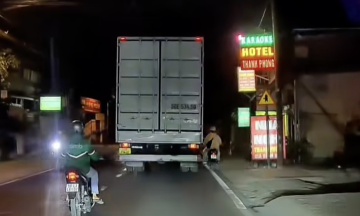
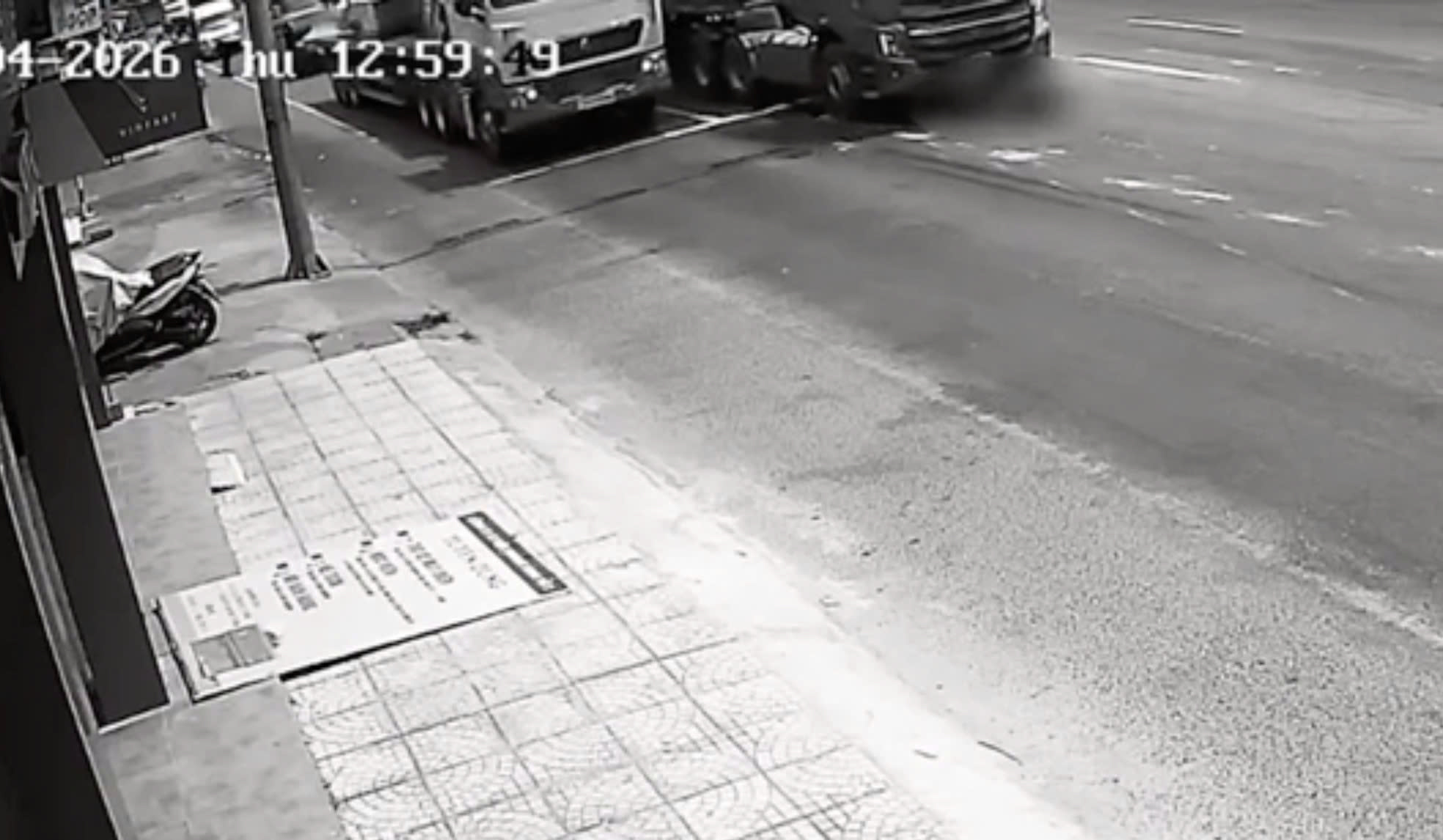
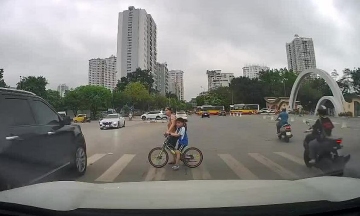
Across many streets in Vietnam, particularly in major cities, it is common to witness a familiar and unsettling sight: pedestrians standing precariously on white crosswalk lines, unsure whether to step forward or retreat, while streams of motorbikes and oto rush past just inches away. These painted lines, intended to protect vulnerable individuals, paradoxically become the most perilous spots, forcing pedestrians to negotiate passage with motor vehicles through hesitant glances, tentative steps, and sheer luck.
This scene repeats daily, to the point where many consider it a normal occurrence. However, this familiarity prompts a critical question: has the culture of yielding to pedestrians been overlooked in Vietnam's driver training, leading drivers to perceive crosswalks as mere decorative elements on the road, inconsequential whether present or absent?
When priority crosswalks become merely symbolic
Legally, pedestrians have priority when crossing at marked crosswalks. Morally, they represent the most vulnerable group in traffic. Yet, in practice, this priority is often inverted. Pedestrians must wait for vehicles, dodge them, or quickly advance or retreat, while motor vehicles rarely slow down, sometimes even accelerating to pass.
This absurdity not only creates danger but also a sad paradox: those who adhere to the law are the most fearful. White crosswalk lines, symbols of safety, transform into tests of courage. This is not merely an issue of a few irresponsible individuals; it reflects a systemic flaw in how we train, evaluate, and perceive driving.
Yielding – absent in driver training
In popular thought, a good driver is considered "skilled": precise steering, smooth gear changes, efficient overtaking, and agile maneuvering. Yielding is often regarded as a personal moral act; it is good to do, but not doing so is perceived as having no impact on one's driving competence. This is a dangerous misconception.
In reality, yielding to pedestrians is as crucial as braking or steering. It is a vital reflex, because a decision not to yield for just a few seconds can result in severe injuries or even loss of life. Unlike technical errors that can be corrected, errors in interacting with pedestrians often lead to irreversible consequences. Yet, paradoxically, this aspect is almost entirely absent from driver training and testing in Vietnam.
Driver training – heavy on technique, light on behavior
Driver training programs primarily focus on vehicle control skills. Content regarding traffic laws, driver ethics, and traffic culture is often relegated to theoretical study, learned solely for passing exams and achieving sufficient scores. Many learners merely need to recall correct answers, showing little concern for the underlying principles. When the sole objective is to pass the exam, the development of civil behavior habits is almost entirely sidelined.
Even during driver's license tests, yielding to pedestrians is rarely genuinely assessed. A learner may achieve a perfect score on the testing grounds, yet on the road, they might speed, cross lanes, and honk aggressively at pedestrians. Legally, they are still qualified drivers. This raises the question: qualified for what? For operating a machine, or for participating in a shared space with other human beings?
Yielding must be a core component of driver training and licensing
First, because it directly concerns human lives. There is no reason for such a vital aspect to be considered less important than parking techniques or hill starts.
Second, habits are most strongly formed during the initial learning phase. If drivers are trained to reflexively yield from the outset, this behavior will become natural on the road, rather than relying on later self-awareness.
Third, the licensing exam is the most important filter. Only when yielding directly impacts the pass or fail result will learners genuinely prioritize it. What is not graded is often overlooked.
Obtaining a driver's license is not merely a journey to acquire a card, but a process of shaping one's traffic character. Learners need to understand that each act of yielding is not a loss, but a choice to protect the lives of others and their own. A civilized society is not measured by the number of oto or the width of its roads, but by how the stronger treat the more vulnerable. When yielding to pedestrians becomes a natural, unprompted reflex, and when white crosswalk lines genuinely instill a sense of safety, only then can we truly speak of a proper traffic culture. And to achieve this, there is no other path than to begin right from the driver's seat.
Reader Bao Ngoc