In the multi-vehicle accident involving a dump truck on Thang Long bridge on the morning of 5/5, the most severe property damage was to a white Honda City, which was crushed from multiple sides. Fortunately, the three occupants—two female passengers and the male driver—were unharmed, sustaining only minor scratches.
Camera footage of the accident on Beltway 3 on 5/5. *Video: CTV*
Following the accident, traffic-related online communities questioned why the Honda City's airbags did not deploy to protect the occupants. Analyzing this issue, Car Awards judging experts stated that based on dashboard camera footage and post-collision photos of the car, the front airbags were not designed to activate in this specific type of incident, making their non-deployment technically reasonable.
Specifically, experts explained that the video and witness accounts indicate the car was initially pushed from behind, then spun sideways and dragged for tens of meters. Both sides of the car were squeezed between the dump truck and the small truck in front, while the front of the car only lightly grazed the adjacent SUV, experiencing no direct frontal impact.
Technicians explain that airbags use sensors to receive signals regarding impact force, angle, and acceleration. The central computer then analyzes this data to determine whether deployment is necessary. Airbags deploy at speeds up to 300 km/h in milliseconds, generating a powerful force that can disorient occupants, so they only deploy when essential.
In the video, the front airbags did not deploy due to the absence of a direct frontal impact. Similarly, any side airbags would not have deployed because this was a dragging collision, meaning the car was not suddenly struck with significant force from the side, like in a T-bone accident where one vehicle crashes directly into the side of another.
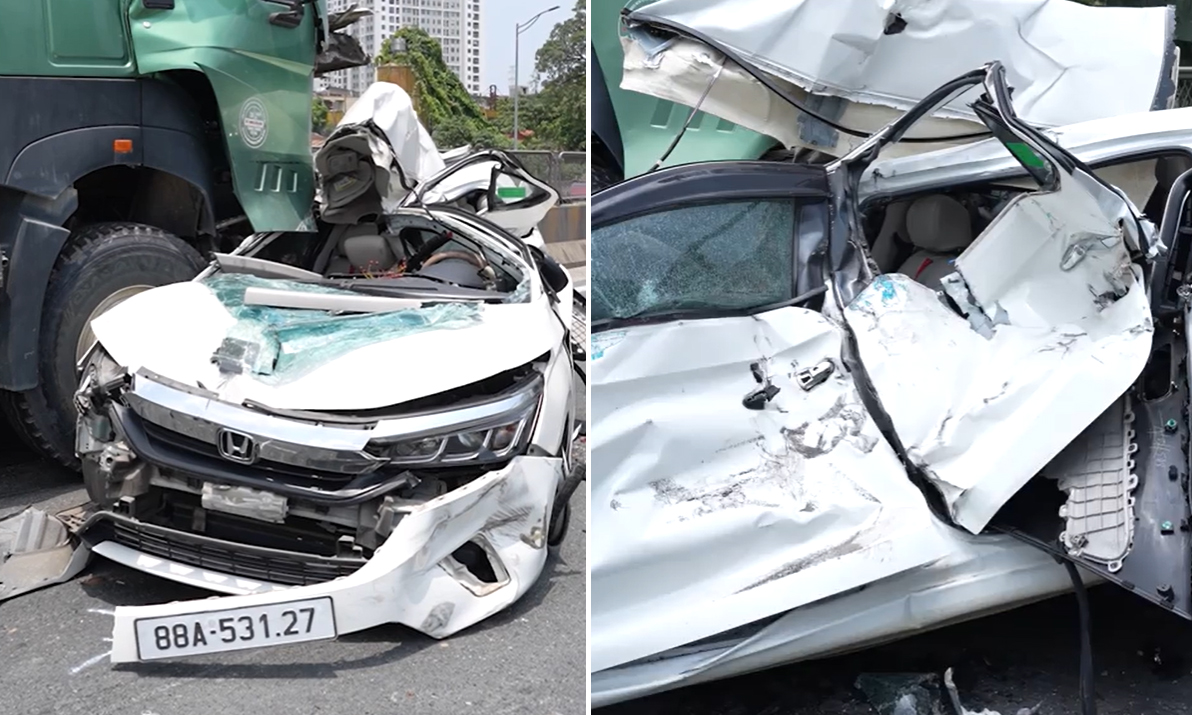 |
The front of the car remained intact, the sides were compressed, but the cabin maintained sufficient space. *Photo: Huy Manh*
Experts assessed that, in this particular scenario, the car's chassis system was sufficient to maintain a safe space within the cabin for the driver and passengers. In accidents involving dragging, multiple rolls, or multi-angle impacts, the chassis system is the most critical element for occupant protection, rather than airbags. Users can refer to the star ratings a vehicle receives from independent organizations, most notably NCAP (e.g., ASEAN NCAP, Euro NCAP), to understand the standards of each car's chassis system.
Minh Hy