At the announcement ceremony for "Vietnam Sustainable Business 2025", Deputy Prime Minister Ho Duc Phoc recognized the sustainable business community as a strong foundation for the national economy.
After committing to net zero emissions by 2050, Vietnam has consistently demonstrated proactive and responsible efforts in global climate change response, clearly embodying the spirit that "commitments must be fulfilled, and fulfillment must be effective".
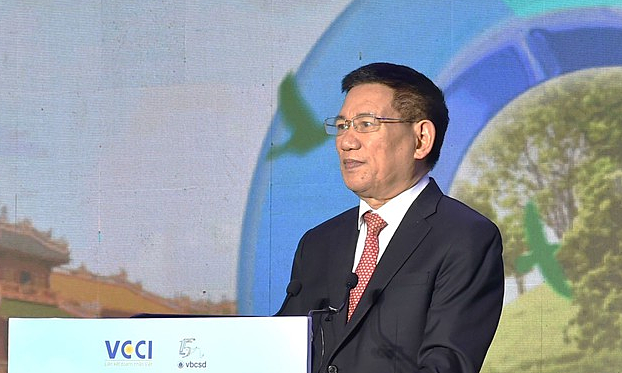 |
Deputy Prime Minister Ho Duc Phoc speaks at the event. Photo: VGP |
For example, Vietnam became one of the three first developing countries to implement the Just Energy Transition Partnership (JETP), attracting international investment for renewable energy and transmission infrastructure. Concurrently, the economy is undergoing a strong transformation towards sustainable development, aiming for green, circular, low-emission, and innovation-driven approaches.
The deputy prime minister urged ministries, sectors, and localities to collaborate closely with the Vietnam Chamber of Commerce and Industry (VCCI) to build a sustainable business community. Within businesses, a renewed mindset on sustainable development is essential, permeating from the highest leadership to every department. This thinking must be integrated from strategies and plans into business activities, investments, products, and services.
The government leader emphasized that sustainable development is a long journey, demanding perseverance and innovation from each business. This journey may start with difficulties, but it will "bear sweet fruit" in the long term, creating competitive advantages and resilience for businesses in the global marketplace.
The deputy prime minister requested businesses to integrate circular economy initiatives, environmental, social, and governance (ESG) assessments, and implement digital transformation alongside green transformation. Crucially, the "G" (governance) aspect must be enhanced through information transparency and accountability, to address financial bottlenecks.
"Preparing and publishing sustainable development and social responsibility reports builds trust with investors and partners", the deputy prime minister said.
Reflecting on a decade of sustainable business development in Vietnam, Nguyen Van Phan, Director of the Center for Environmental Education and Communication (Vietnam Union of Science and Technology Associations), noted that businesses have shown the most improvement in compliance, resource conservation, and waste reduction, particularly plastic waste. These practices directly or indirectly generate financial resources for businesses.
However, many businesses are still unfamiliar with new requirements such as greenhouse gas reduction and participation in carbon markets.
The Vietnamese government has issued a series of policies encouraging green growth, carbon markets, renewable energy development, and digital infrastructure, forming a policy framework for businesses to transition their growth models towards green-digital approaches.
The deputy prime minister urged businesses to closely follow policy guidelines and promptly leverage trends such as green markets and responsible consumption, thereby expanding their markets and creating sustainable competitive advantages.
Bao Bao