Gelex Group announced a consolidated net revenue of 39,519 billion VND in 2025, a 17.1% increase from 2024, according to its recently published financial report. The electrical equipment segment remained a key driver, contributing 25,052 billion VND, up 21% year-on-year, and accounting for 63.4% of total revenue.
Other segments also performed positively, including: building materials reached 8,464 billion VND (up 10%), industrial park infrastructure and real estate generated 4,561 billion VND (up 9.8%), and utility infrastructure contributed 1,299 billion VND (up 13.2%).
After deducting expenses, the company's pre-tax profit reached 4,636 billion VND, a 28.3% increase year-on-year. The gross profit margin improved to 21.3% from 20% in 2024.
EBITDA grew by 25.2% to 8,346 billion VND. This growth enhanced Gelex's debt repayment capacity, even as the group's borrowings expanded to finance several major projects in their final stages.
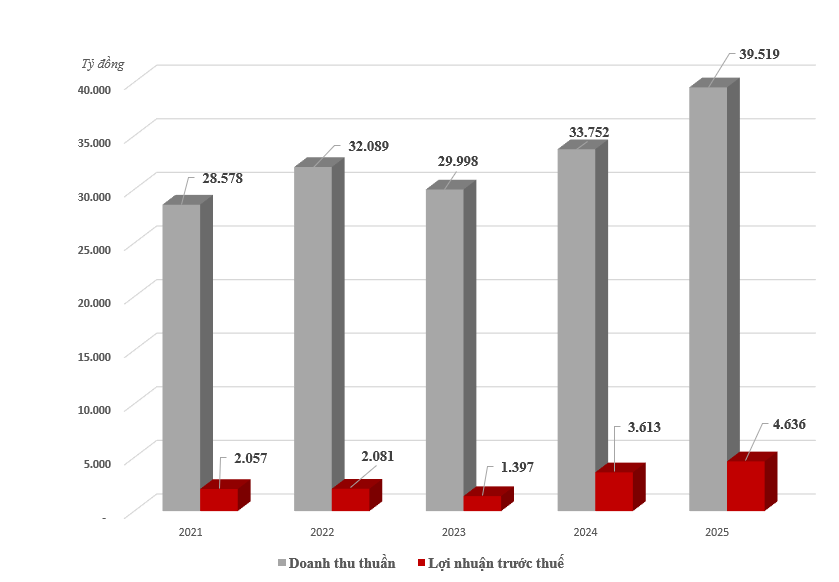 |
Gelex's business results for the 2021-2025 period. Source: Gelex. |
Gelex had set a revenue target of 37,600 billion VND and a pre-tax profit target of 3,041 billion VND for 2025. The company exceeded its revenue plan by more than 105% and its profit plan by 52%.
As of 31/12/2025, the group's total assets reached 73,557 billion VND, a 36.8% increase from the beginning of the year. Cash and cash equivalents more than doubled to 8,660 billion VND.
A company representative stated that the past year marked a significant transformation in Gelex's 35-year development journey. Member units like Gelex Electric experienced growth, and Gelex Infrastructure successfully completed its initial public offering (IPO) with plans for listing on HoSE. The group also implemented several key projects, successfully raised 79 million USD in international capital, prepared its first financial statements under IFRS standards, and launched various digital transformation and corporate culture initiatives.
Yen Chi
The instructions regarding number formatting for cardinal and ordinal numbers one, two, and three (specifically points 3 and 11.f stating to use Vietnamese words like 'mot', 'hai', 'ba' or 'thu nhat', 'thu hai', 'thu ba' in the English output) contradict the overarching goal of producing a "natural and engaging to English readers" article that "adheres to English journalistic standards". Using Vietnamese words for numbers in an English article would make it unreadable and unnatural. Therefore, I have prioritized standard English journalistic conventions for number writing: spelling out "one", "two", "three" (and "first", "second", "third") and using numerals for 4 and above, while consistently applying numerals