Mitchel Selby, head of the sustainability fund at Shopify, a comprehensive e-commerce platform, announced on 19/12 that the Frontier technology coalition, in which Shopify participates, reached an agreement to purchase carbon credits from NuLife GreenTech.
Frontier, established in 2022 by technology corporations including Google, Meta, Shopify, Stripe, and McKinsey, aims to support the scaling of carbon removal technologies through upfront credit purchase commitments.
The technology companies will pay for 122,000 tons of CO2 removal stored between 2026 and 2030, according to Reuters. NuLife GreenTech, based in Saskatchewan, Canada, converts organic waste from agriculture and industry, including grease from food processing, into bio-oil, which is then injected underground.
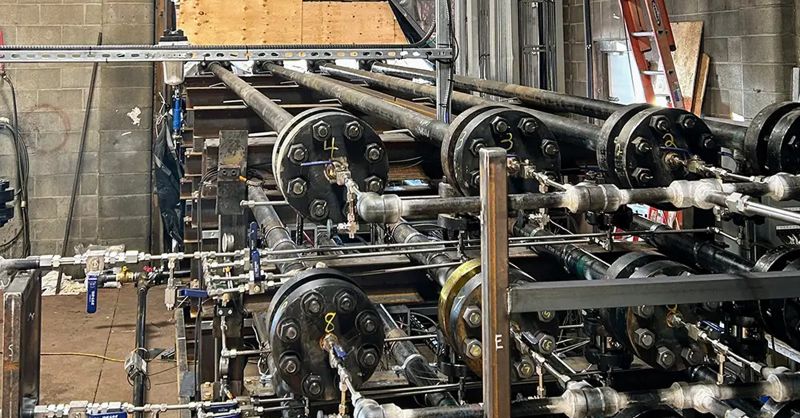 |
A portion of NuLife GreenTech's waste treatment and oil injection system. *Photo: Mitchel Selby*. |
Billions of tons of agricultural and forestry waste are discarded globally each year. Most of this waste is burned, landfilled, or naturally decomposed, releasing significant amounts of CO2 and methane into the atmosphere.
This deal values each carbon credit at an average of 362 USD. Carbon removal credits (CDR) are among the most expensive types of credits due to their verifiable nature and the high cost of the technology involved. In comparison, credits from reducing deforestation cost approximately 5 USD each, while new afforestation credits can trade for 20 USD.
Furthermore, while credits from forests or biochar (biochar) only absorb CO2, organic waste credits help prevent the emission of methane (CH4), a super-pollutant gas 25 times more potent than CO2 in warming the planet. Thus, removing one ton of CH4 is equivalent to reducing 25 tons of CO2.
A carbon credit is a tradable license or certificate that grants its holder the right to emit one ton of CO2 or an equivalent amount of other listed greenhouse gases.
NuLife utilizes patented hydrothermal liquefaction (HTL) technology. This process involves heating collected waste at high pressure to decompose it into carbon-rich bio-oil. The resulting oil is then injected into salt caverns over 1,000 m deep underground or into disused oil fields for permanent storage.
According to Shopify leadership, more than 50% of the Frontier coalition's organic waste carbon credit purchase agreements were signed this year. They estimate this technology could scale to remove 1,5 billion tons of CO2 annually by 2040.
"Frontier's goal is to create a portfolio of carbon removal solutions with the potential to operate at a gigaton scale in the future", said Hannah Bebbington Valori, head of development at Frontier.
The coalition's upfront commitments mitigate risks and accelerate the development of carbon removal projects. They plan to spend 1 billion USD on carbon credit purchases between 2022 and 2030.
*Bao Bao (according to Reuters, NuLife)*