According to data from the Vietnam Interbank Market Research Association (Vira), the average Vietnamese dong interbank offered rate on 3/2 sharply increased by 2 to 7.9 percentage points across most maturities up to one month.
Specifically, the overnight lending rate, a key maturity accounting for most transactions, rose to 17%; the one-week rate increased to 15%, the two-week rate to 6.4%, and the one-month rate to 9.5%.
Concurrently, the average US dollar interbank offered rate saw a slight increase of 0.01 to 0.04% across all maturities. Overnight to one-month rates ranged from 3.6% to 3.8%.
On the open market operations (OMO) channel, on 3/2, the State Bank of Vietnam (SBV) offered 60,000 billion VND for seven-day maturities, 37,000 billion VND for 28-day maturities, and 21,000 billion VND for 56-day maturities, all at an interest rate of 4.5%. In total, the SBV offered 118,000 billion VND through the OMO channel.
In total, over 80,900 billion VND was successfully bid, covering seven-day, 28-day, and 56-day maturities. The SBV did not offer treasury bills.
Thus, in yesterday's trading session, the SBV net-injected over 65,000 billion VND into the market. The total outstanding volume on the OMO channel surged to over 441,200 billion VND, reaching an all-time high.
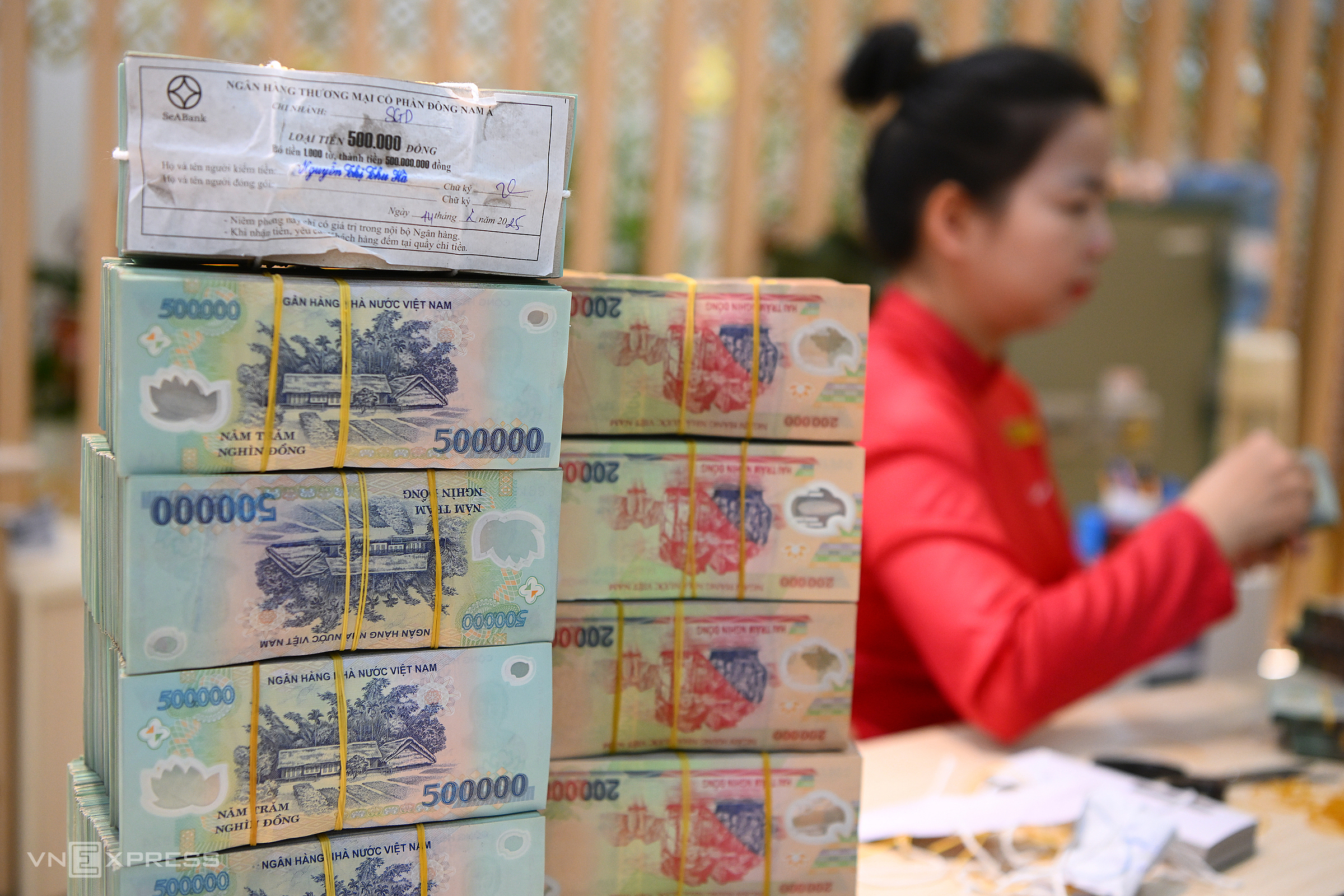 |
A transaction office at a private bank. Photo: Giang Huy |
A transaction office at a private bank. Photo: Giang Huy
Speaking with VnExpress, Nguyen Hoan Nien, an analyst at Shinhan Securities, stated that the 17% interest rate is the highest in a decade. This level was last seen in late 2010-2011, a period marked by significantly negative market developments.
However, according to Nien, the latest data indicates that the overnight rate has since decreased to 9.5-10%, suggesting the 17% spike may be temporary. This development has compelled the SBV to continuously inject substantial liquidity into the market. While further monitoring is necessary, forecasts suggest interbank rates will likely settle at a higher level, lasting at least until the end of Q1 this year.
According to the expert, several converging factors contributed to this situation. Late January is when businesses provisionally pay quarterly corporate income tax. When these funds are submitted to the treasury, it takes time for the treasury to reallocate them back into the banking system. Concurrently, during the Tet holiday, businesses require funds for Tet bonuses and year-end payments to employees, necessitating banks to replenish liquidity and accept high borrowing rates during this peak period.
Quynh Trang