Vietnam has established its first legal framework for international carbon credit trading with the recent issuance of Decree 112 by the Government. Specifically, projects utilizing new, high-cost technologies that are not yet widely implemented in Vietnam, such as offshore wind, carbon capture technology, or green hydrogen production, can sell up to 90% of the carbon credits they generate.
The Climate Change Department, under the Ministry of Agriculture and Environment, states this mechanism aims to attract international investors. It particularly targets sectors requiring advanced technology and substantial capital. Permitting the transfer of a large portion of carbon credits enhances capital recovery, thereby encouraging the implementation of large-scale emission reduction projects.
In contrast, emission reduction activities already common domestically have a maximum transfer rate of 50%. This lower rate ensures a supply of credits remains for national emission reduction targets.
The Ministry of Agriculture and Environment is the approving authority for these credit transfers. All corporate carbon credit transactions will be recorded in a national registry to prevent the double counting of emission reductions and ensure transparency.
A carbon credit is a tradable permit or certificate. It has commercial value and grants the holder the right to emit one ton of CO2 or another greenhouse gas from a specified list of greenhouse gases.
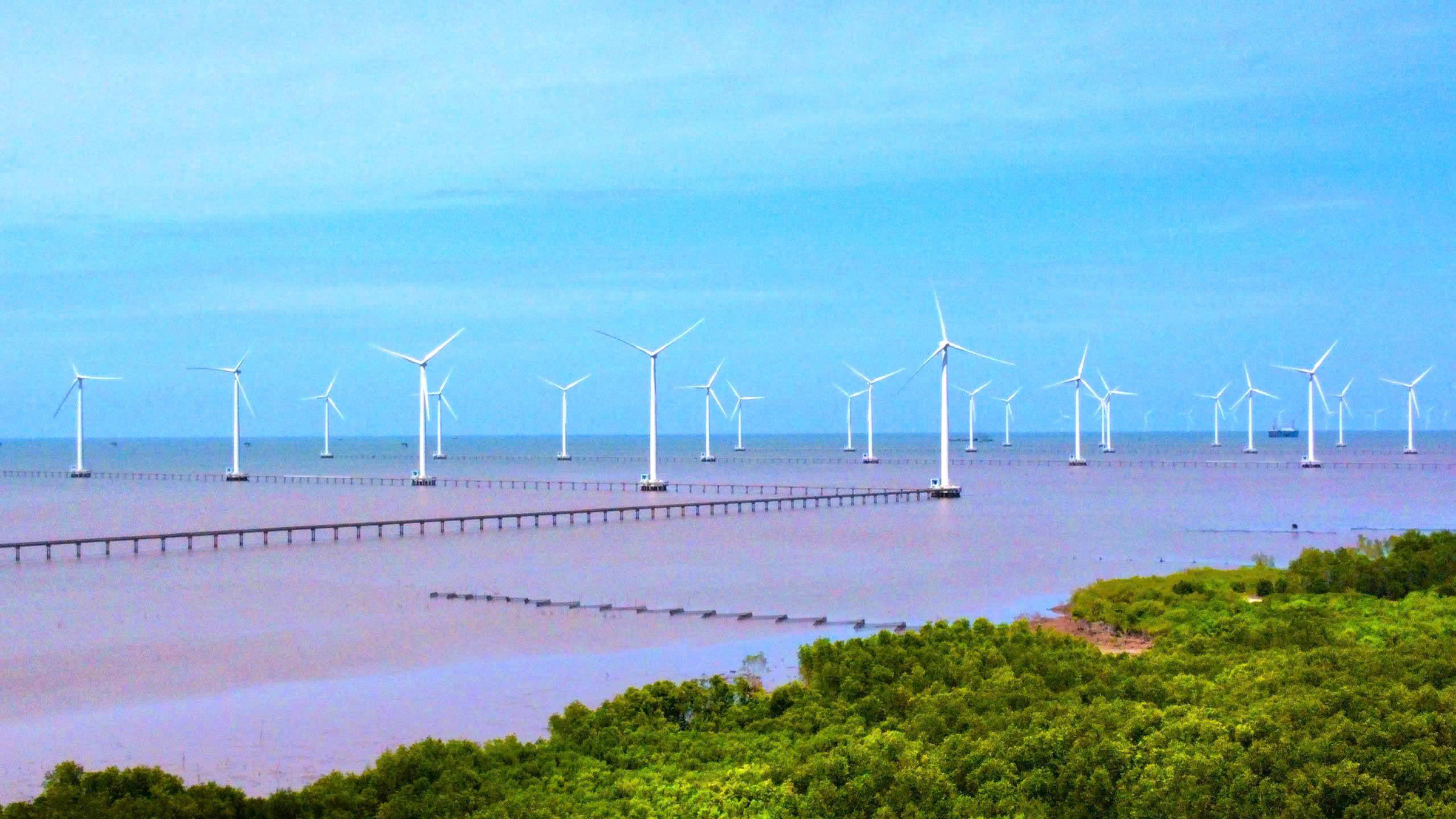 |
Bac Lieu Wind Power Plant in Hiep Thanh ward, Ca Mau province. Photo: An Minh |
Also, under the decree, three carbon exchange mechanisms are established. These are based on the provisions of the Paris Climate Agreement concerning cooperation, a centralized market mechanism, and independent carbon standards.
Additionally, the decree allows domestic organizations to purchase and utilize international carbon credits to fulfill international commitments. This opens an additional channel for mobilizing resources for the green transition.
Vietnam aims to achieve net-zero emissions by 2050. The Environmental Protection Law 2020 previously laid the groundwork for a carbon market. However, it lacked specific regulations for international trading activities.
According to the Revised Power Master Plan VIII, offshore wind power capacity is projected to reach 6,000 MW by 2030 and increase to 17,000 MW by 2035. This energy source could achieve 113,000-139,000 MW by 2050, playing a crucial role in the nation's carbon neutrality goal.