A newly published HSBC analysis indicates that the "tariff storm" did not diminish Vietnam's export momentum in 2025; in fact, it saw growth. This follows data from the General Statistics Office, which reported that goods export turnover for the first 11 months of the year exceeded 430 billion USD, marking a 16,1% increase compared to the same period in 2024.
The bank attributes this growth partly to frontloading activities, particularly during Quarter II. Additionally, while most countries in the region significantly curbed exports to the United States, Vietnam maintained high growth. Data from the General Department of Vietnam Customs shows that turnover to this market reached over 138,6 billion USD in the first 11 months, an increase of over 27% year-on-year.
"Overall, the impact of tariffs on Vietnam's economy appears lighter than initially anticipated," HSBC's analysis team noted.
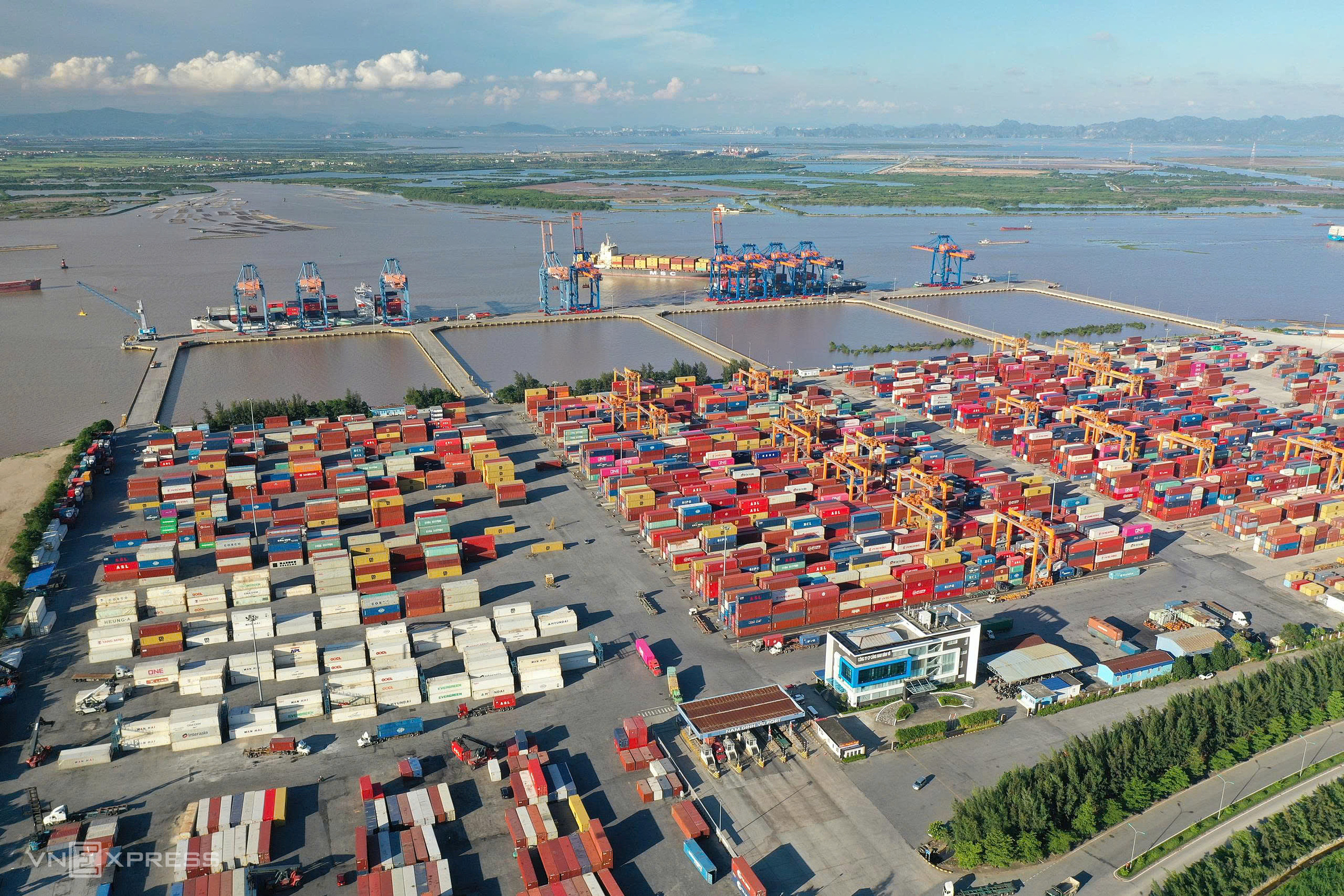 |
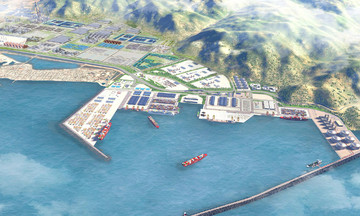
Cang bien tai Khu cong nghiep Nam Dinh Vu, Hai Phong. Anh: Le Tan
Two primary reasons explain this outcome. First, Vietnam proactively engaged with US President Donald Trump's administration, even before he officially took office. After information about a 46% retaliatory tariff, Vietnam actively negotiated and is now in the same 19-20% tariff group as other ASEAN countries, effectively returning all parties to square one.
Second, strong export growth to the United States is also due to a shift in commodity structure. In 2013, 60% of export turnover consisted of light industrial goods such as textiles, footwear, and toys. However, in the recent decade, the proportion of electronics has rapidly increased, becoming the main driver this year. For the first 11 months, the United States spent nearly 50 billion USD importing computers, phones, cameras, camcorders, electronic products, and various components from Vietnam.
HSBC suggests this aligns with Vietnam's progress in the technology value chain, enhancing its position in the final assembly of consumer electronics recently. Continuous investment by Samsung since 2007 played a significant role. Furthermore, in higher value-added segments, Vietnam's role in integrated circuit (IC) manufacturing is also growing, thanks to Intel's investments.
With exports remaining positive, both HSBC and UOB recently upgraded their growth forecasts for Vietnam. This year, the government aims for GDP growth of 8% or more.
However, Vietnam's export outlook for 2026 remains unpredictable. S&P Global's purchasing managers' index (PMI) for November recorded an expansion of 53,8 points, with new export orders increasing for two consecutive months.
Despite the positive PMI, HSBC believes it is "hard to predict" for 2026. "We still need to consider potential trade risks, and it is perhaps too early to assess the full extent of the impact," the report stated.
Additionally, two issues require clarification: the 40% transit tariff and sectoral tariffs on semiconductors. Experts suggest these will significantly influence Vietnam's trade and growth.
On a broader scale, the Organization for Economic Cooperation and Development (OECD) projects global trade growth in 2026 to decrease to 2,3% from 4,2% in 2025. OECD Secretary-General Mathias Cormann noted that the impact of US President Donald Trump's tariff policies has been relatively mild so far and has not fully materialized.
"The full impact will become clearer from early next year, once companies' accumulated inventory has decreased," he commented. Due to weaker external demand affecting exports, the OECD forecasts Vietnam's growth in 2026 to decrease to 6,2%.
Both the OECD and HSBC also highlight that exports to the United States accounting for nearly 30% of total turnover will make Vietnam vulnerable. "Vietnam has boosted trade with the US, but this also increases dependence on it as the final consumer market," HSBC observed. These developments necessitate more urgent market diversification and leveraging trade agreements like EVFTA or CPTPP.
Vien Thong