Coinbase, the world's second-largest digital asset exchange by trading volume, reports that institutional investors are moving beyond a simple "buy and hold" strategy for digital assets. They are now actively seeking stable income streams from their holdings. Many institutions already include Bitcoin (BTC) and Ether (ETH) on their balance sheets. While long-term price appreciation remains a goal, investors increasingly aim to "put these assets to work" to generate income while they wait, explained Brett Tejpaul, head of institutional clients at Coinbase.
This shift, according to Tejpaul, will define the next wave of institutional capital entering the digital asset market. This "second wave" emphasizes applying blockchain technology for payments, settlements, cost optimization, and enhanced transparency. This is distinct from the initial wave, which involved hedge funds, endowment funds, and affluent investors seeking arbitrage opportunities. The subsequent wave is more distinct, comprising banks and payment companies developing products on digital asset platforms.
A key driver of this trend is tokenization, which allows traditional assets to be moved onto blockchain networks, leading to faster circulation and reduced settlement times. By tokenizing fund certificates on the blockchain, asset managers can simplify ownership tracking and transfer, while also enabling 24/7 trading. For institutions accustomed to multi-day settlement periods, this offers a tangible benefit. Tejpaul noted that nearly 50% of current discussions with institutional clients focus on stablecoins and tokenization, reflecting a significant increase in interest after recent regulatory shifts in the US.
Stablecoins, typically pegged to fiat currencies, offer a low-cost intermediary value without relying on conventional payment systems. Major financial institutions are exploring blockchain to facilitate faster and lower-cost money transfers, particularly for cross-border payments. Consequently, both traditional financial institutions and crypto-native companies (those that acquire digital assets before any other) are racing to build or integrate stablecoin infrastructure. They view this as foundational for the next phase of the financial market.
Several major financial institutions have already embraced this direction. BlackRock, the world's leading asset manager, launched a tokenized US Treasury bond fund. JPMorgan, the world's largest bank by market capitalization, is experimenting with tokenized deposits and blockchain-based payments. Franklin Templeton, a global investment management firm, has also brought its money market fund (MMF) onto the blockchain, signaling growing adoption of this model within the asset management industry.
Institutions are also increasingly focusing on market structure. 24/7 trading and near-instant settlement are emerging as key advantages, especially as the New York Stock Exchange and Nasdaq, the two largest US stock exchanges, prepare to offer continuous trading to clients. In traditional markets, transactions can take several days to settle, leading to locked capital and inherent risks. "People want to know where their money is at all times and do not want it tied up in the settlement process," Tejpaul stated.
However, adoption remains uneven. Most institutional capital continues to concentrate on a few major tokens, with limited interest in smaller assets following recent market volatility. Additionally, large institutions are inherently cautious and may take years to thoroughly evaluate new technologies.
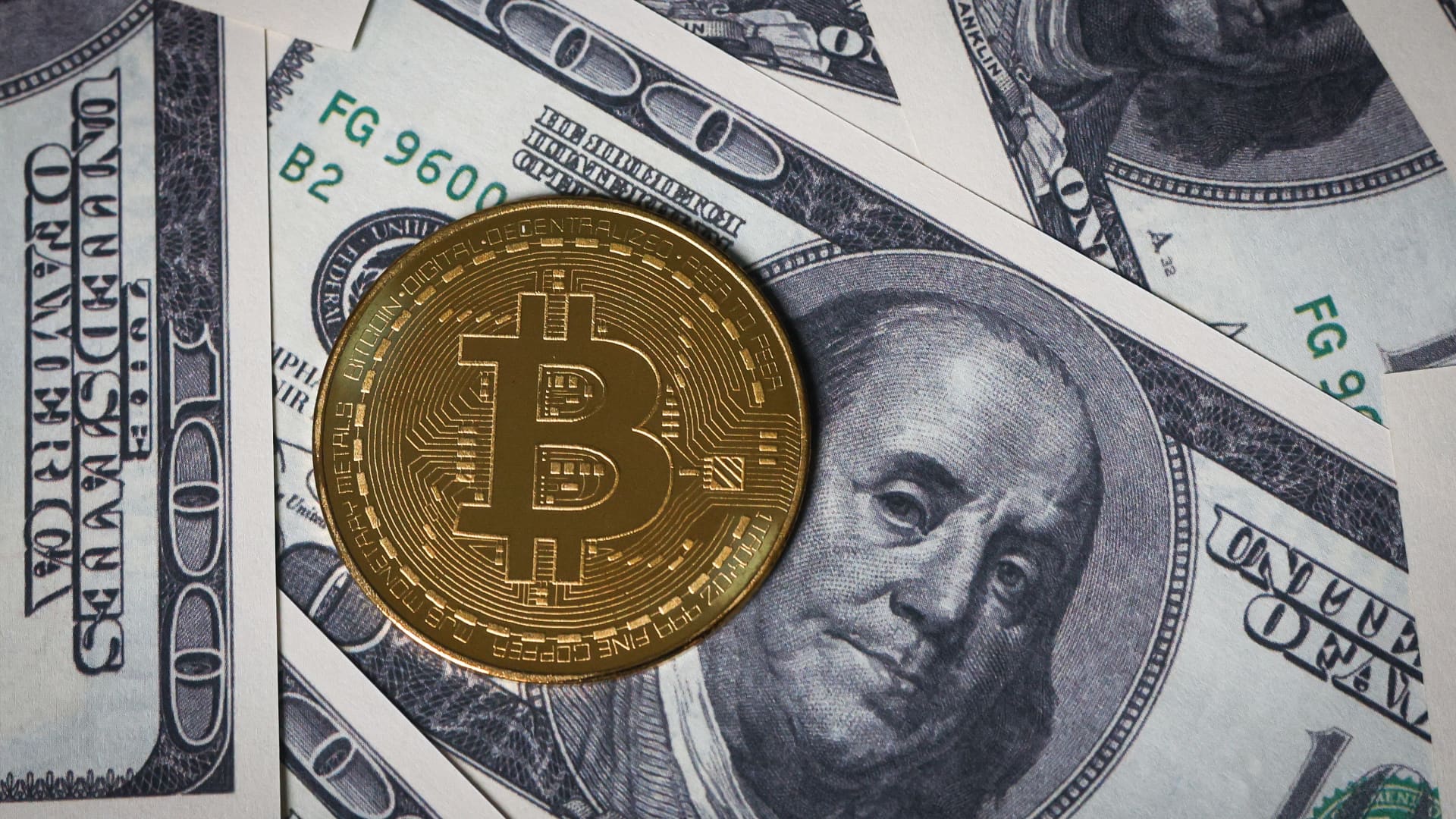 |
A symbolic Bitcoin coin rests on US dollar bills. Photo: CNBC |
By Tieu Gu (according to CoinDesk)