


ETFs, especially BlackRock's IBIT, have significantly influenced Bitcoin (BTC) prices over the past two years. However, CoinDesk analysts recently uncovered another betting-related ETF exhibiting a notable correlation with BTC's cycles since 2020. This ETF appears to provide early signals for turning points in the world's largest cryptocurrency.
The ETF in question is the Roundhill Sports Betting & iGaming ETF (BETZ), listed on the NYSE in the US. BETZ invests in companies involved in online sports betting, online casinos, and iGaming, including DraftKings, Flutter, and Entain. It offers investors access to the growing global online entertainment industry and the trend of sports betting legalization. Launched in June 2020, the fund has attracted 98 million USD in net inflows, establishing itself as the world's largest sports betting ETF. As of yesterday, it manages approximately 50 million USD in assets.
TradingView data indicates a 90-day correlation coefficient of 0,73 between BETZ and Bitcoin, with the 365-day coefficient reaching 0,91. The correlation coefficient quantifies the similarity in two assets' price movements, ranging from -1 to 1. A value closer to 1 signifies that assets typically move in the same direction, while a value near -1 indicates opposite movements. A coefficient close to 0 suggests little to no relationship.
This correlation translates to an R² coefficient of approximately 0,83, implying that over 80% of the price fluctuations in both assets are statistically linked. The R² (R-squared) coefficient measures how closely two assets' movements statistically align.
Notably, an overlay of BETZ's price chart onto Bitcoin's reveals a consistent pattern: BETZ often forms peaks or troughs several weeks before BTC. For instance, BETZ peaked in September 2021, two months before Bitcoin reached its peak in November of the same year, by which point the ETF was already declining. Similarly, BETZ's trough in September 2022 preceded Bitcoin's by about three months. This leading indicator pattern was observed again last year, with BETZ peaking in August 2025, approximately two months ahead of Bitcoin.
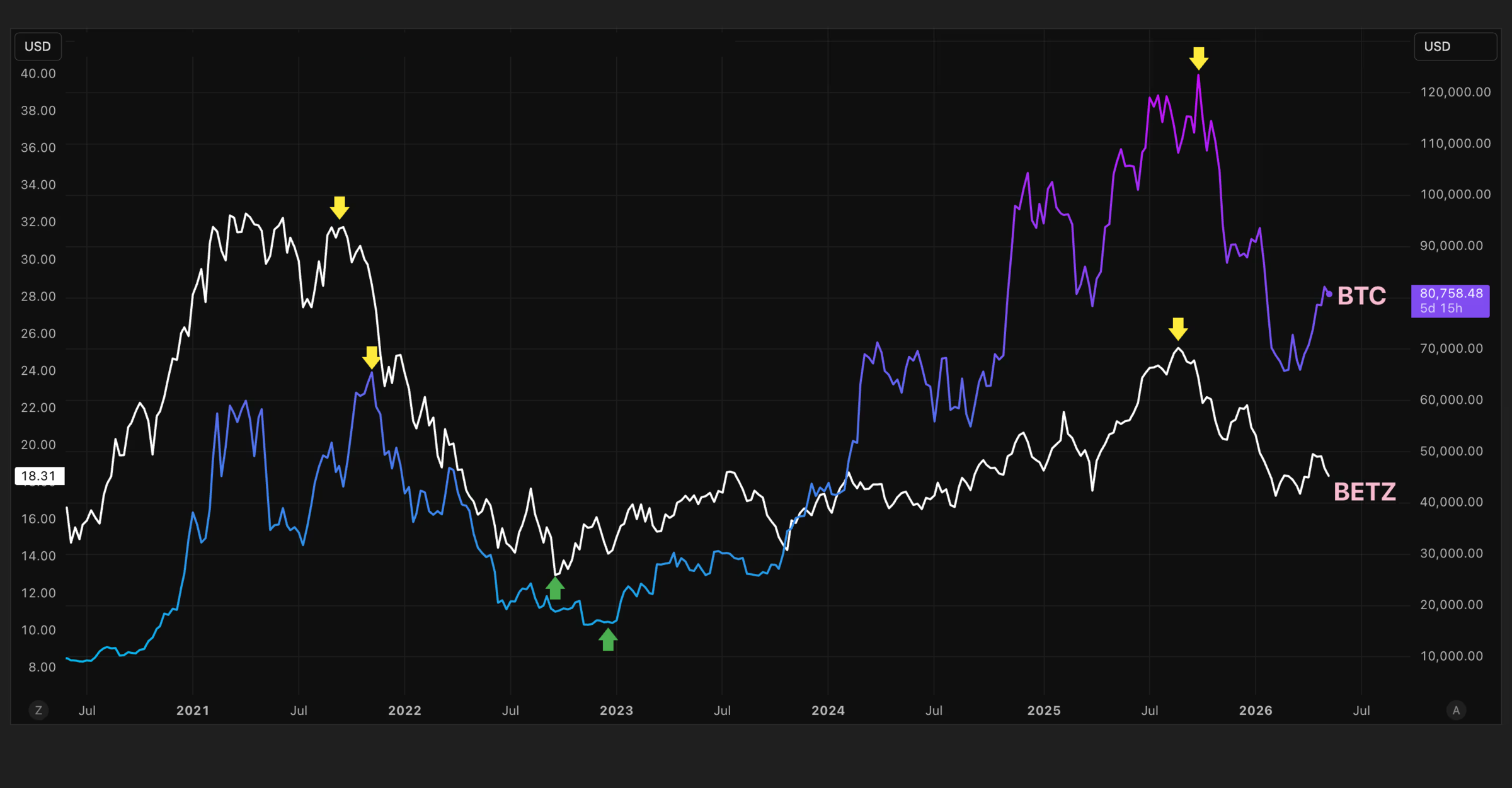 |
Overlay chart of Bitcoin and BETZ price movements from 2020 to present. The left column refers to BETZ price. The right column refers to BTC price. Photo: TradingView
While correlation does not imply causation, the phenomenon's recurrence across multiple cycles is difficult for observers to disregard. This reinforces the perspective of many experts, including Ray Dalio, founder of Bridgewater Associates, one of the world's largest investment funds. Dalio suggests Bitcoin continues to act as an asset sensitive to market sentiment and liquidity rather than a "safe haven."
However, CoinDesk cautions that short-term traders should consider BETZ a supplementary indicator of sentiment and capital flows, not an independent forecasting tool for Bitcoin trends.
Notably, BETZ has recently begun to diverge from Bitcoin's upward momentum. "This could be an early signal worth monitoring," the analysis team stated, "although it might also just be noise in a relationship that has never been guaranteed to last."
Tieu Gu


