The global energy market has incurred losses estimated at 50 billion USD, with 500 million barrels of crude oil and condensate stranded, following the month-long effective closure of the Strait of Hormuz. This disruption, which began in late February, represents the largest energy supply interruption in history. While Iran's Foreign Minister Abbas Araqchi announced a temporary reopening of the Strait on 17/4 during an Israel-Lebanon ceasefire, the recovery of supply and traffic is expected to be slow.
The scale of the halted supply is significant. The 500 million barrels of crude oil and condensate currently unable to reach the global market are equivalent to nearly one month of demand for the United States, or over one month of total European demand. This volume also represents enough fuel to sustain international maritime transport for approximately four months. Johannes Rauball, an analyst at Kpler, calculated that with an average oil price of around 100 USD a barrel, the 500 million barrels stuck translates to a revenue loss of about 50 billion USD for the energy sector. This figure is comparable to the gross domestic product of nations like Latvia or Estonia.
The impact has been acutely felt in oil-producing regions. In March alone, output from Arab Gulf countries decreased by 8 million barrels a day. This reduction is equivalent to the combined total production of Exxon Mobil and Chevron, two of the world's leading oil companies. Furthermore, jet fuel exports from Saudi Arabia, Qatar, UAE, Kuwait, Bahrain, and Oman plummeted from 19,6 million barrels in February to 4,1 million barrels in March and April, according to Kpler data. Reuters estimates this drop is sufficient to fuel 20,000 round-trip flights between New York's JFK Airport and London's Heathrow.
A video shows ships turning back upon approaching the Strait of Hormuz, despite Iran's announcement of its reopening on 17/4. Source: CNBC
Despite the announced reopening, the situation in the Strait of Hormuz remains largely unchanged. Data collected by maritime security consultancy Control Risks indicates little alteration following Iran's statement. Shipping industry leaders are hesitant to resume normal operations without firm assurances of safety, and they may be reluctant to comply with Iran's requirement for vessels to follow a designated route close to its coastline. Iranian officials have warned that ships still require permission to traverse the Strait.
The long-term repercussions are also a concern. Global onshore crude oil inventories decreased by 45 million barrels in April, with disrupted output reaching 12 million barrels a day since late March. Kpler analyst Rauball predicts that heavy oil fields in Kuwait and Iraq could take 4-5 months to return to normal operations, extending the inventory reduction through the summer. Additionally, damage from attacks on refineries and Qatar's Ras Laffan liquefied natural gas complex will prolong the regional energy infrastructure's recovery for many years. Iain Mowat, an analyst at Wood Mackenzie, highlighted the drastic measures needed to offset this oil surplus: global aviation would need to cut demand for 10 weeks, road transport would have to cease for 11 days, or the world would need to halt oil consumption for five days.
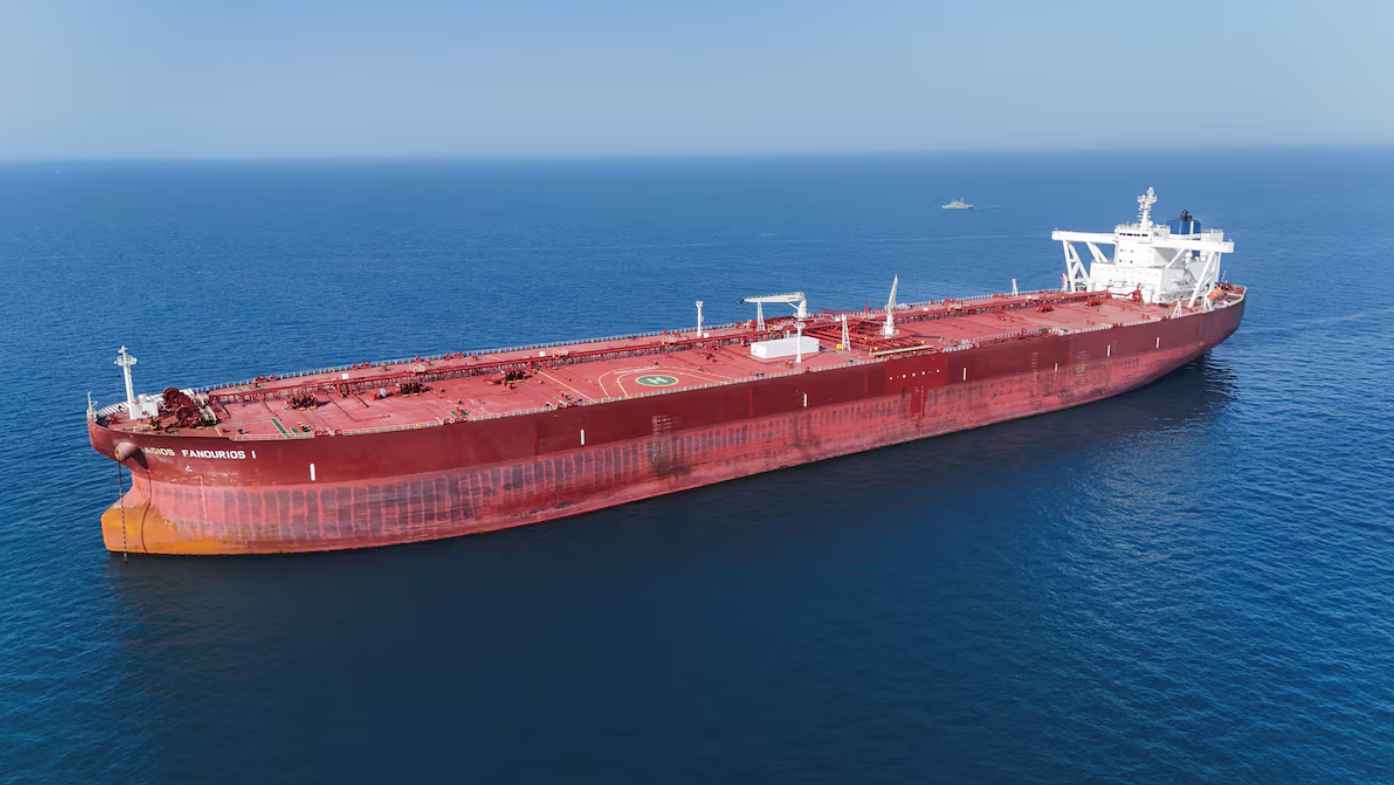 |
The oil tanker Agios Fanourios I transits the Strait of Hormuz en route to Iraq on 17/4/2026. Photo: Reuters