Forbes last week published its "New Ivies" list, featuring US universities highly valued by employers for the quality of their graduates, distinct from the eight traditional Ivy League institutions.
Forbes noted a prominent commonality among these 20 schools: all prioritize proficiency in artificial intelligence (AI) as a core educational objective.
For instance, Purdue University became the first public institution to mandate "AI proficiency" as a graduation requirement. At Rice University, advanced data science students must engage AI models like ChatGPT and Claude in debates, then evaluate their arguments.
These universities are also expanding their AI programs and faculty. Case Western Reserve University has tripled its AI course offerings to over 100 classes, organizing student groups for direct practical experience at companies. Other institutions such as the University of Florida, University of Notre Dame, University of Wisconsin-Madison, and University of Texas-Austin plan to recruit 40-50 new AI teaching positions.
Most of these universities are ranked within the top 50 nationally, according to the 2026 US News rankings. Annual tuition for international students ranges from 30,900 USD to 71,300 USD.
The 20 US universities most sought after by businesses, according to Forbes:
| Group | University | 2026 US News Ranking | Acceptance Rate (%) | Median SAT Score | Tuition (USD/year) |
| Private Universities | Carnegie Mellon University | 20 | 12 | 1540 | 68.100 |
| Case Western Reserve University | 51 | 37 | 1510 | 69.300 | |
| Emory University | 24 | 11 | 1520 | 68.100 | |
| Georgetown University | 24 | 13 | 1490 | 71.300 | |
| Northwestern University | 7 | 8 | 1540 | 70.600 | |
| University of Notre Dame | 20 | 11 | 1520 | 67.600 | |
| Rice University | 17 | 8 | 1550 | 65.500 | |
| Tufts University | 36 | 11 | 1510 | 73.600 | |
| Vanderbilt University | 17 | 6 | 1540 | 71.200 | |
| Washington University-St Louis | 20 | 12 | 1540 | 69.600 | |
| Public Universities | US Air Force Academy | - | 14 | 1330 | - |
| University of Florida | 30 | 24 | 1400 | 30.900 | |
| Georgia Institute of Technology | 32 | 14 | 1480 | 35.100 | |
| University of Michigan | 30 | 16 | 1460 | 66.200 | |
| University of North Carolina-Chapel Hill | 26 | 15 | 1480 | 45.200 | |
| Purdue University | 46 | 15 | 1480 | 28.800 | |
| University of Texas-Austin | 30 | 27 | 1390 | 44.900 | |
| University of Virginia | 26 | 17 | 1480 | 62.900 | |
| William & Mary | 51 | 34 | 1470 | 52.200 | |
| University of Wisconsin-Madison | 36 | 45 | 1460 | 44.200 |
This marks the third year Forbes has released this list. The data was compiled from a survey of over 100 senior executives and recruiters.
To be considered for evaluation, universities had to be outside the Ivy League (such as Harvard, Yale, Princeton) and Ivy Plus groups (like Johns Hopkins, Massachusetts Institute of Technology, University of Chicago). They needed a minimum of 3,000 students, highly selective admissions, and at least half of their applicants had to submit SAT or ACT scores.
The "New Ivies" list emerges amidst growing skepticism among recruiters regarding whether a degree from an Ivy League institution remains the best guarantee of talent quality.
Instead, recruiters believe that the brightest and most diligent students can be found at prestigious public universities or less renowned private schools with rigorous academic programs.
According to Forbes, 37% of recruiters indicated less enthusiasm for hiring Ivy League graduates compared to five years ago. Only 6% reported hiring more from this group. Conversely, 42% tend to prioritize students from public universities.
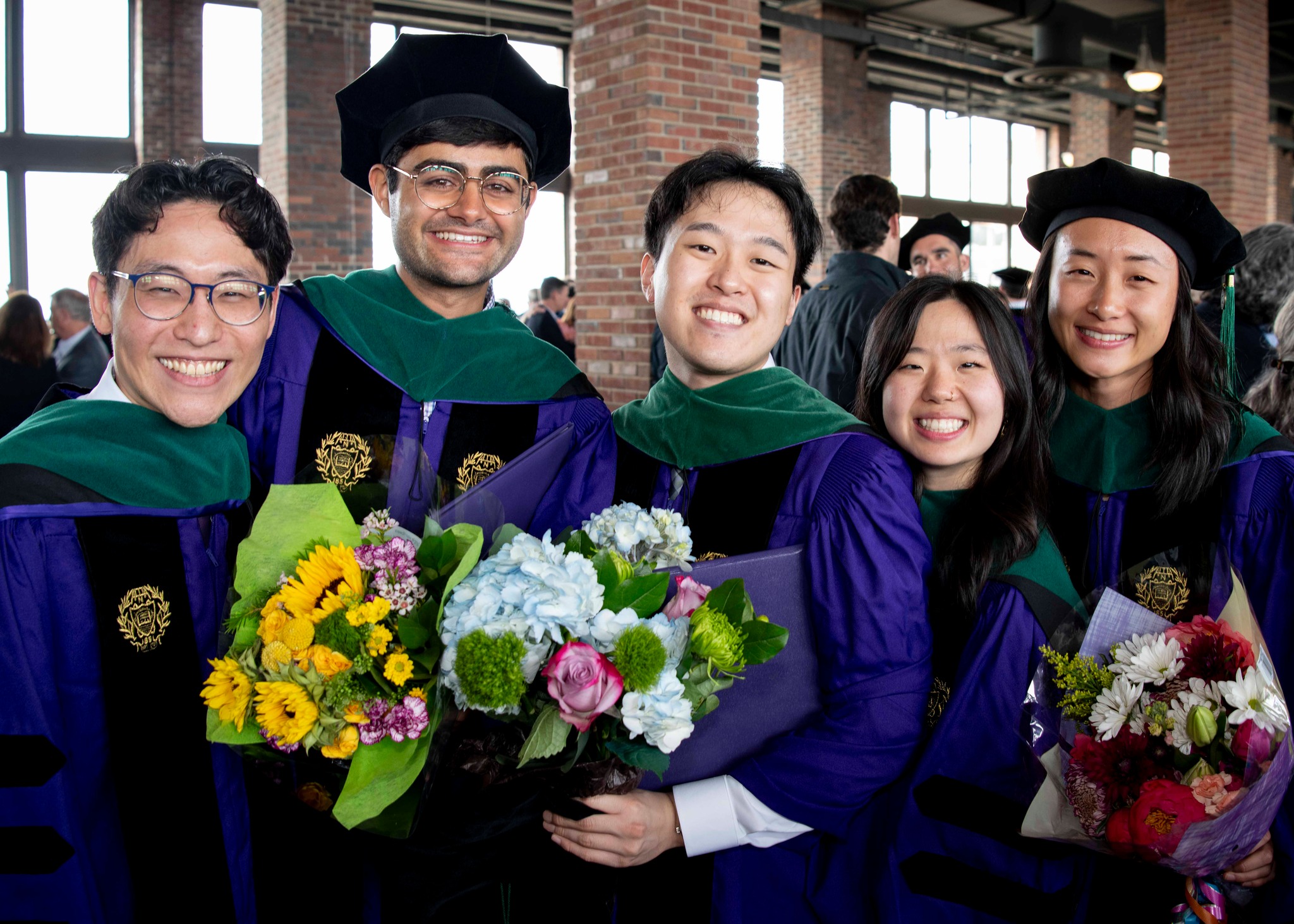 |
Northwestern university students on graduation day, 5/2025. Photo: University Fanpage. |
Khanh Linh