The university announced its decision on 3/8 to establish four new colleges: Economics and Public Management, Business, Law and Political Science, and Vietnam-Japan Business and Innovation.
This strategic move is part of Foreign Trade University's ambition to become a reputable research and innovation-driven university in education, solidifying its position among leading universities in Asia.
Establishing these colleges will also grant the units greater autonomy in governance, enhance operational efficiency, and foster interdisciplinary cooperation, connecting with businesses, localities, and international partners.
In the future, Foreign Trade University plans to establish three additional colleges: Finance - Accounting; Language, Culture and Arts; and Technology and Data Science.
Under the Higher Education Law, there is a distinction between a "truong dai hoc" (university or academy) and a "dai hoc" (multi-college university). A "truong dai hoc" is an institution that provides training and research across various majors. In contrast, a "dai hoc" is a comprehensive institution offering training and research across multiple fields, comprising several member colleges and faculties.
To transition from a "truong dai hoc" to a "dai hoc", Government Decree 99 of 2019 outlines three key conditions: the institution must be assessed as meeting quality standards by a legal accreditation body; it must have at least three colleges and 10 doctoral training programs, with a full-time student enrollment exceeding 15,000; and it must receive approval from its direct managing agency and investors.
Currently, there are 13 multi-college universities nationwide, including two private institutions.
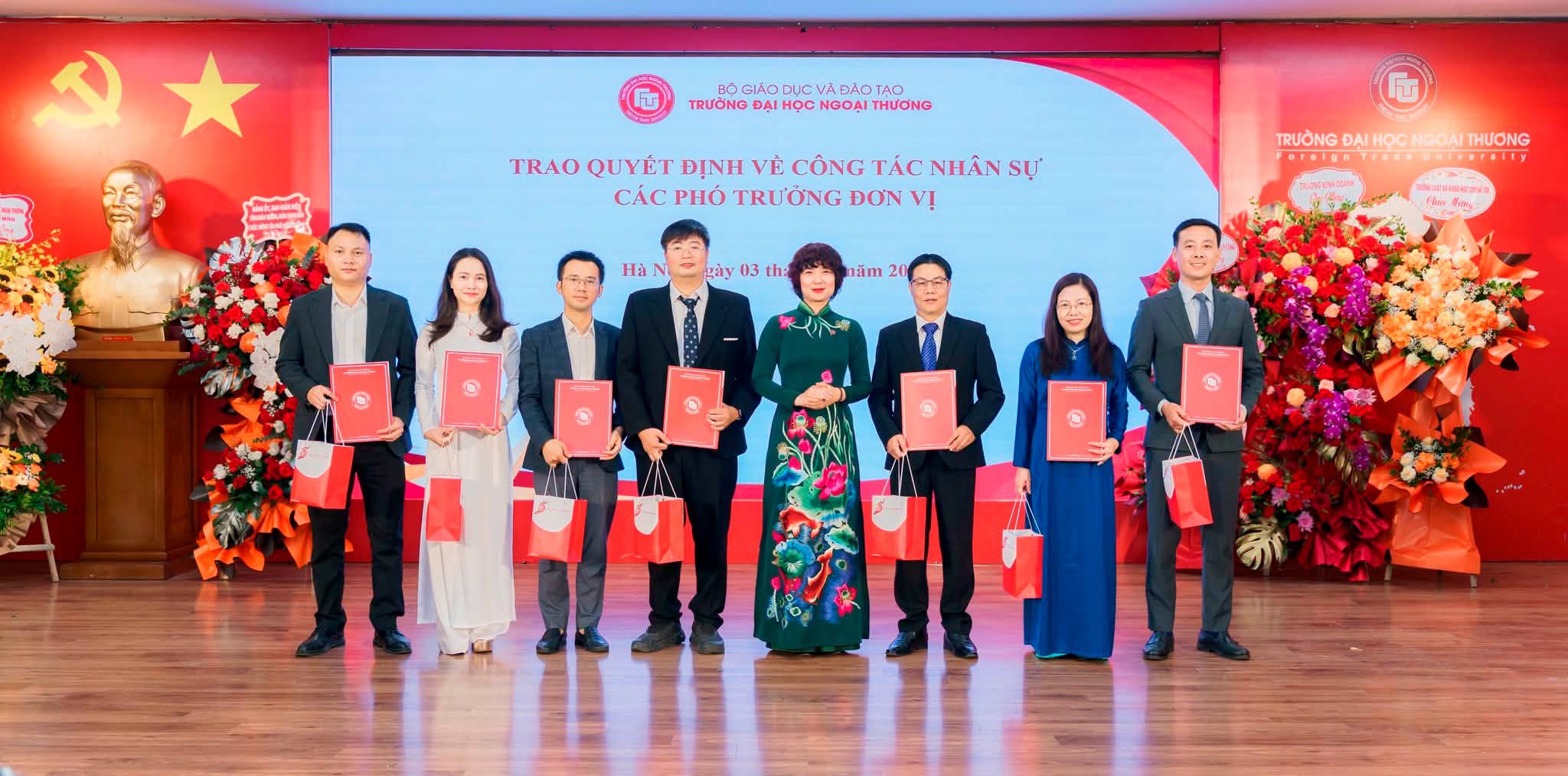 |
Associate Professor Dr. Pham Thu Huong (fourth from right) presents appointment decisions to heads and deputy heads of units, on the morning of 3/8. Photo: FTU Times
Foreign Trade University, established in 1960, currently offers nearly 40 undergraduate programs and nearly 20 master's and doctoral programs. The total number of learners, including students and trainees, exceeds 20,000.
Thanh Hang