Professor Doctor Chu Duc Trinh, rector of the University of Technology, Vietnam National University, Hanoi, made this statement on 15/4, on the sidelines of the "promoting future generation development: Netherlands - Vietnam semiconductor cooperation" workshop.
Trinh noted that the semiconductor field is challenging. He cited examples from the University of Technology where some highly capable students had to retake a related subject three times to fully grasp it.
To succeed in this field, students need a strong grasp of fundamental high school subjects like mathematics, physics, natural sciences, English, and even literature, to articulate their knowledge effectively.
Due to these stringent requirements, the Ministry of Education and Training has established program standards for microchip and semiconductor training. Applicants for majors in this field must achieve a high school graduation exam score in mathematics within the top 20% nationally, and their combined score for the three subjects in the admission cluster must be in the top 25%.
After university admission, Trinh emphasized that students must be diligent, possess a passion for the field, and focus on strengthening their foundational knowledge and skills through dedicated study. He stressed that students should avoid the pitfall of starting work early in their second or third year of university. Neglecting studies in later years can lead to a loss of foundational knowledge and delays in graduation.
Phung Viet Thang, director of Intel Vietnam, added that readiness is paramount for the semiconductor workforce. He noted that recent university graduates are generally not immediately suitable for corporate roles, requiring additional training or even retraining. "However, the speed and extent of that process depend on your readiness", Thang stated. He defined readiness as actively seeking opportunities to engage with semiconductor companies for learning, proactively participating in laboratory research and practice, and dedicating more time to these activities than currently.
Thang observed that university laboratories are significantly improved, now equipped with modern facilities. He believes that students who approach these labs with curiosity will gain valuable experiences and foundational knowledge for future practical work.
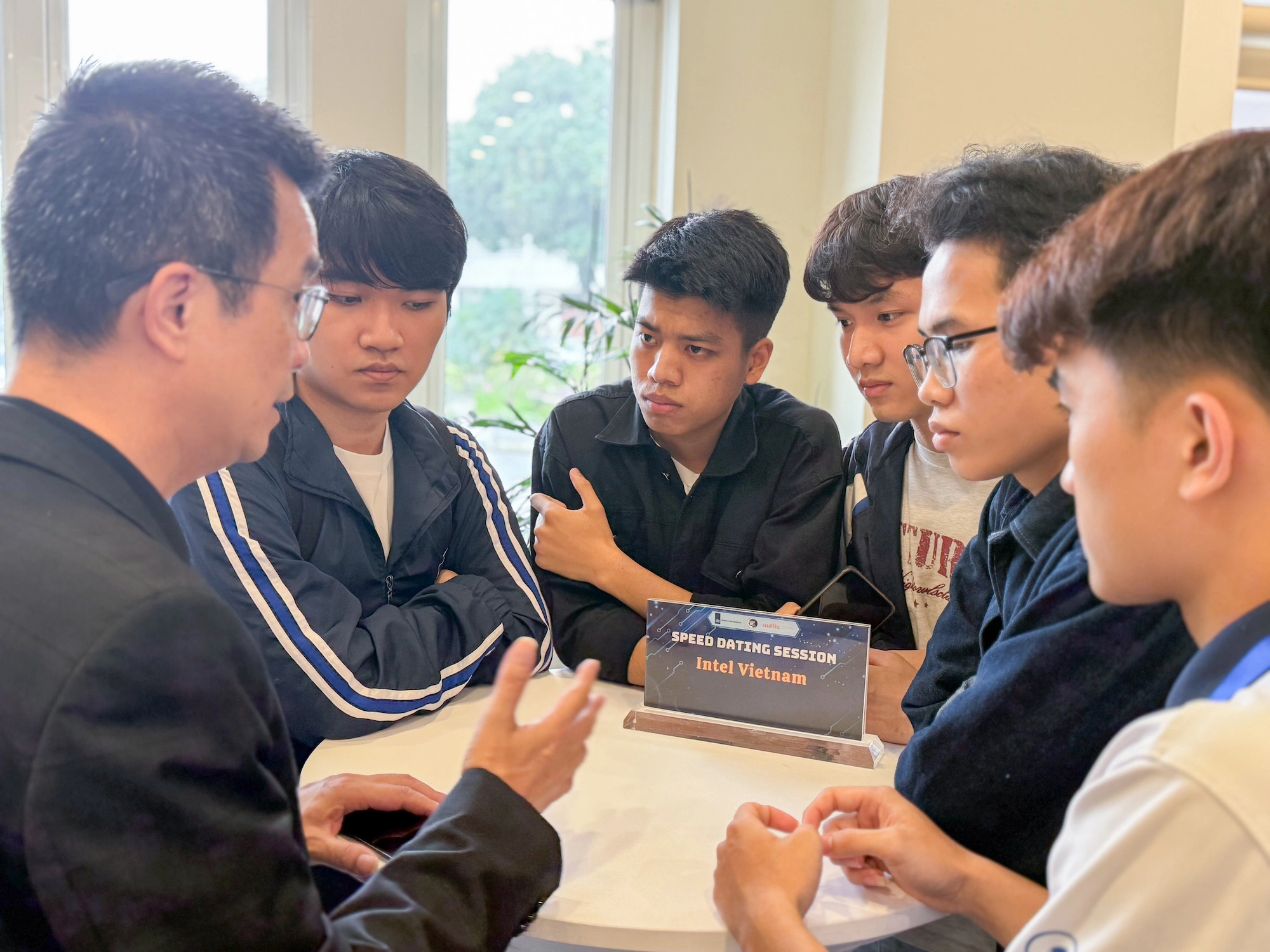 |
Students from the University of Technology, Vietnam National University, Hanoi, converse with representatives from Intel Vietnam on 15/4. *Photo: Duong Tam* |
Training programs for the semiconductor workforce
For the 2024-2025 academic year, nearly 19,000 students enrolled in semiconductor-related majors, representing about 10% of those pursuing STEM fields, according to the Ministry of Education and Training. Chu Duc Trinh clarified that these students are distributed across 38 majors, including computer science, computer engineering, mechatronics, and electronics and telecommunications engineering, not solely within dedicated microchip and semiconductor training programs.
Vietnam aims to train at least 50,000 semiconductor engineers by 2030, with a vision to 2050, under the "semiconductor industry human resources development program." This includes 15,000 microchip design engineers and 35,000 engineers for manufacturing and packaging processes.
To attract students from related fields into the semiconductor industry, Trinh emphasized the critical role of university guidance. He suggested that collaborating with businesses to facilitate student internships and refine training programs to match industry demands is an effective approach. This helps students better understand and develop an affinity for the field.
Duong Tam