Writer Nguyen Manh Tuan will introduce his memoir, "Chua Ngot Doi Van" (Sweet and Sour Literary Life), on 25/11, alongside his novel "Ke Khon Hon Vua" (The One Wiser Than the King). He stated that at his advanced age, he wishes to release the books soon to encapsulate a lifetime of writing experiences. He views the memoir not as a traditional autobiography but as a conversation with reporters, journalists, and fellow authors.
The memoir features 11 articles addressing issues relevant to generations of writers, including: Can a writer live by their profession?, Huge royalties from books translated abroad, and Ways to reduce writers' vulnerability. According to Nguyen Manh Tuan, writing requires talent, but every author should understand the labor involved to contribute long-term. At 80 years old, he has not ceased his creative career. He also points out the "delusion" common among many writers, emphasizing that writers need to be romantic but not delusional.
In an interview with writer Tran Quoc Toan, Nguyen Manh Tuan was asked about the literary community's assertion that only two Vietnamese writers, Nguyen Nhat Anh and himself, have comfortably made a living from their craft. He responded that whether official or rumored, this number is too small. If not properly understood, a writer's work in Viet Nam would be "the cheapest labor among all existing professions."
In his early years of writing, he harbored ambitions of having his books published abroad, allowing Vietnamese writers to gain international recognition and "become USD millionaires." It was only when he decided to try living by his profession that he realized the less delusion in writing, the clearer the creative path. "I write with the sole purpose of making a living from it and for a better society, so I always start at the lowest level, within my capacity, to ensure a long journey," he said.
"This profession, the illness of illusion may seem gone, but the temptation of delusion remains forever, so one must stay sober until the last breath," the writer shared. He believes that any writing should start from the basics, recognizing life as a constant teacher, requiring lifelong learning to curb the attitude of self-importance.
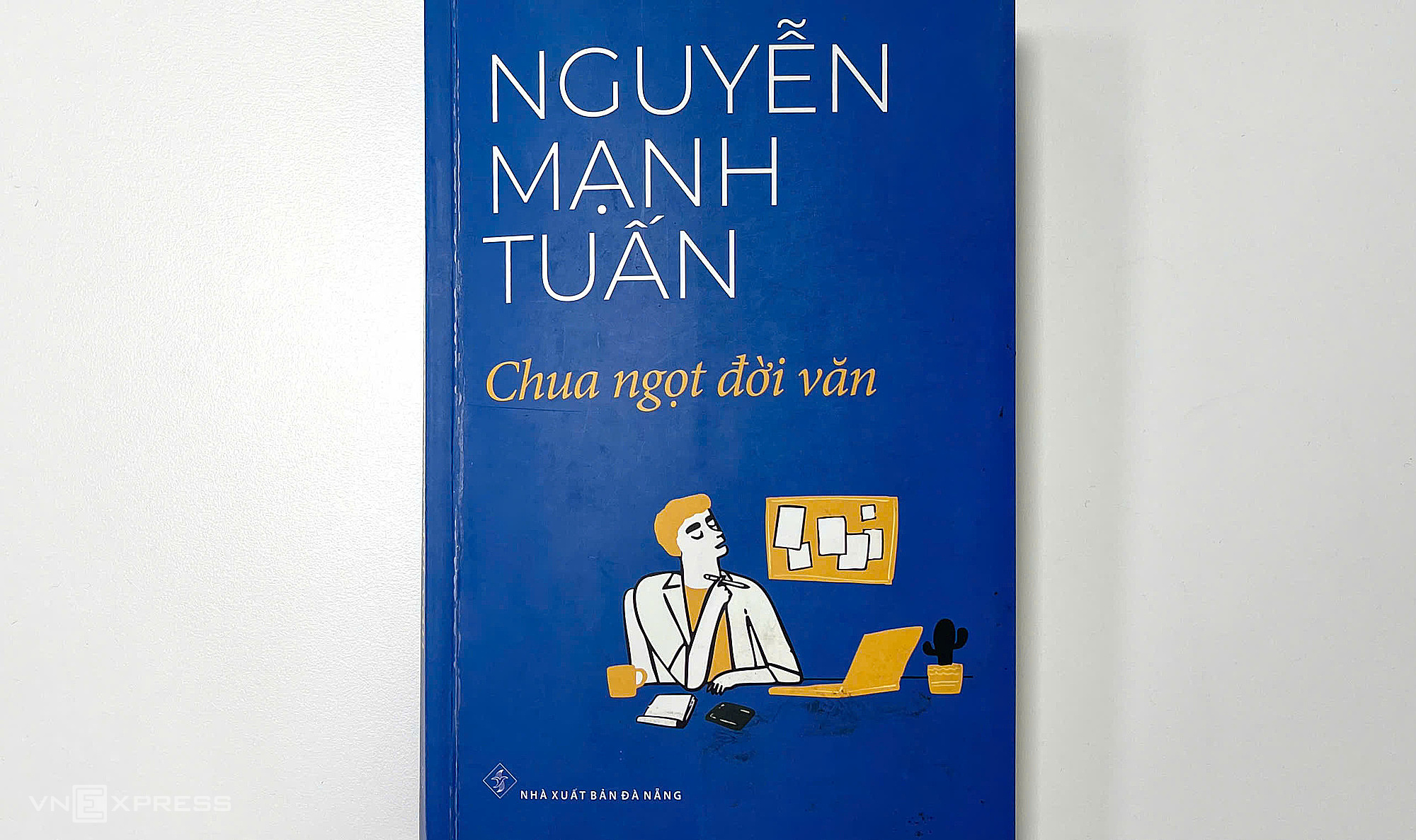 |
The 372-page publication, published by Da Nang Publishing House. Photo: Phuong Linh |
Beyond literary works, Nguyen Manh Tuan's career is marked by numerous film and television screenplays. Most of these works were commissioned, providing him with additional income to sustain his profession. However, this trend has historically not been highly regarded by the literary community.
In his article "Rua Tay Gac But" (Washing Hands, Hanging Up the Pen), in response to poet Le Thieu Nhon, Nguyen Manh Tuan admitted that many writers once disparaged him, accusing him of writing for money. In the 1970s, while still a laborer, he and other amateur writers from northern provinces were often invited to writing camps organized by local cultural associations or the Viet Nam Writers' Association. There, organizers frequently invited famous writers to lecture or share creative experiences. Among the many lessons taught by these mentors, he remembered the advice: "You should never write by commission, but rather write from emotion, perception, and the command of your heart."
At that time, the writer held a contrasting view, believing that commissions meant work, which generated income and demonstrated a certain level of trust from society. Therefore, he continued to accept writing commissions, yet focused on how to write so that "my heart and brain remained dominant," avoiding arbitrary work for money. The writer confessed that he lacked courage, only daring to speak out about this later in life.
Interspersed with his narratives are dialogues between Nguyen Manh Tuan and many friends and colleagues. His storytelling is direct, unafraid to address issues such as royalty mechanisms from 1990 onwards, the difficulties writers face when bringing their products to publishers, and the flourishing trend of book gifting that spurred a "hundred flowers bloom" writing culture.
Poet Le Thieu Nhon believes Nguyen Manh Tuan's literary experiences are worthy of a "memoir." Through the book, readers can glimpse the literary life of an era and the author's ups and downs. Le Thieu Nhon expressed admiration for the writer's memory, as he precisely recounted the tone and language of individuals during conversations without needing notes.
Nguyen Manh Tuan, a writer and screenwriter, is 80 years old, originally from Soc Son, Ha Noi, and currently lives in TP HCM. He is known for novels such as "Nhung Khoang Cach Con Lai" (The Remaining Distances, 1980), "Dung Truoc Bien" (Standing Before the Sea, 1982), and "Cu Lao Tram" (Tram Islet, 1984). His works reflect societal contexts through human destinies, creating significant impact in the literary world.
The writer also penned numerous film screenplays, including "Bien Sang" (Bright Sea, 1982), "Xa Va Gan" (Far and Near, 1983, adapted from the novel "Nhung Khoang Cach Con Lai"), "Luoi Troi" (Sky Net, 2004) – which won a Silver Lotus for the film and a Golden Lotus for screenplay at the Viet Nam Film Festival, and "Nuoc Mat Phuong Xa" (Distant Tears, 2008). Additionally, he is the author of television series screenplays like "Dong Tien Xuong Mau" (Blood Money, 1990), "Nguoi Thay" (The Teacher, 1993), "Dau Chan Tron Trong Lu" (Round Footprints in the Flood, 1998), "Trai Tim Vuong" (Square Heart, 2000), and stage plays "Tren Ca Troi Xanh" (Above the Blue Sky, 1999) and "Ngoi Nha Anh Tuc" (The Poppy House, 2005).
Phuong Linh