The South Korean government views AI as a new growth engine for the content industry. It actively invests in and develops policies to promote the application of technology in culture, arts, and media, thereby maintaining the competitiveness of the Hallyu wave (Korean cultural wave) in the global market.
In December 2025, during an interview with YTN about AI-related television programs, Lee Sang Hoon, Director of the Korea Communications Agency (KCA), stated that AI is becoming a core technology. It is comprehensively transforming K-content production methods, which encompass various creative fields and the distribution of entertainment content, including music, films, webtoons, and games.
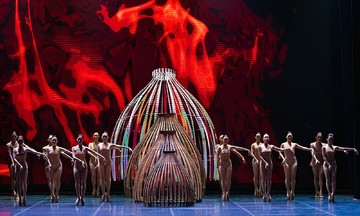
Naevis, an AI-generated member, released her debut music video "Done". Video: YouTube/ SMTOWN
AI-generated content is used across many genres to automate various stages, such as video editing, subtitle creation, voice synthesis, visual effects (VFX) processing, post-production, and distribution.
Chosun Biz once commented that "South Korea currently uses artificial intelligence at an astonishing speed", especially in the cultural, artistic, and entertainment industries. Due to positive responses from users in the country, AI is seen as a tool to enhance efficiency and expand creative possibilities.
One of the most positive impacts is in the film industry. These tools assist in scriptwriting and suggesting scene layouts for entertainment programs, as well as building digital sets and automatically color-correcting in television drama production.
Taxi Driver 3 is a prominent television series that applies AI. In this work, AI assists in processing more than 100 scenes per episode, including background removal, actor face editing, and performance compositing, significantly shortening production time.
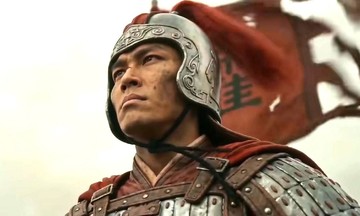
Behind the scenes of "Taxi Driver 3". Video: YouTube/ SBS Catch
In the hit drama Queen of Tears, some scenes where characters move through a snow-covered forest were created using Generative AI (a generative AI chatbot that can create new content mimicking human creativity). This technology allows for the recreation of natural spaces with high detail and synchronization with the actors' performances. The technique helps expand the scope of visual expression, especially in settings difficult to reproduce with traditional filming methods.
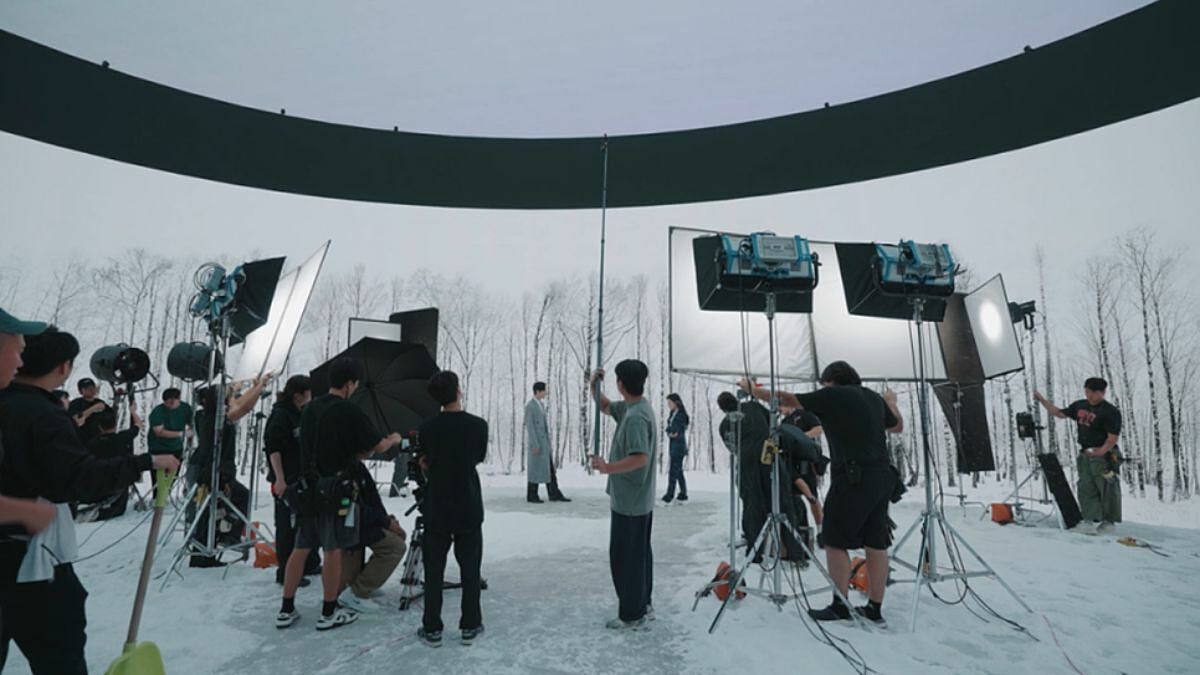 |
A snow forest scene in "Queen of Tears".
In Wonderland, a film with an AI theme, the crew used image processing technology and conventional set design. They also created character voices based on actor Gong Yoo's real voice. South Korean cinema also experiments with AI for actor rejuvenation and creating characters that do not exist in real life.
Beyond films, AI is used in entertainment programs, particularly in the music industry. At the Korea Culture Industry Forum on 18/12/2025, Herald Economy stated, "AI will evolve from a supporting role in content production to a technologically advanced Hallyu wave, with AI artists replacing real artists".
A prime example is the virtual group MAVE:, one of the first virtual Kpop groups with members created by machine learning, deepfake, and 3D CGI. Another AI member, Naevis from SM Entertainment, also debuted independently with her first single in 2024, with vocals and visuals synthesized and processed by AI.
AI is also used to create scenes and visual effects in Kpop music videos. For instance, the group aespa used the technology in their Supernova music video, where scenes simulating facial movements are combined with effects recreated by technology, balancing them with the real artists' expressions.
According to YTN Science, support from the South Korean government and agencies like the Korea Communications Agency and the Ministry of Culture, Sports and Tourism, plays a key role in developing policies and promoting AI application in the K-content industry. These support programs include funding AI-driven content production projects, training human resources, and developing technical infrastructure to meet the demand for producing large quantities of high-quality content.
Lee Sang Hoon believes AI should be seen as "a tool to expand creative capacity, not a subject to replace humans". He argues that the biggest challenge for South Korea's cultural industry in the coming period is not the speed of technology adoption, but how to establish standards for AI usage.
"We need to protect copyright and maintain the central role of humans in content creation," Lee said.
Mai Anh