Among the 12 zodiac animals, the horse (ma) is consistently represented as the same animal in Vietnam and many other countries, unlike Mao (which is a cat in Vietnam but a rabbit in China, South Korea, and Japan). The horse is a familiar figure, appearing frequently in Vietnamese cultural life and literature with multiple layers of meaning and symbolism.
Horses were not just a means of daily transportation for people but were also integral to warfare, accompanying brave generals into battle when cavalry was a core force. Consequently, many horses were honored as warhorses, symbolizing speed, power, loyalty, and prestige.
Additionally, according to Doctor Chu Xuan Giao of the Institute of Cultural Studies, Vietnam Academy of Social Sciences, the horse symbolizes a bridge between the real world and the spiritual realm. For instance, in the divine pantheon of Tam Phu and Tu Phu, the red ritual horse is considered a means of embodiment, carrying supernatural divine power and bringing the Saints from the invisible realm to the earthly world.
This animal is also familiar, appearing frequently in traditional games and festivals. Many people's childhood memories include the children's rhyme "Chi chi chanh chanh/ Cai danh thoi lua/ Con ngua chet truong/ Ba vuong ngu de...", or the song "Nhong nhong ngua ong da ve/ Cat co bo de cho ngua ong an". The image of the horse has also inspired many paintings and is chosen for the architecture of temples, pagodas, and shrines.
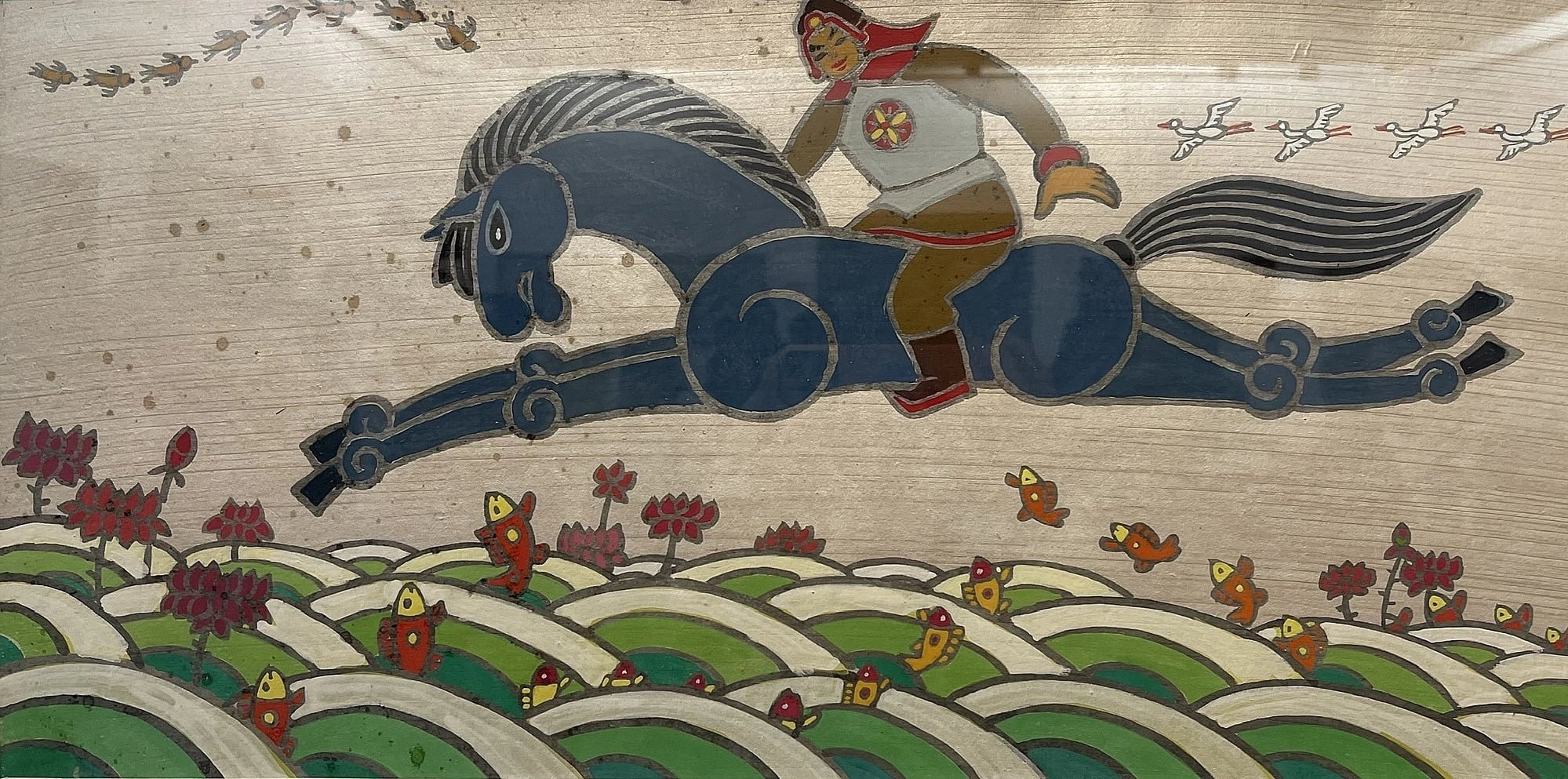 |
The artwork "Ong Giong" by the late artist Ngo Manh Lan, featured in the specialized exhibition "Horses in Visual Arts," held from 30/1 to 1/3 at the Vietnam Fine Arts Museum. Photo: Vietnam Fine Arts Museum |
In Vietnamese culture, horses are primarily associated with bright colors and the sun. Consequently, the Year of the Horse is often anticipated as a time for significant progress and comprehensive transformation – "the galloping horse."
The diverse presence of the horse image in cultural and spiritual life is also reflected and refracted into literary works. According to Doctor of Literature Ha Thanh Van, literature in each period has different conceptions and artistic methods of portrayal.
In folklore, the horse takes on strong mythical and supernatural characteristics, such as Thanh Giong's iron horse, which could fly and breathe fire. It is deified, symbolizing insurgent power, the will to protect the community, and the ancient Vietnamese people's aspiration to conquer nature.
During the feudal era, the horse's image was constrained by highly conventional artistic norms. It was often associated with heroes and noblemen embodying ideals of loyalty to the monarch and service to the nation, with phrases like "da ngua boc thay" (dying on the battlefield and being wrapped in a horse hide). Simultaneously, the horse served as an artistic metaphor to express abstract concepts, using the sound of hooves to depict the sorrow of separation (as in Chinh Phu Ngam) or "the shadow of a horse passing a window" to lament the finite nature of human life against endless time. At this time, the horse's image carried philosophical and melancholic undertones.
In modern literature, particularly romantic literature from the 1930-1945 period, the horse became a symbol of the free self and a proud spirit. The "wild horses" in Le Van Truong's work "Ngua Da Thuan Roi Moi Ngai Len" (The Horse is Tamed, Sir, Please Mount) express the desire for movement, breaking prejudices, and living true to one's authentic self.
Doctor Ha Thanh Van states that the evolution of the horse's image reflects Vietnamese literature's transition from feudal myths and norms to the multifaceted reality of life. This shift primarily stems from the horse's practical role, once highly valued in ancient and medieval times on battlefields, but now diminished with the advent of mechanized weaponry.
Van also explains that this process reveals the evolution of human thought – from selflessness and integration into the surrounding community to self-awareness. As the frame of reference shifts and ideologies change, the horse no longer carries a national mission but instead conveys personal feelings, aspirations for individual freedom, and the psychological nuances of people in the new era.
Consequently, the art of depicting horses also shifted from mythical and conventional symbolic styles to realism and psychological depth. Modern writers view horses and humans through an everyday lens, delving into their destinies and sorrows, no longer moralizing or creating heroic portrayals.
Nevertheless, the Eastern conception of the horse remains distinct, viewing it as part of "cosmic order and morality," encompassing destiny, virtuous governance, achievements, and paths. This contrasts with the Western perspective, which often sees the horse as a personal "machine" and a mythical figure, such as Pegasus, the winged horse in Greek mythology representing poetry and intellectual sublimation, the chivalric spirit (Don Quixote by Miguel de Cervantes), or freedom (wild Mustang herds).
Khanh Linh