Why exactly do we fear death so much that we avoid it entirely?
Deep down, we know we cannot escape death forever. We understand, as Milarepa said, that: "The very thing we dread and call a corpse is living with us here and now". The more we postpone confronting death, the more we ignore it, the greater our fear and insecurity become, haunting us. The more we try to flee that fear, the more colossal it grows.
Death is a vast mystery, but two things we can affirm: We will certainly die, and we do not know for sure when or how we will die. Thus, the only certainty is the uncertainty of the time of death, which becomes an excuse for us to postpone confronting it directly.
We are like children playing hide-and-seek, covering our eyes and thinking no one can see us.
Why do we live in terror of death?
Our instinct is to live and continue living, while death is a harsh end to what we are familiar with. We feel that when it comes, we will be thrust into a completely alien place or become an entirely different person. We imagine feeling lost and confused, in a terrifying and unfamiliar environment. We think dying will be like waking up alone, tormented by anxiety, in a foreign country, knowing nothing of the land or language, without money, acquaintances, documents, or friends.
Perhaps the deepest reason we fear death is our lack of self-knowledge. We believe in a unique and distinct personal identity; but if we dare to examine it, we will find that identity is entirely dependent on an endless array of auxiliary things: name, background, partner, family, home, job, friends, credit cards. We rely on these fragile and transient supports for a sense of security. So, when all those things are taken away, do we still know who we truly are?
Losing familiar anchors, we confront ourselves, a person we do not know, a frightening stranger we have lived with all this time but never truly wanted to meet. Is this why we try to fill every moment with noise and activities, no matter how boring or trivial, to ensure we never have to be alone in silence with this stranger?
Does this not point to a tragedy in our way of life? We live under a temporary, false identity, in a delusional wonderland not unlike the Mock Turtle in Alice in Wonderland. Hypnotized by the excitement of construction, we have built the houses of our lives on sand. This world seems convincing until death shatters the illusion and drives us from our hiding places. What will become of us if we have no understanding of a deeper reality?
When we die, we leave everything behind, especially this body, which we have cherished deeply, blindly relied upon, and strived to keep alive. But our minds are no more reliable than our bodies. Observe your mind for just a few minutes. You will see it resembles a flea, constantly jumping from one place to another. You will see thoughts arising continuously without reason or connection. Swept away by momentary chaos, we are victims of our mind's own capriciousness. If this is the only state of mind we are familiar with, then relying on the mind at the time of death is truly a perverse gamble.
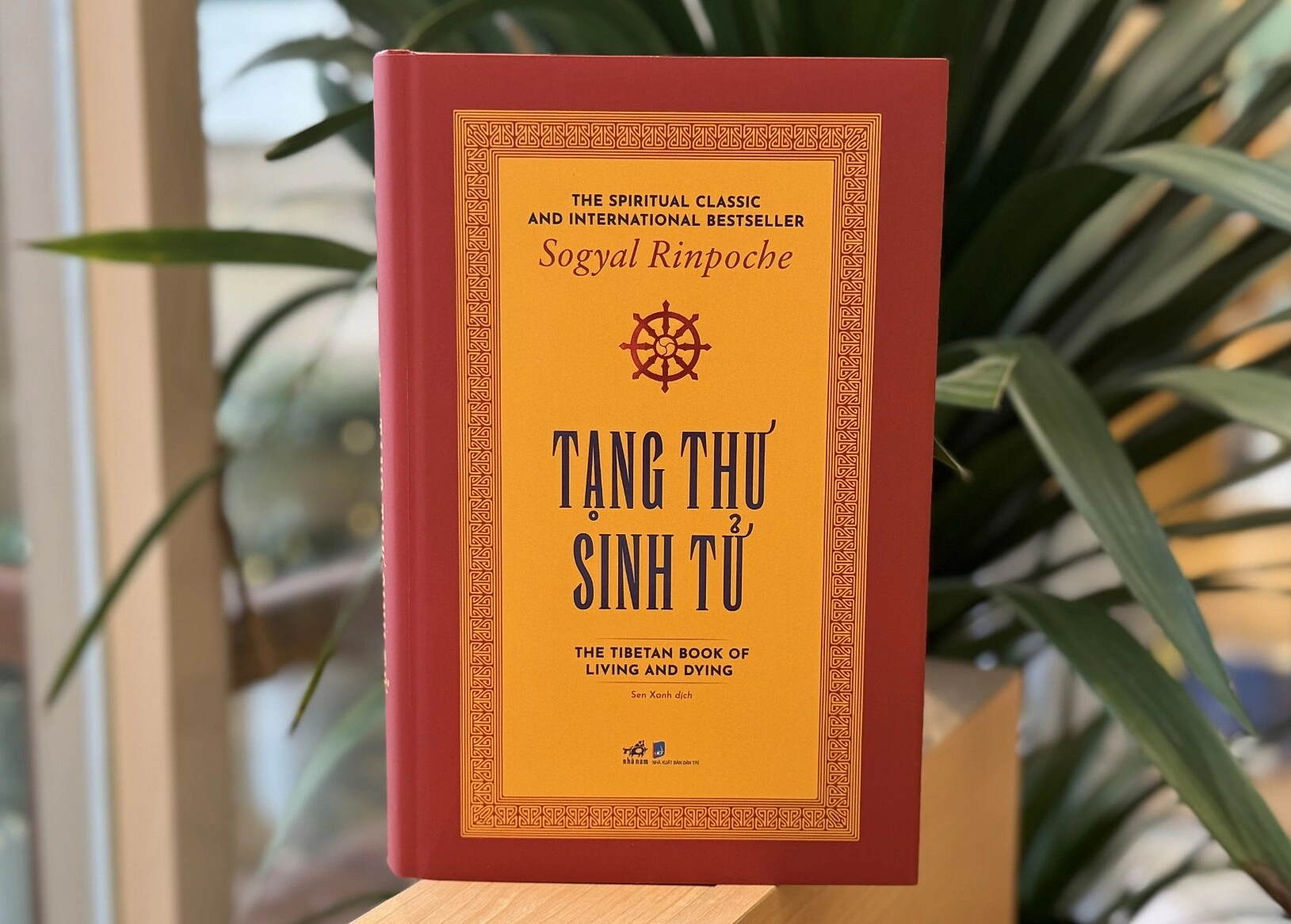 |
Sogyal Rinpoche’s 'The Tibetan Book of Living and Dying', translated by Sen Xanh, published by Dan Tri Publishing House in association with Nha Nam in early March. The work clearly presents Tibetan Buddhist teachings, based on the Tibetan Book of the Dead. Photo: Nha Nam |
After my teacher passed away, I became close to Dudjom Rinpoche, one of the era's greatest meditation masters, mystics, and yogis. One day, he was driving through France with his wife, admiring the countryside. They passed a long cemetery, freshly painted and adorned with fresh flowers. Dudjom Rinpoche’s wife remarked: "Rinpoche, look how neat and clean everything is in the West. Even the resting place for the dead is spotless. In the East, even houses for the living are not that clean." He replied: "Ah, yes, that is true; this is a civilized country. They have wonderful houses for the dead. But have you not noticed? They also have wonderful houses for the living dead."
Whenever I think of this story, I reflect on the emptiness and meaninglessness of life when built upon a false belief in continuity and permanence. Living this way, as Dudjom Rinpoche said, we become soulless living dead.
Nor do we dedicate much time or thought to this life. Consider those who work for many years, then retire, only to realize they do not know what to do as they age and face death. While we talk much about living "realistically", in the West, "realistic" often equates to being shortsighted and selfish. This short-term focus on this life, only the present life, is a great deception, the root of the cruel and destructive materialism of the modern world.
No one speaks of death, and no one speaks of the afterlife, because people are convinced such conversations would only hinder "progress" in this world. Yet, if our deepest desire is to live and continue living, why do we blindly insist that death is the end? Why not at least explore the possibility of life after death? If we truly live realistically, as we claim, why not begin to seriously ask ourselves: "Where does my true future lie?"
After all, no one lives longer than 100 years. And after that, an eternity stretches out, unaccounted for.
(Excerpt from 'The Tibetan Book of Living and Dying')