On 22/7, a representative from Phu Tho General Hospital reported that a 15-year-old patient was brought to the hospital by relatives in a semiconscious state, unable to communicate, with left facial paralysis and complete left-sided hemiplegia. Brain MRI results confirmed extensive cerebral infarction in the right hemisphere due to internal carotid artery occlusion. Doctors diagnosed an ischemic stroke, with the patient admitted 2,5 hours after symptom onset.
The emergency team activated and performed mechanical thrombectomy to restore blood flow to the brain. Following the intervention, the patient regained full consciousness, communicated well, and had stable vital signs. However, left-sided hemiplegia persists, and the patient is currently undergoing medical treatment and rehabilitation therapy under close supervision from doctors.
Cerebral stroke, also known as cerebrovascular accident, occurs when blood supply to a part of the brain is interrupted or severely reduced, leading to oxygen and nutrient deprivation in that brain region. Brain cells begin to die within minutes of insufficient blood and oxygen. Severe or widespread brain cell damage can result in death or significant lasting impairments in motor function, cognition, language, and vision.
While strokes can affect children, the incidence is lower than in adults. Between 80% and 85% of pediatric stroke cases are caused by ruptured cerebral vascular malformations. Children face a high mortality risk, ranging from 25% to 40%. Additionally, 40% to 50% of cases result in long-term sequelae like weakness or paralysis, impacting a child's development. Young individuals are also susceptible to strokes due to cerebral vascular malformations, where abnormally developed blood vessels form aneurysms, leading to hemorrhagic stroke, or narrow blood vessels, causing ischemic stroke. In this particular case, doctors are conducting specialized tests to diagnose the underlying cause and integrate early rehabilitation.
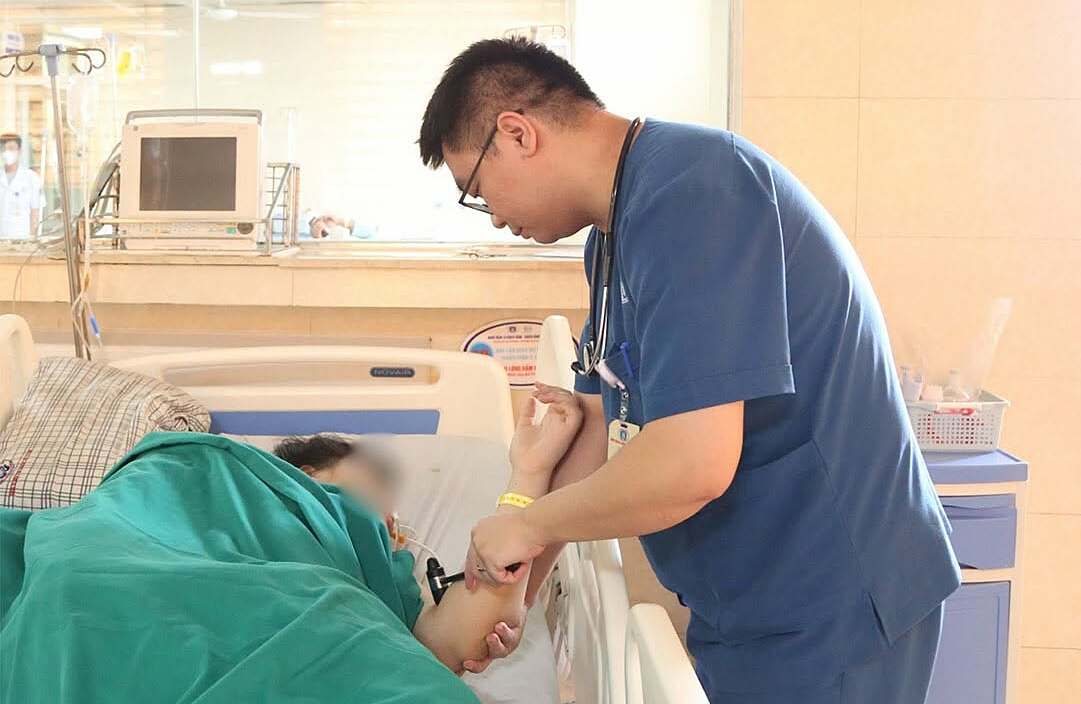 |
Doctor treating the child patient. *Photo: Hospital provided*
Doctor Luu Van Thin, from the Department of Emergency and Neuro-Stroke Intensive Care, Stroke Center, stated that every stroke case requires urgent emergency care because "time is brain". The earlier treatment is administered, the higher the chance of saving damaged brain tissue and achieving functional recovery. Stroke patients generally need early emergency intervention within the "golden hour" window (3 to 4,5 hours or more for ischemic stroke, 8 hours or more for hemorrhagic stroke) to maximize treatment effectiveness.
For timely and simple detection, the World Stroke Organization recommends checking for symptoms using the F.A.S.T. rule. F stands for Face: ask the person to smile or frown; if one side of the face droops or cannot move normally, it could be a sign of stroke. A stands for Arms: ask the person to raise both arms; be vigilant if one arm is weak or drifts downward, unable to stay raised.
S stands for Speech: ask the person to repeat a simple sentence; if their speech is slurred or they cannot speak, it could be a sign of stroke. T stands for Time: if any of the above signs are observed, call emergency services immediately and transport the person to the nearest facility capable of providing emergency stroke treatment.
Thuy Quynh