


On 28/1, Transport and Communications Hospital announced the successful transfer of a male patient to Emergency Center A9, Bach Mai Hospital, following an extraordinary life-saving effort. The 22-year-old student, who had collapsed with unexplained cardiac arrest, is now stable and well enough to return to his studies, after doctors performed nearly one hour of continuous chest compressions.
The critical incident occurred during class at the University of Transport and Communications on 23/1. The male student suddenly collapsed at his desk, losing all consciousness and responsiveness. Teachers and fellow students immediately notified the medical room and called for assistance from the nearby Transport and Communications Hospital.
Upon receiving the call, an emergency response team and ambulance promptly arrived. Doctor Le Hoang Linh, Deputy Head of the Emergency Department at Transport and Communications Hospital, who directly participated in the rescue, described the situation as critical. The patient had experienced cardiac and respiratory arrest for about 15 minutes before doctors reached him. The emergency team decided to perform external chest compressions immediately on site.
The race against "death" was intense, lasting nearly one hour. Doctors performed continuous chest compressions for 10 minutes at the scene, 5 minutes in the ambulance, and an additional 30 minutes immediately upon hospital admission. In total, the cardiopulmonary resuscitation (CPR) process lasted almost 50 uninterrupted minutes before the patient regained a pulse and vital signs. A subsequent computed tomography (CT) scan revealed no signs of cerebral hemorrhage.
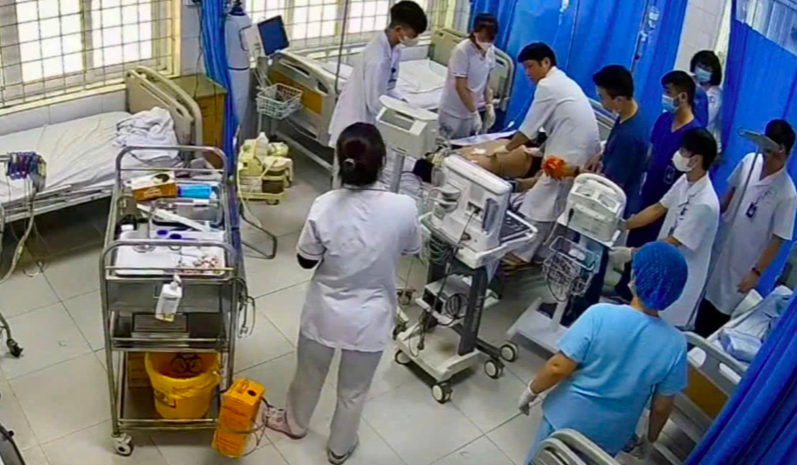 |
Doctors performing chest compressions for a student in cardiac arrest. Photo: Hospital provided
Evaluating the case, Doctor Linh affirmed that the student's survival underscores the critical importance of the "golden hour" in cardiac arrest emergencies. Early detection and correct first aid play a decisive role in a patient's life.
Experts advise the community to acquire out-of-hospital cardiac arrest first aid skills. If someone shows signs of cardiac or respiratory arrest, individuals should immediately call emergency services (115), place the patient on their back on a hard surface, and perform chest compressions with the correct technique. The compression site is the lower half of the sternum, with the rescuer's arms kept straight and perpendicular to the patient's chest. The compression rate should be 100-120 times per minute, with enough force to depress the chest 5-6 cm deep. If another person is assisting, two rescue breaths should be administered after every 30 chest compressions.
Le Nga


