Mr. Ly, a Cambodian national, had a history of heart disease but inconsistently took his medication. Recently, he experienced shortness of breath and chest pain with exertion. After an unsuccessful stent intervention at one facility, he was transferred to Tam Anh General Hospital Ho Chi Minh City for examination. Professor Doctor Vo Thanh Nhan, Director of the Interventional Cardiology Center, reported that the patient's three coronary arteries were severely calcified and complexly damaged, leading to extensive myocardial ischemia. The left anterior descending artery was completely blocked, the circumflex artery was severely narrowed, and the right coronary artery had diffuse severe narrowing, almost occluded, posing a high risk of acute myocardial infarction.
Given the patient's advanced age, multiple underlying conditions (hypertension, dyslipidemia, weak kidneys), and complex lesions, surgical intervention carried a high risk. Therefore, a stent intervention was chosen. Professor Nhan assessed that atherosclerotic plaque had accumulated over time, leading to severe calcification that obstructed the delivery of stent placement devices using conventional techniques. Consequently, the team employed a specialized machine equipped with an elliptical diamond-tipped drill (Rotablator) to break up the hardened, calcified plaque.
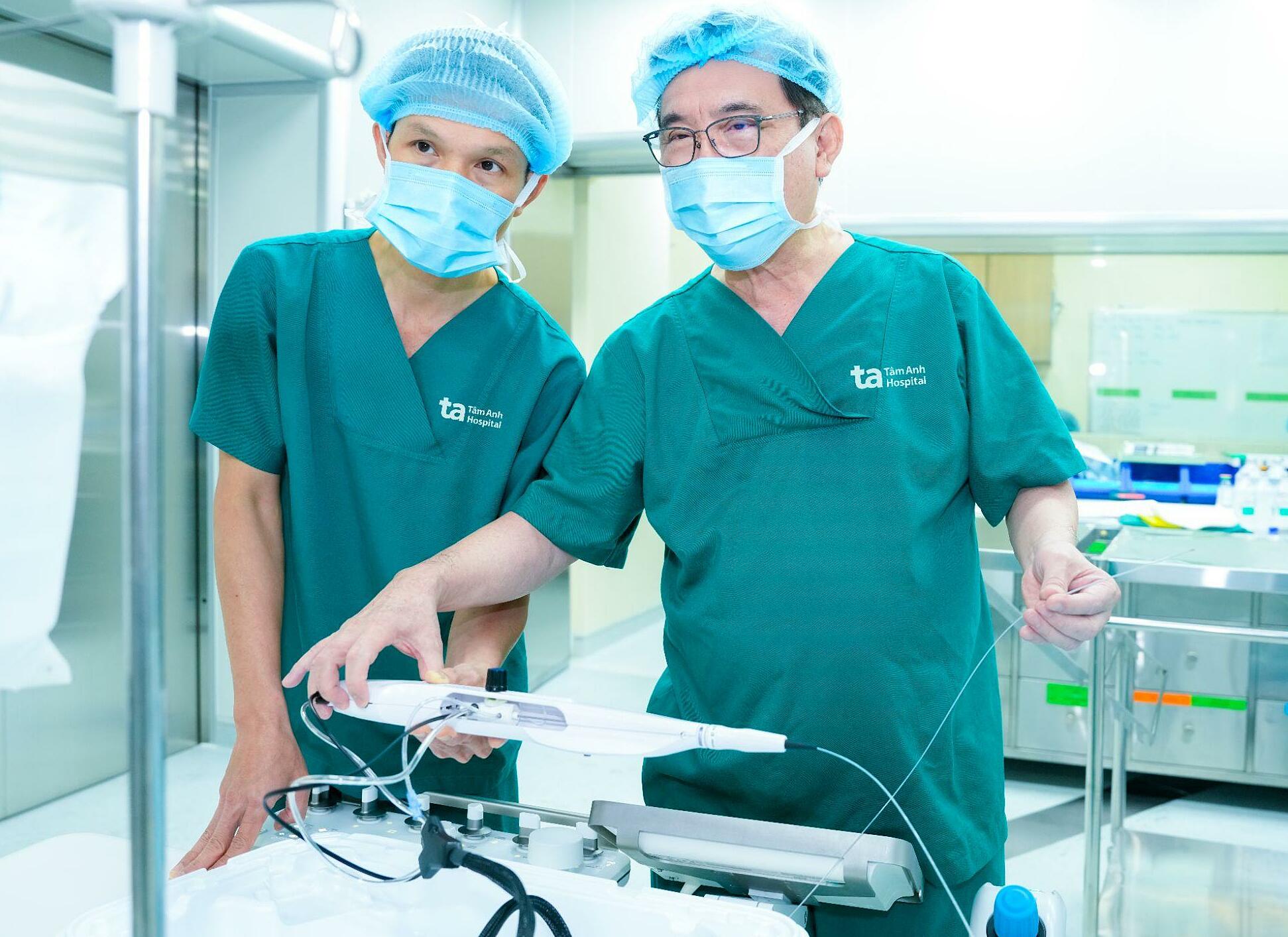 |
Professor Nhan (right) and his team test a model of the diamond-tipped drill machine before the intervention. *Ngoc Ha*
Before drilling, doctors threaded a guidewire through the narrowed vessel segment to create a "railway" for the drill. This prevented the drill from damaging the vessel wall in convoluted sections, as the patient's blood vessels were tortuous and twisted, making it difficult to advance equipment to the distal part of the lesion.
The drill, with a 1,5 mm diameter, operated at a speed of 140,000-180,000 revolutions per minute. It generated friction and cutting forces, pulverizing the calcified plaque into microscopic particles (5-10 μm) smaller than red blood cells, thus preventing embolization.
Master Doctor, Level 1 Specialist Nguyen Minh Chau, from the Interventional Cardiology Center, reported that the team drilled five times, two to three times more than usual, due to the lesion's length and hardness. Doctors then smoothed the artery's inner surface, followed by balloon angioplasty and the placement of three stents in the right coronary artery, restoring blood flow to the heart. During the intervention, an intravascular optical coherence tomography (OCT) system helped doctors select appropriate stent sizes, ensuring full stent expansion, close apposition to the vessel wall, no dissection at either end, and minimized risks of acute occlusion and restenosis.
The intervention lasted approximately three hours, with the patient fully conscious under local anesthesia. Each time the drill operated, Professor Nhan communicated with the patient, helping to reduce stress while closely monitoring vital signs via a specialized monitor system. This allowed doctors to detect and promptly manage any complications, such as hypotension, arrhythmias, or absent blood flow due to micro-embolization.
Post-intervention, Mr. Ly received optimal medical treatment, experienced no chest pain, and was discharged. He will have regular follow-ups for doctors to plan revascularization of the remaining two coronary artery branches at an appropriate time. Professor Nhan advised the patient to engage in suitable physical activity, adhere to medication schedules, maintain a healthy diet, and reduce salt and sugar intake.
 |
Mr. Ly thanks Professor Nhan after the successful intervention. *Ngoc Chau*
According to Professor Nhan, high-pressure balloon angioplasty was previously common for severely calcified coronary artery disease. However, balloons often failed to fully or evenly expand, causing calcified plaque fractures and a high risk of early restenosis, perforation, or vessel dissection leading to acute occlusion. Currently, drilling calcified plaque with a diamond-tipped drill can mitigate these drawbacks. This is a complex technique requiring modern equipment and interdisciplinary coordination, including interventional cardiology, cardiac surgery, and cardiac resuscitation, to support and prevent risks.
Doctors recommend that elderly individuals with multiple underlying conditions undergo regular cardiovascular check-ups at specialized medical centers. Early detection and treatment adherence help minimize severe coronary artery damage that would necessitate complex interventional techniques.
Ngoc Chau
| Readers can submit cardiovascular disease questions here for doctors to answer. |