When small bumps appear on the eyelid, many people immediately think of a stye or chalazion. However, not all cases are common inflammatory conditions. Some eyelid lesions can be eyelid tumors, but their initial symptoms closely resemble those of styes and chalazia.
According to Doctor Doan Thi Phuong Nhi, a first degree specialist at the High-Tech Eye Center, Tam Anh General Clinic District 7, patients need an accurate assessment of the lesion through external signs, symptoms, and a slit-lamp examination.
Eyelid tumors do not resolve on their own and can be benign or malignant.
Eyelid tumors arise from various causes such as UV ray exposure, trauma, or genetic factors. They typically appear as round or domed nodules on the upper or lower eyelid, with a skin-colored or light brown hue. The surrounding skin rarely shows swelling, redness, or inflammation. These tumors tend to increase in size over time and do not heal spontaneously.
In some cases, large tumors can cause irritation, itching, tearing, or affect vision. With malignant tumors, patients may experience ulceration, bleeding, eyelash loss in the affected area, or repeated recurrence at the same site.
The diagnosis of an eyelid tumor primarily relies on a slit-lamp examination, which uses a microscope with a high-intensity light source to magnify eye structures. If malignancy is suspected, doctors may recommend a biopsy for definitive diagnosis. The common and safe treatment method is complete surgical removal of the tumor. For malignant cases, radiation therapy and chemotherapy may be combined, and patients are monitored for metastasis risk.
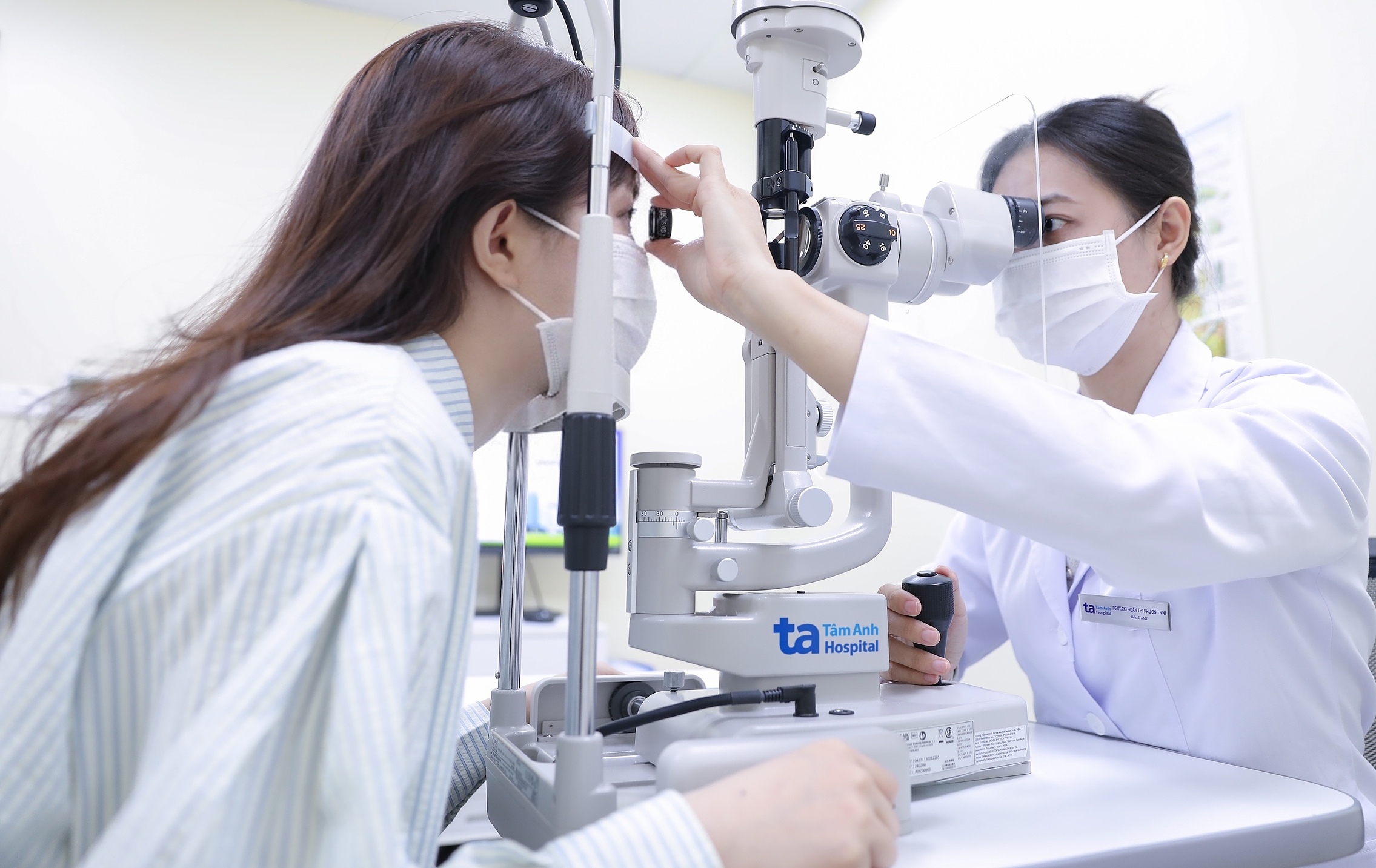 |
Doctor Nhi examines a woman's eyes. Photo: Tam Anh General Hospital |
Styes progress quickly and can resolve spontaneously.
A stye is an acute bacterial infection of the sebaceous glands or eyelash follicles, often caused by Staphylococcus bacteria or due to a blockage of the sebaceous or sweat glands.
Styes can develop on the outer skin of the eyelid (external stye) or on the inner surface of the eyelid (internal stye). They often resemble a pustule with a white or yellow head and develop rapidly within a few days. Patients typically experience pain, a foreign body sensation, swelling, and redness, which may be accompanied by tearing. After about one to two weeks, a stye can spontaneously rupture and drain pus, leading to a gradual reduction of symptoms. Treatment primarily involves warm compresses, eyelid hygiene, topical antibiotics, or incision and drainage of the stye (if there is a localized pus collection) as directed by a doctor.
Chalazia develop slowly and are usually painless.
A chalazion occurs when an oil-secreting gland in the eyelid becomes blocked, leading to chronic inflammation. It manifests as a round, firm lump that develops slowly and is typically painless. This condition is common on the upper eyelid, and its size can gradually increase over several weeks. Unlike styes, the skin around a chalazion is less red and does not contain pus. Some cases may cause a feeling of obstruction or affect vision.
Chalazia can resolve on their own; however, if they persist or recur, a doctor may recommend minor surgery to remove the core of the chalazion.
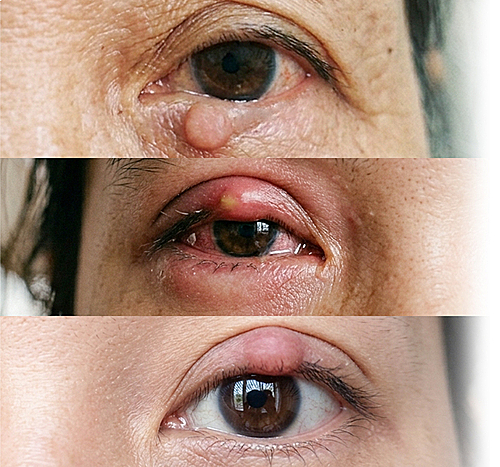 |
From top to bottom: eyelid tumor, stye, and chalazion. Illustration: Tam Anh General Hospital |
Doctor Nhi notes that some cases of chronic or recurrent chalazia can mask the signs of an eyelid tumor, particularly a malignant one. Therefore, patients should seek an eye examination if an unusual eyelid lump persists for two to four weeks, recurs multiple times, or is accompanied by signs such as ulceration, bleeding, eyelash loss, or impaired vision. Patients should avoid self-treating at home, such as squeezing or lancing, to prevent an increased risk of infection and dangerous complications.
Ngoc Kim Tham
Readers can submit questions about ophthalmological conditions here for a doctor's response.