Whenever alcohol touched his lips, Nam's face would turn a vivid red, but he was convinced it meant his body was "detoxifying through the skin." Colleagues dubbed him the "drinking god," while Nam proudly claimed to have "fighter's blood," treating drinking sessions like business meetings.
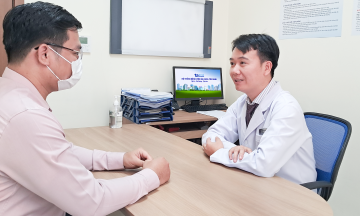
Recent pain in his right side and stomach finally forced him to the hospital. Doctors diagnosed him with stomach ulcers and cirrhosis, explaining that each time his face flushed, his internal organs were signaling distress – his body lacked the enzyme to metabolize alcohol, leading to severe poisoning. "I always thought a red face was a good sign, never realizing my liver was screaming under the strain," he sighed after leaving the clinic with a bag of medication.
 |
Drinking alcohol became a specialty for the 32-year-old office worker. *Photo: Supplied* |
Nam's case is not unique in Asian drinking culture. Lien, 32, despite a 5-year history of hepatitis B and cirrhosis, maintained her drinking habit even with severe bodily reactions. After just a few small drinks, her face would turn red, and her limbs would develop an itchy rash. Instead of worrying, Lien reassured herself that these were signs her body was functioning well, "quickly and safely" eliminating toxins.
Facial flushing after drinking alcohol, also known as "Asian flush," does not indicate high alcohol tolerance or efficient detoxification. Doctor Doan Du Manh, Deputy Director of the Cardiology and Stroke Center at Phuong Dong International Hospital, explains that this is a manifestation of a genetic defect related to alcohol metabolism. Normally, alcohol entering the body is converted by the liver into acetaldehyde – a toxin – which is then further broken down into harmless acetate by the enzyme ALDH (aldehyde dehydrogenase). However, a large percentage of East Asians carry a mutated gene that causes their bodies to be deficient in ALDH or to have the enzyme function inefficiently.
As a result, acetaldehyde accumulates in the blood at concentrations up to 6 times higher than in normal individuals. This toxin causes significant vasodilation, leading to facial redness, rapid heartbeat, nausea, and headaches. Far from being a sign of "detoxification," rapid facial flushing is evidence of acute acetaldehyde poisoning. Studies from the US National Institute on Alcohol Abuse and Alcoholism (NIAAA) and publications in the US National Library of Medicine have shown a strong link between this syndrome and cancer risk. Specifically, individuals who experience facial flushing when drinking alcohol have a significantly higher risk of esophageal cancer compared to those who do not, due to the continuous assault of acetaldehyde on cells.
More dangerously, complacency, as seen in the cases of Nam and Lien, can lead to life-threatening immune reactions. Doctor Nguyen Huu Truong from Bach Mai Hospital warns that acetaldehyde accumulation not only harms the liver but also stimulates mast cells to release massive amounts of histamine. This mechanism triggers allergic reactions ranging from hives, Quincke's edema (swelling of the lips and eyes) to bronchospasm and shortness of breath. In a party setting with various drinks containing additives, preservatives, or yeast, the risk of anaphylactic shock further increases for sensitive individuals.
Health experts recommend a relatively safe limit of no more than two units of alcohol per day for men (equivalent to 300 ml of beer or 30 ml of spirits) and half that amount for women. If individuals experience headaches, abdominal pain, dizziness, hypothermia, changes in blood pressure, or blurred vision after drinking alcohol, they should seek immediate medical attention at the nearest healthcare facility.
Thuy An